Fears of escalation
Explosions in Tehran – Air Defense Sounds the Alarm
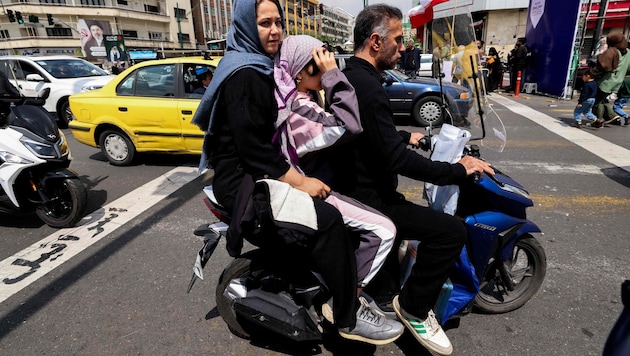

According to media reports, explosions were heard in the Iranian capital of Tehran for the first time since the ceasefire with the U.S. went into effect. At the same time, the air defense system was activated—a clear sign of the tense situation. Israel and the U.S. sought to calm the situation—President Donald Trump also extended the ceasefire in Lebanon by three weeks.
 Kronen Zeitung als bevorzugte Google-Quelle hinzufügen
 As the state news agency Irna reported on Thursday, “the sound of air defense fire” could be heard. The news agency Mehr also reported that the defense system had been activated in several parts of the capital against “hostile targets.” No information on possible damage or casualties was initially available.
Drones Likely the Trigger
According to new information from the Iranian agency Fars, the cause may now be clearer: A reporter for the agency reported that the activation of the air defense system was due to small drones being spotted in the sky in several locations across Iran. Similar incidents in which drones triggered air defense systems have also been reported in the past.
Israel says it is not attacking
Israel stated on Thursday evening that it is not currently carrying out an attack against Iran. “Israel is not attacking Iran at the moment,” security sources said. At the same time, Israeli Defense Minister Israel Katz had previously emphasized that his country was “ready to resume the war against Iran.”
The targets have already been “marked,” and they are waiting for the “green light” from the U.S. In a video message, Katz also spoke of wanting to completely eliminate the leadership surrounding the Khamenei dynasty and threatened to “send Iran back to the Stone Age.”
Ceasefire Extended – Talks Uncertain
U.S. President Donald Trump had extended a ceasefire, initially set for two weeks, indefinitely. This is to remain in effect until Iran presents a proposal to end the conflict and talks are concluded. Whether and when new negotiations will take place is currently unclear.
Trump himself stated on his platform Truth Social that he was under no time pressure and had “all the time in the world,” while for Iran, “the clock is ticking.” He also sharply attacked the U.S. media and made far-reaching, unconfirmed claims about the state of the Iranian armed forces. Among other things, he wrote that the navy was “at the bottom of the sea,” the air force had been destroyed, and the air defense system had been taken out. He also claimed that Iranian leaders were no longer in office. An agreement, he said, would only be reached if it suited the U.S. and its allies.
According to U.S. President Donald Trump, the current ceasefire between the pro-Iranian Hezbollah militia in Lebanon and Israel is also to be extended by three weeks. Trump announced this on Thursday afternoon (local time) on his Truth Social platform following a meeting at the White House between representatives of the hostile neighboring countries Israel and Lebanon.
Third U.S. aircraft carrier arrives in the Middle East
Nearly two months after the start of the war with Iran, the U.S. has deployed a third aircraft carrier to the region. The “USS George H.W. Bush” has reached the area of responsibility of U.S. Central Command (Centcom), which oversees the Middle East, in the Indian Ocean, Centcom announced on Thursday via the online service X, publishing a photo of the aircraft carrier with numerous fighter jets on deck.
Previously, the U.S. had already deployed the aircraft carriers “USS Gerald R. Ford” and “USS Abraham Lincoln” to the region.
Negotiating team weakened
A report by the Israeli broadcaster N12 is causing additional uncertainty: According to the report, Iranian Parliament Speaker Mohammad Baqer Qalibaf has left his country’s negotiating team. The reason is said to be an intervention by the Revolutionary Guards. Qalibaf had played a central role in the talks so far.
Experts view the move as a possible sign of a harder line within the Iranian power structure. This could further complicate an agreement with the U.S. – and also delay the reopening of the strategically important Strait of Hormuz.
Oil prices rise significantly
These developments are also impacting the energy markets. The price of a barrel (159 liters) of Brent crude oil for June delivery rose to $105.56, up 3.6 percent from the previous day. The price of U.S. WTI crude also rose by a similar margin.
The war in Iran began on February 28 with attacks by Israel and the U.S. Among those killed was Supreme Leader Ayatollah Ali Khamenei.
Diplomatic solution likely still a long way off
Since then, Tehran has responded with missile and drone attacks on Israel, as well as on several Gulf states and U.S. facilities in the region. In addition, the vital Strait of Hormuz has been effectively blocked by the Revolutionary Guards since the fighting began.
About a week and a half ago, talks between the U.S. and Iran, mediated by Pakistan, ended without a resolution. Current developments now suggest that a diplomatic solution remains a long way off.
This article has been automatically translated,
read the original article here.











Willkommen in unserer Community! Eingehende Beiträge werden geprüft und anschließend veröffentlicht. Bitte achten Sie auf Einhaltung unserer Netiquette und AGB. Für ausführliche Diskussionen steht Ihnen ebenso das krone.at-Forum zur Verfügung. Hier können Sie das Community-Team via unserer Melde- und Abhilfestelle kontaktieren.
Hinweis in eigener Sache: Das krone.at-Forum präsentiert sich ab sofort in neuem Design! Wir freuen uns über konstruktives Feedback. Damit die Diskussionen in den Kommentarbereichen beim jeweiligen Thema bleiben, können Sie uns Rückmeldungen hier hinterlassen.
User-Beiträge geben nicht notwendigerweise die Meinung des Betreibers/der Redaktion bzw. von Krone Multimedia (KMM) wieder. In diesem Sinne distanziert sich die Redaktion/der Betreiber von den Inhalten in diesem Diskussionsforum. KMM behält sich insbesondere vor, gegen geltendes Recht verstoßende, den guten Sitten oder der Netiquette widersprechende bzw. dem Ansehen von KMM zuwiderlaufende Beiträge zu löschen, diesbezüglichen Schadenersatz gegenüber dem betreffenden User geltend zu machen, die Nutzer-Daten zu Zwecken der Rechtsverfolgung zu verwenden und strafrechtlich relevante Beiträge zur Anzeige zu bringen (siehe auch AGB). Hier können Sie das Community-Team via unserer Melde- und Abhilfestelle kontaktieren.