Oil, pellets, gas:
An expensive heating season is just around the corner

Austrian households are facing higher heating costs this winter: Oil and pellets, in particular, are significantly more expensive than last year, and gas and district heating are also generally costing more. Those who heat with electricity, on the other hand, can hope for some relief. However, the extent of the additional costs depends on the heating system and, to some extent, on where you live.
 Kronen Zeitung als bevorzugte Google-Quelle hinzufügen
 Looking at current trends in energy costs, many Austrians are hoping for a mild winter. Compared to last year, virtually all households will have to dig deeper into their pockets this year. The “Krone” provides an overview:
Heating oil: The hardest hit are the more than 400,000 households that rely on “light heating oil.” Due to geopolitical conflicts, the average price per 100 liters for a purchase of 3,000 liters has risen to 183 euros. A year ago, it was still 107 euros—a price increase of a whopping 70 percent. In August (chart), the sharp rise of the past few weeks was not yet fully reflected. The bottom line is that heating costs for an average household this season will total around 5,500 euros.

Households with oil-fired heating systems are currently feeling the strain the most, as heating oil prices are directly tied to the international crude oil market.
Franz Angerer, Geschäftsführer der Energieagentur
Bild: Österreichische Energieagentur
Wood pellets: Far behind are the approximately 250,000 private households with pellet heating systems. While a typical single-family home using six metric tons of wood pellets paid 313 euros per metric ton in September 2025, for a total of 1,880 euros plus delivery, this year the price has already risen to 419 euros per metric ton—a total of just over 2,500 euros—an increase of about 600 euros, or more than 30 percent.
Natural gas: For a typical household using natural gas (15,000 kWh consumption), the additional costs this year are likely to amount to around 150 to 250 euros. Two factors are primarily “to blame” for this. On the one hand, there are labor costs, which, according to the Energy Agency, rose by just under 8 percent in August. For an average household, this amounts to about 50 to 80 euros. However, those who still have a lower-cost contract with a fixed term need not expect any additional costs. There’s no escaping the statutory grid fees, however. These have been raised by an average of 18.2 percent across Austria this year—representing an increase of between 60 and 140 euros, depending on the state. Another increase is expected starting in January 2027.
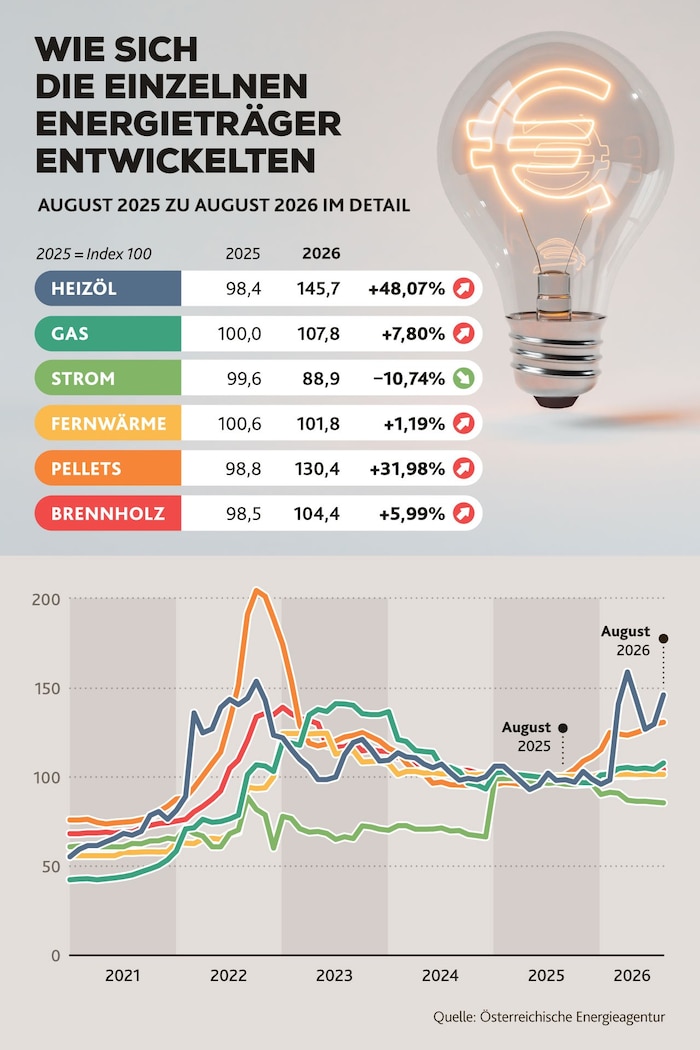
Electricity: The situation is quite different for homes with modern heat pumps, which have an average annual consumption of 4,000 kWh. Three factors are particularly significant here: the energy rate, grid fees, and the electricity surcharge. Those with a plan that includes a price guarantee (such as Verbund’s “Österreich” rate) won’t face any higher costs in this regard.
As for electricity grid costs, these have varied by state. For example, they have fallen in Salzburg and Vienna, while they have risen in Burgenland and Tyrol. Depending on where you live, this cost may therefore actually decrease.
In any case, the government lowered the electricity surcharge this year from 1.5 cents to 0.1 cents per kWh. This results in an average savings of over 50 euros per year. In short: Depending on the state, households with heat pumps and price guarantees may even pay less for electricity this year than they did last season.
District heating: The approximately 1.2 million households that rely on district heating will also pay about five to eight percent more this winter than in the previous season. However, the increase varies depending on the city. Linz AG, for example, raised rates by six percent in August, while Wien Energie’s “Klima-Fit” rate saw an increase of about eight percent in the active energy price. Roughly estimated, the average district heating household will have to pay about six to ten euros more per month.
Bottom line: Only those who heat with electricity will get off lightly this winter—or may even pay less. For everyone else, it’s time to take advantage of savings opportunities. For example, lowering the room temperature by one degree reduces the amount of heating energy needed by as much as six percent.
This article has been automatically translated,
read the original article here.











Willkommen in unserer Community! Eingehende Beiträge werden geprüft und anschließend veröffentlicht. Bitte achten Sie auf Einhaltung unserer Netiquette und AGB. Für ausführliche Diskussionen steht Ihnen ebenso das krone.at-Forum zur Verfügung. Hier können Sie das Community-Team via unserer Melde- und Abhilfestelle kontaktieren.
Hinweis in eigener Sache: Schon bald erwartet Sie auf krone.at ein rundum erneuerter Forenbereich mit vielen neuen Features! Mehr Informationen finden Sie hier.
User-Beiträge geben nicht notwendigerweise die Meinung des Betreibers/der Redaktion bzw. von Krone Multimedia (KMM) wieder. In diesem Sinne distanziert sich die Redaktion/der Betreiber von den Inhalten in diesem Diskussionsforum. KMM behält sich insbesondere vor, gegen geltendes Recht verstoßende, den guten Sitten oder der Netiquette widersprechende bzw. dem Ansehen von KMM zuwiderlaufende Beiträge zu löschen, diesbezüglichen Schadenersatz gegenüber dem betreffenden User geltend zu machen, die Nutzer-Daten zu Zwecken der Rechtsverfolgung zu verwenden und strafrechtlich relevante Beiträge zur Anzeige zu bringen (siehe auch AGB). Hier können Sie das Community-Team via unserer Melde- und Abhilfestelle kontaktieren.