On-site Visit
How is our Armed Forces really doing?
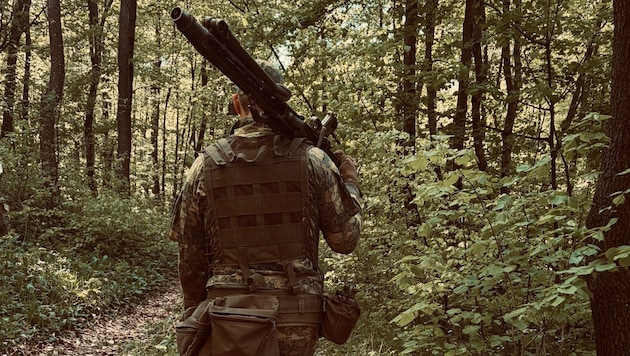

More money, new missions: Austria’s armed forces are undergoing the biggest restructuring in their recent history. The “Krone” visited Austria’s barracks, airfields, forest outposts, and Blue Helmets’ bunkers in Lebanon.
 Kronen Zeitung als bevorzugte Google-Quelle hinzufügen
 In a wild field of wild garlic among the dry spruce trees of the Leitha Mountains, seven men lie pressed deep into the soft forest floor. Delicate spiderwebs stretch between the leaves of the wild garlic. They have been watching the winding cart track ahead of them for a long time. So long that their uniforms have taken on the garlic-like scent of the wild garlic. They communicate with each other only through hand signals. Tension hangs in the air.
Suddenly, shots ring out. The hidden group of hunters opens fire almost simultaneously with blank ammunition. A machine gun rattles into the underbrush, where a shadow darts from tree to tree in the thicket. Commands are shouted; things become frantic. No one pays attention to the finely woven spiderwebs anymore. Minutes of explosive noise before the relieving order to halt is given. Weapons are unloaded. The men take a sip of water from their canteens, which some of them have laced with intensely flavored caffeine powder. Then the drill begins anew.
Civilians in Uniform
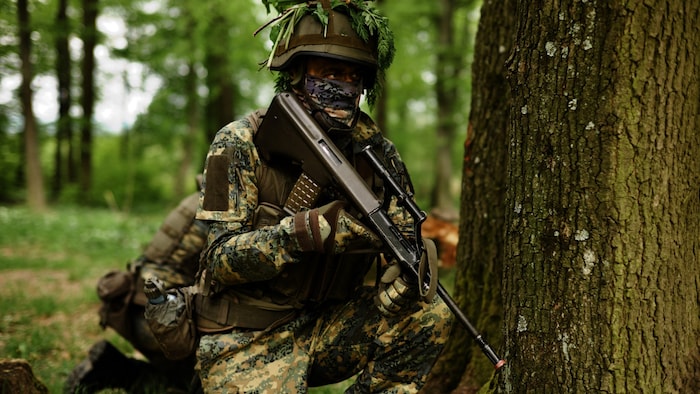
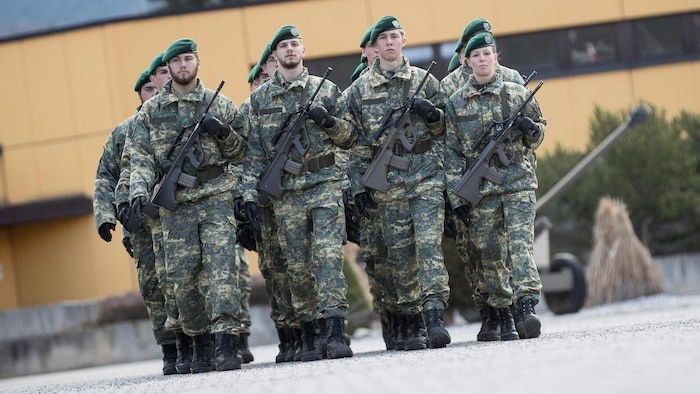
The people training here are structural engineers, waiters, and a civil engineer. A pawnbroker, a job seeker, and a security guard who, in his civilian life, protects Jewish institutions in Vienna. But today they are infantrymen, members of the 3rd Platoon, 2nd Company of the Lower Austria Jäger Battalion. One of those militia units that form the core of the Austrian Armed Forces. Around 40,000 militia soldiers stand in contrast to 15,000 professional soldiers in the Austrian Armed Forces. National defense in Austria is not outsourced to a small warrior caste; it is a general civic duty.
This also has its drawbacks. Militia soldiers rarely train. Every two years, they undergo a major training exercise, which until now has primarily focused on police support activities: border operations, COVID-19 response, crowd control at Airpower, and guard duty at critical infrastructure. “But the threat situation, as you all know, has changed dramatically,” says Brigadier Christian Habersatter, commander of the higher-level 3rd Jäger Brigade and later military commander of Vienna, addressing the men.
“We must return to the classic soldier’s craft. Attack, defense, delay. We’ll handle any support missions on the side.” In the coming years, according to the plan, the “citizens in uniform” are set to receive brand-new armored personnel carriers, radios, and drones—something unthinkable just a few years ago.
Equipment & Acquisitions
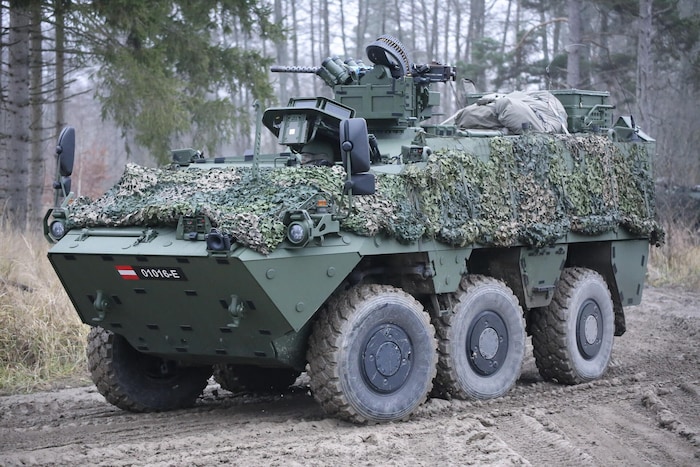
The “2032+ Development Plan” centers on three key areas: By 2032 at the latest, Austria’s soldiers are to be better protected and significantly more mobile, as well as self-sufficient in the event of a power outage—keyword “blackout.” To this end, investments are being made in armored personnel carriers: 100 Pandurs will be supplemented by 225 new Pandur Evos, along with AW 169 and “Black Hawk” transport helicopters, to enable the deployment of at least one company (around 120 troops) in a single operation in the future. When it comes to protection from above, air surveillance will be bolstered with new jets and ground-based medium-range missiles—keyword: “Sky Shield.”
A unit of 55,000 troops is reorganizing
The restructuring of the Lower Austria Hunter Battalion exemplifies the profound transformation currently underway in the Austrian Armed Forces. “After many years of the peace dividend, we must once again prepare for conventional threats,” says Lieutenant General Bruno Günter Hofbauer in an interview with “Krone.” He is the architect of the “2032+ Development Plan,” which aims to restore the armed forces to their former strength over the next six years. “No one can say whether Ukraine will fall by then. Or whether the Balkans will destabilize again.” The Ministry of Defense’s annual “Risk Assessment” also lists Russia’s expansionist plans, cyberattacks, psychological warfare, and unilateral action by the U.S. as the greatest threats to Austria.
Being neutral means having to be able to do everything yourself
Based on this document, but also on the national
security strategy, which is currently being revised (see interview on the next page), the National Defense Report, and intelligence findings, the first step was to go shopping: an additional 16 billion euros is set to pour into the armed forces over the next few years, transforming a withered auxiliary army back into a vital, agile combat force. A completely new missile defense shield is planned, code-named “Sky Shield,” and a second jet fleet is being acquired. Pandur wheeled armored vehicles, Italian helicopters, new repair hangars, radio equipment—those who do not belong to an alliance must spend a lot of money. On land as well as in the air.
Measures against the threat of drones
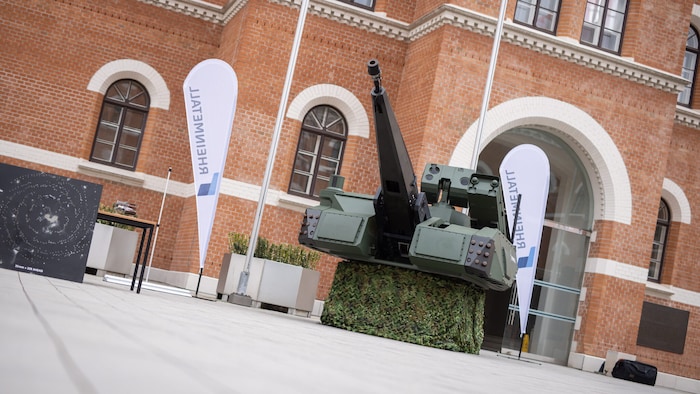
“I was in the army for 38 years, in Afghanistan, Syria, and Iraq. And I never had to look up.” This quote from U.S. General Richard Clarke describes the era before drones—and how much warfare has changed with their advent. Nowadays, all eyes, sensors, and weapons are trained on the sky when unmanned combat drones approach. Austria is surprisingly far along in developing a defense system: The Austrian Armed Forces was the first country to order “Skyranger” systems, which are specifically designed for drone defense.
We are in Zeltweg, the home of the Eurofighter, and stride across the spring-warm asphalt of the apron. Before us stands the sky-high maintenance hangar, where all repairs to the complex fighter jet can be carried out. “Come on, I’ll show you something,” says Major General Gerfried Promberger, Chief of the Austrian Air Force, as we enter the high-end workshop. Five of the Austrian Armed Forces’ 15 Eurofighters are lined up here, some jacked up and connected to diagnostic computers, their cockpits open. “Take a closer look at the markings on the horizontal stabilizers.” Hard to make out here are inconspicuous codes like AS003 or AS005—“A” for Austria; the aircraft was produced specifically for Austria in the early 2000s. But some of the aircraft are marked GS003 or GS011. “The ‘G’ stands for Germany. Nine of the aircraft we’ve been flying since 2007 were previously in service with the German Air Force. And they came to us secondhand as part of the Darabos deal,” says Promberger. “If we had ordered only new, more modern Eurofighters back then as planned, we could have taken nearly ten years longer to complete the replacement procurement.”
Eurofighter Replacement as the Next Major Project
But that is not the case. According to planners, the Eurofighter will need to be replaced starting in 2035. And since procurement in the defense sector can often take a decade, the Republic would now have to enter into contract negotiations with one of the major suppliers. Of all times, right now. At a time of austerity and extreme budget pressure. The plan is for 36 supersonic jets instead of 15, with the ambitious goal of achieving 24-hour readiness for interception missions. Currently, the Eurofighters only take off during daylight hours.
Both the Ukraine conflict and the Iran conflict have shown that the greatest dangers are currently expected from the air. “We are now dealing with a new mix of threats,” explains Colonel Ewald Papst. He is responsible for ground-based air defense, meaning anti-aircraft guns and interceptor missiles. Very fast, high-flying threats such as ballistic missiles or fighter jets must be countered just as effectively as low-flying, slow drones. “Last November, during a maneuver, we simulated drone swarms that could attack us in waves in 2037,” adds Promberger. “One conclusion was: We need to become more mobile. Smaller radar systems, for example, belong on the beds of pickup trucks. Or on a high-rise building with a tripod.” Interceptor jets, too, should no longer take off only from Zeltweg. Instead, they should also be able to launch from straight stretches of highway when necessary.
Foreign deployments are decreasing—fortunately
2,200 kilometers away, on the southern border of Lebanon with Israel. The sun beats down on the bare concrete structures at the United Nations’ Camp Naqoura. Around 170 Austrian soldiers and one female soldier are on duty here. They are members of the UN contingent in Lebanon, which is actually supposed to monitor the ceasefire between Israel and Hezbollah. They rarely leave the camp. “It’s comparable to open-air detention,” a young sergeant from Großmittel (home of the Jansa Barracks in Lower Austria) told the “Krone” during a visit to the camp. Privately, he speaks of “one of those typical, failed UN missions.” The disarmament of Hezbollah has failed, and the ceasefire is broken almost daily. Most pass the time with sports, and training takes place regularly. Everyone serving here has volunteered.
The days pass slowly, the weeks quickly. And the mission in Lebanon is drawing to a close: The mandate expires this year, after which the troops will be redeployed.
Foreign Missions Under Scrutiny
Although Austria is neutral, foreign deployments have been an integral part of Austrian security policy in recent decades. However, under strict conditions: In practice, either a UN mandate was a prerequisite or various EU or NATO peace-support partnerships. A large Austrian contingent was stationed in Cyprus for a long time, as well as on the Golan Heights; both missions resulted in casualties and have since been ended or significantly scaled back. Currently, three major missions are underway in Bosnia, Kosovo, and Lebanon, but since the war in Ukraine, the Ministry of Defense has been making efforts to shift the focus more toward domestic operations.
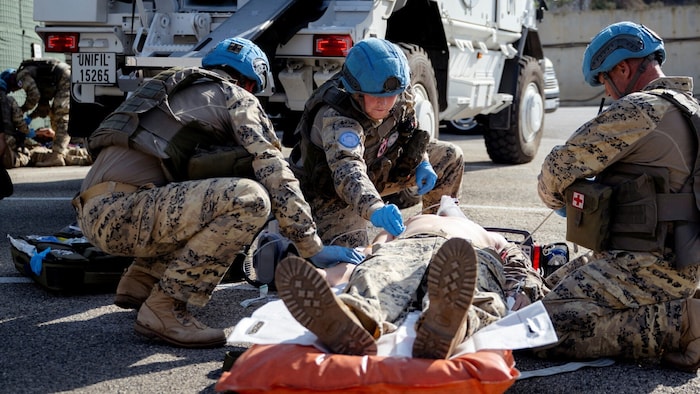
The Austrian Armed Forces are thus running out of foreign missions. Alongside Bosnia and Kosovo, Lebanon was one of three remaining major foreign deployments. Strategically, this is not inconvenient for planners at the Rossauer Barracks in Vienna: they wanted—see the militia—to focus less on foreign and assistance missions and more on their own national defense anyway.
Longer military service to combat a shortage of soldiers
After all, the armed forces are also looking for personnel. While the Austrian Armed Forces reported a positive balance in the first quarter of 2026—with approximately 500 more new recruits than retirements—soldiers are still needed to handle the enormous influx of equipment. Professional soldiers are required to operate high-end equipment such as fighter jets or defense missiles costing millions. Conscripts who can, for example, drive armored personnel carriers or perform minor maintenance. “The Military Service Commission has issued a clear recommendation here,” says Defense Minister Klaudia Tanner, before endorsing it in the same breath: Military service is to be extended from the current six months to eight months; in the years following that, the newly trained recruits are to complete two additional months of training, spread out over individual training weeks. If things move quickly, this model could take effect as early as January 1, 2027. “We could finally conduct large-scale exercises in formation again, just like in the past,” says Chief Planner Hofbauer, welcoming the initiative. Mixed signals are coming from the business community. Civilian service would also be extended back to 12 months, meaning thousands of young people would be temporarily absent from the labor market. A decision has not yet been made.
Discussion on longer military service
At six months, military service in Austria is one of the shortest among those European countries that still require compulsory military service. Due to the changed security situation, a military service commission was tasked nearly exactly a year ago with finding new models. At the end of January, it presented its findings: The “8+2” model was identified as the preferred option. Basic military service would last eight months again, as in the past; after that, soldiers (up to about age 30) would have to complete two more months of mandatory reserve training, spread out over individual training weeks. Civilian service would be extended to 12 months, as it was in the past. The rules could take effect on January 1, 2027.
Using shotguns against small combat drones
“Drone, drone, drone!” In heavy rain, prospective career officers in Freistadt leap out of their trenches and crouch beneath nearby conifers. Above them, an unmanned aerial vehicle roars; this time, it is unusually easy to spot because it stands out clearly against the cloud-covered sky. Eyes turn upward. As a last resort, the soldiers would now use shotguns to defend themselves against the approaching weapons. A unsettling thought, but a relevant one: drones have dominated warfare for years. Experts such as the world-renowned Austrian military analyst Colonel Markus Reisner speak of the “transparent battlefield”: Both sides can see at any given moment where the enemy is, where they are moving, and how they are equipped. Which is why Austria is also procuring drones. The range extends from small combat drones to unmanned reconnaissance aircraft that circle at altitudes of many kilometers, controlled remotely. These are expensive acquisitions that can quickly become obsolete due to rapid development cycles. But they also serve as a potential deterrent: After the end of the Cold War, Hungarian sources revealed that the Austrian Armed Forces of the late 1980s—with roughly three times as many troops as today and powerful equipment—had certainly caused Soviet strategists serious headaches. Tens of thousands of casualties among the Hungarian People’s Army, which would have attacked in the event of an invasion, were factored in.
A mix of World War I and a drone-filled future
In the Leitha Mountains, among the men of the Lower Austria Ranger Battalion, none of this is an issue yet. They are back in their positions in the spruce forest, rifles at the ready, watching the undergrowth. The trenches through which they moved here are hardly different from those of World War I. If the radio isn’t working, a messenger is sent out on foot. Old military traditions remain relevant even on the battlefield of the 21st century. Yet everyone here in Bruckneudorf is also aware of the upheaval Europe’s armed forces are undergoing. “With drones, things would look completely different here,” says a young sergeant, gazing ominously at the sky. Then he complains about the stinking wild garlic—and watches the lonely cart track stretching out before him.
This article has been automatically translated,
read the original article here.











Willkommen in unserer Community! Eingehende Beiträge werden geprüft und anschließend veröffentlicht. Bitte achten Sie auf Einhaltung unserer Netiquette und AGB. Für ausführliche Diskussionen steht Ihnen ebenso das krone.at-Forum zur Verfügung. Hier können Sie das Community-Team via unserer Melde- und Abhilfestelle kontaktieren.
User-Beiträge geben nicht notwendigerweise die Meinung des Betreibers/der Redaktion bzw. von Krone Multimedia (KMM) wieder. In diesem Sinne distanziert sich die Redaktion/der Betreiber von den Inhalten in diesem Diskussionsforum. KMM behält sich insbesondere vor, gegen geltendes Recht verstoßende, den guten Sitten oder der Netiquette widersprechende bzw. dem Ansehen von KMM zuwiderlaufende Beiträge zu löschen, diesbezüglichen Schadenersatz gegenüber dem betreffenden User geltend zu machen, die Nutzer-Daten zu Zwecken der Rechtsverfolgung zu verwenden und strafrechtlich relevante Beiträge zur Anzeige zu bringen (siehe auch AGB). Hier können Sie das Community-Team via unserer Melde- und Abhilfestelle kontaktieren.