Filzmaier analyzes
Hungary’s decisive election should concern us too
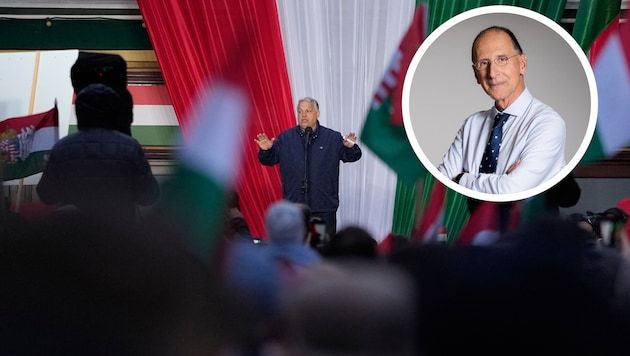

About ten million people live in Hungary. Although that is only two percent of all EU citizens, Austria is also affected by the Hungarian election. At stake is, in part, the future of Europe, explains Prof. Peter Filzmaier.
 Kronen Zeitung als bevorzugte Google-Quelle hinzufügen
 The key question in the parliamentary election is whether the “Citizens’ Alliance”—Prime Minister Viktor Orbán’s Fidesz party—will retain its majority after 16 years in power. This becomes a fundamental issue because Orbán and Russian dictator Vladimir Putin are practically best friends.
For the EU, however, Russia is the central security threat on our continent today.
A world turned upside down in Hungary
Although Putin simply invaded Ukraine in violation of international law, Orbán paints a very different picture: He repeatedly claims that the greatest danger to Hungary does not come from Russia, but from the EU and Volodymyr Zelenskyy. Here, he even speaks of an “axis of evil” consisting of Brussels, Berlin, and Kyiv.
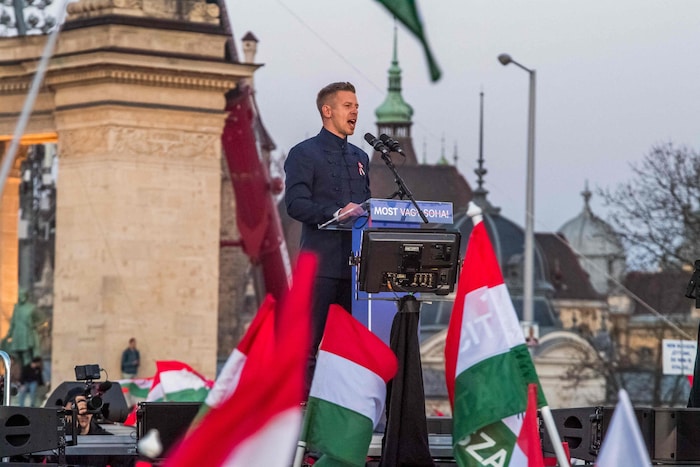
Orbán’s rival, Péter Magyar, comes from Fidesz. Within the party’s “system of national cooperation”—an inner circle of government officials, party elites, and media moguls—there was consensus on right-of-center policies.
The enemy from within
Magyar’s current party, “Respect and Freedom”—named after the Tisza River—was founded only after serious corruption and child abuse scandals involving Viktor Orbán. Yet, unlike Orbán, Magyar is also pro-European.
At the very least, Magyar is willing to seek common solutions in the European Council of heads of government. Orbán, taking advantage of the unanimity principle, has gleefully blocked countless decisions on foreign and security policy as well as the budget.
This hampered the EU’s ability to act until the Kremlin’s ally was bribed with funding to end his veto. Whereupon Orbán was quite happy to remain in the EU as the very embodiment of evil.
Why should this election matter to us?
But regardless of how one feels about the EU as an Austrian, one cannot be indifferent to the election in the neighboring country. After all, Orbán describes democracies as a social decline and also raves about China. He has had the electoral law rewritten in his favor and, moreover, illegally has officials run his election campaign using public funds. This is another reason why the outcome remains uncertain despite Magyar’s lead in the polls.
Austria must want a politically stable neighbor, but if Orbán loses, it is uncertain whether he will accept the result. Chaos looms. And one more thing: Hungary is economically on the brink. Millions live at or below the poverty line. The minimum pension is only 80 (!) euros. Whether Magyar is better in terms of economic policy is unknown, but impoverished neighboring countries do us no good.
This article has been automatically translated,
read the original article here.











Willkommen in unserer Community! Eingehende Beiträge werden geprüft und anschließend veröffentlicht. Bitte achten Sie auf Einhaltung unserer Netiquette und AGB. Für ausführliche Diskussionen steht Ihnen ebenso das krone.at-Forum zur Verfügung. Hier können Sie das Community-Team via unserer Melde- und Abhilfestelle kontaktieren.
Hinweis in eigener Sache: Schon bald erwartet Sie auf krone.at ein rundum erneuerter Forenbereich mit vielen neuen Features! Mehr Informationen finden Sie hier.
User-Beiträge geben nicht notwendigerweise die Meinung des Betreibers/der Redaktion bzw. von Krone Multimedia (KMM) wieder. In diesem Sinne distanziert sich die Redaktion/der Betreiber von den Inhalten in diesem Diskussionsforum. KMM behält sich insbesondere vor, gegen geltendes Recht verstoßende, den guten Sitten oder der Netiquette widersprechende bzw. dem Ansehen von KMM zuwiderlaufende Beiträge zu löschen, diesbezüglichen Schadenersatz gegenüber dem betreffenden User geltend zu machen, die Nutzer-Daten zu Zwecken der Rechtsverfolgung zu verwenden und strafrechtlich relevante Beiträge zur Anzeige zu bringen (siehe auch AGB). Hier können Sie das Community-Team via unserer Melde- und Abhilfestelle kontaktieren.