Following the Wellenbecken Case
Coalition Tightens Sexual Offenses Laws—Partially
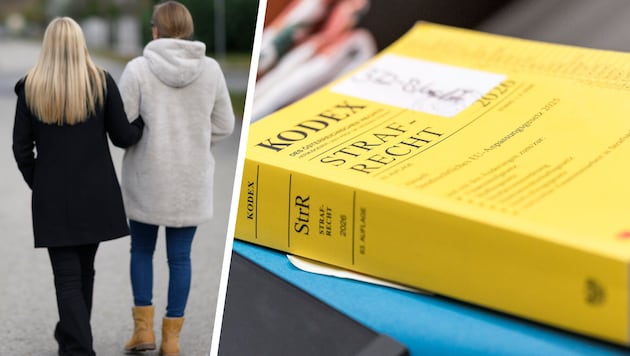

Following the four acquittals in the Vienna “Wellenbecken” case, the government plans to introduce a package of measures to protect women on Wednesday. One of the more contentious issues is the principle of consent in sexual criminal law. But there has also been discussion of stiffer penalties for sexual offenses. At the same time, an unusual alliance is forming in support of women’s protection.
 Kronen Zeitung als bevorzugte Google-Quelle hinzufügen
Outrage remains high. Last year, a group of men sexually harassed girls at the Laaerbergbad in Vienna. Because it could no longer be determined exactly who had done what, the four Bulgarian men were acquitted last week.
As reported, Chancellor Christian Stocker used the case as an opportunity to call for stricter sexual offense laws. This is currently under review; in the Council of Ministers on Wednesday, the ÖVP, SPÖ, and NEOS intend to introduce an initial, smaller package of measures to protect women, and on Tuesday evening, the coalition was still negotiating the details. Specifically:
“Only ‘Yes’ Means ‘Yes’”: There was a lengthy discussion about introducing the principle of consent. If the SPÖ has its way, the phrase “against their will” in criminal law will be replaced with “without their consent,” so that “the law stands on the side of the victims,” according to Justice Minister Anna Sporrer. According to negotiators, whether an agreement is reached on this point will be decided “only at the last moment.”
Higher Penalties: The working group at the Ministry of Justice, which had also addressed the “Yes Means Yes” principle, is now tasked with examining an increase in the penalties for sexual offenses.
“Deepfake” ban: Generating or manipulating intimate images or videos using AI is to be made a criminal offense in the future.
“Crackdown” on FGM: Authorities also plan to take tougher action against female genital mutilation. Approximately 11,000 girls and women in Austria are affected by this practice.
And what about electronic monitoring for dangerous offenders? Thatmeasure will not be included in today’s package. Although the three coalition partners agree on the issue, there are still hurdles regarding practical implementation. This is because electronic monitoring cannot be ordered by the police, but only by courts and prosecutors—and that process takes weeks. Too long in an emergency.
Protection against violence is not a matter of faith. Four religious communities are launching a new poster campaign together with the ministry.
For many people, religious communities are important places of gathering. It is precisely there that Minister for Women’s Affairs Eva-Maria Holzleitner (SPÖ) wants to reach as many people as possible with a clear message: “Violence against women is not a private matter. It is our shared responsibility to pay attention, take a stand, and protect women from violence,” said the minister.
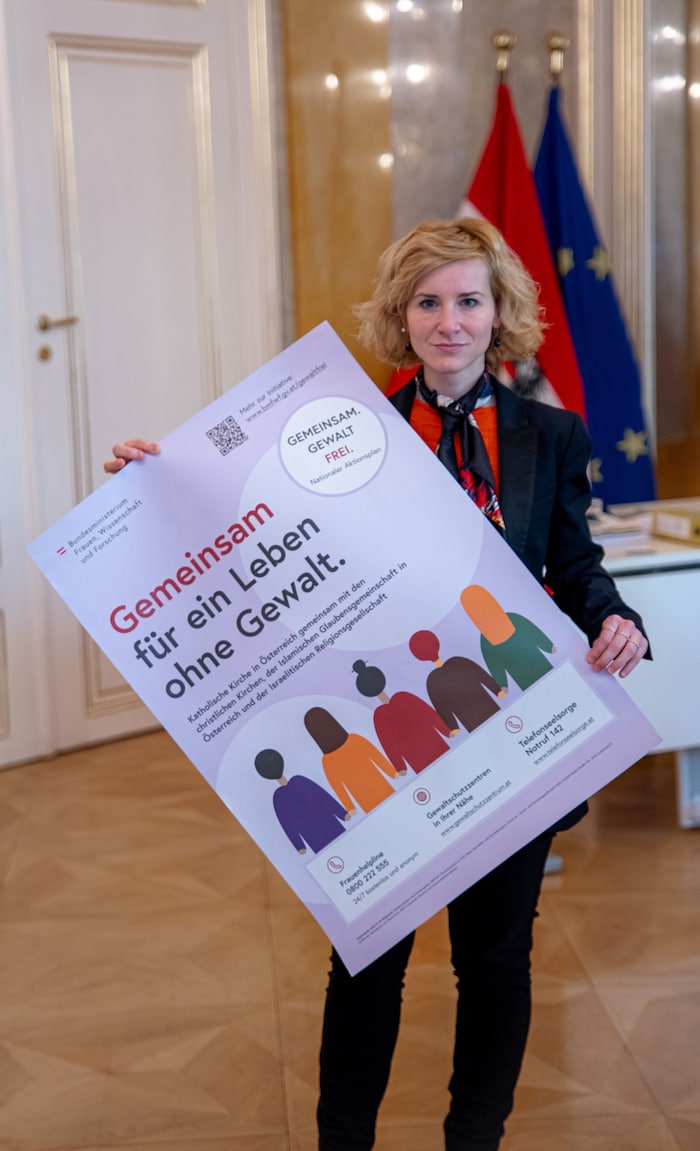
To mark the start of the “16 Days of Activism Against Gender-Based Violence” campaign, she has therefore forged an extraordinary alliance: Together with four religious communities, the Ministry for Women is sending a strong message and launching a campaign. Under the slogan “Together for a Life Free of Violence,” posters are being displayed in religious institutions starting today (see photo on the left). Among those on board are the Catholic, Protestant, and other Christian churches, the Islamic Religious Community, and the Jewish Religious Community.
“Those who remain silent leave those affected alone,” says Ümit Vural, president of the Islamic Religious Community. Cornelia Richter, bishop of the Evangelical Church A.B., also supports the initiative. According to her, women and girls must not “once again increasingly become victims of hate and violence.” And for the Catholic Church, too, this is “not a marginal issue, but a massive social problem,” emphasizes Gabriele Eder-Cakl of the Pastoral Institute of the Bishops’ Conference.
This article has been automatically translated,
read the original article here.











Willkommen in unserer Community! Eingehende Beiträge werden geprüft und anschließend veröffentlicht. Bitte achten Sie auf Einhaltung unserer Netiquette und AGB. Für ausführliche Diskussionen steht Ihnen ebenso das krone.at-Forum zur Verfügung. Hier können Sie das Community-Team via unserer Melde- und Abhilfestelle kontaktieren.
Hinweis in eigener Sache: Das krone.at-Forum präsentiert sich ab sofort in neuem Design! Wir freuen uns über konstruktives Feedback. Damit die Diskussionen in den Kommentarbereichen beim jeweiligen Thema bleiben, können Sie uns Rückmeldungen hier hinterlassen.
User-Beiträge geben nicht notwendigerweise die Meinung des Betreibers/der Redaktion bzw. von Krone Multimedia (KMM) wieder. In diesem Sinne distanziert sich die Redaktion/der Betreiber von den Inhalten in diesem Diskussionsforum. KMM behält sich insbesondere vor, gegen geltendes Recht verstoßende, den guten Sitten oder der Netiquette widersprechende bzw. dem Ansehen von KMM zuwiderlaufende Beiträge zu löschen, diesbezüglichen Schadenersatz gegenüber dem betreffenden User geltend zu machen, die Nutzer-Daten zu Zwecken der Rechtsverfolgung zu verwenden und strafrechtlich relevante Beiträge zur Anzeige zu bringen (siehe auch AGB). Hier können Sie das Community-Team via unserer Melde- und Abhilfestelle kontaktieren.