Meinl-Reisinger on ORF
If the federal government cuts spending, taxpayers should get money
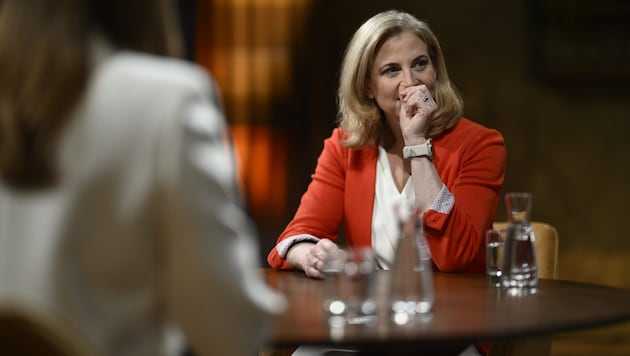
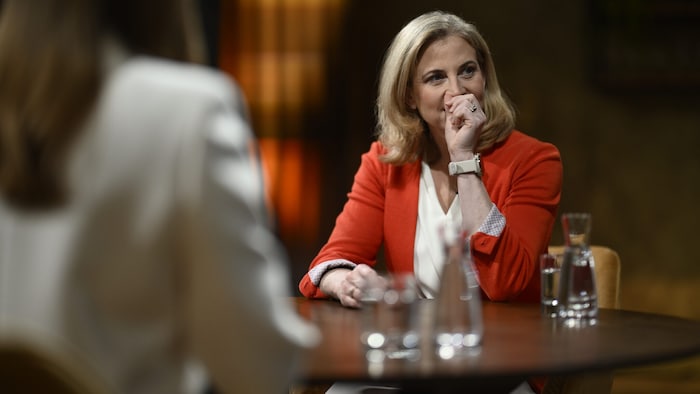
Second episode of the “ORF” Summer Talks: While Leonore Gewessler was invited to discuss the climate crisis—a feel-good topic for the Greens—last week amid the heat wave, NEOS leader Beate Meinl-Reisinger had a lot to explain. Her party is slipping in the polls, its members are leaving—even party founder Matthias Strolz isn’t holding back on his criticism. The pink-clad frontwoman remained surprisingly low-key for long stretches—but announced money for all taxpayers, to be paid out presumably in the 2029 election year...
 Kronen Zeitung als bevorzugte Google-Quelle hinzufügen
 A week ago, it was sweltering at Leonore Gewessler’s place; on Monday evening, it was 22 degrees, with wind and rain. Fittingly, things didn’t get all that heated either: Foreign Minister and NEOS leader Beate Meinl-Reisinger—appearing on the show for the ninth time—had a lot to explain to host Simone Stribl on Vienna’s Küniglberg regarding the government’s work and her own party—but she consistently sidestepped the latter in particular...
Money for taxpayers—right in an election year?
However, she did announce a new bonus—for all taxpayers. “If we consolidate the budget, implement more reforms, and then have some leeway, that money must not be squandered again.” Instead, a so-called “reform dividend” should be distributed: If the federal government exceeds its deficit target, no one—no ministry, no coalition, no election campaign—should be allowed to immediately squander that surplus on new spending initiatives. Under the reform dividend, half of every euro the government saves beyond the agreed-upon budget targets would automatically go toward debt reduction, while the other half would go to working people in the form of tax relief.
That could very well be the case in the 2029 election year, host Stribl calculated. As an election sweetener? “That is exactly what must not happen.” But it probably would...
“Drought knows no party politics”
For Meinl-Reisinger, who took a seat inside the Küniglberg, the discussion also centered heavily on the heat—and compensation for farmers. There must be no “whatever the cost” approach, the foreign minister emphasized repeatedly, issuing a cautionary reminder of the government’s COVID-19 policies under Chancellor Sebastian Kurz. Hail insurance estimates this year’s heat damage at one billion euros —while funding should be provided, the main focus, she said, is on prevention.
NEOS and the SPÖ are using the current weather conditions as leverage to push for a new climate protection law, according to Stribl. “No, drought knows no party politics,” countered Meinl-Reisinger. But: “Politicians are called upon not to always just react when there’s no other option left, but perhaps to look ahead and plan for the future.”
What did you think of the pink party leader’s performance?
The NEOS leader quickly shifted from the heat to NEOS’s core issue of education: Measures for schools had been decided at the heat summit—but again with a caveat: “A core problem in Austria, just as with hospitals, is that there are different school and hospital operators.” However, where NEOS Education Minister Christoph Wiederkehr is in charge, he has put forward a roadmap to ensure that heat protection standards are met in the future.
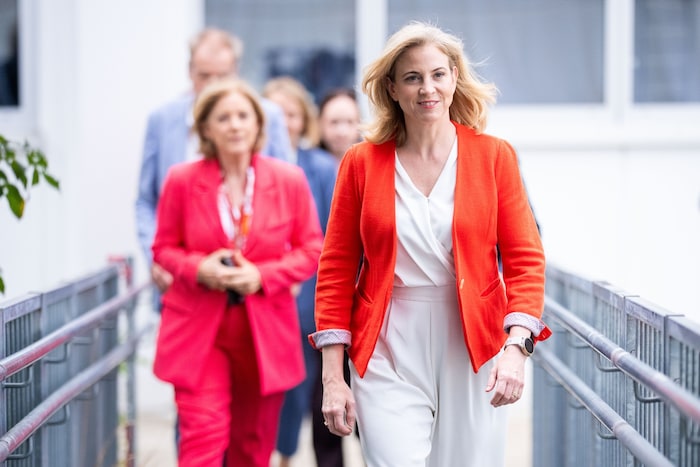
In the summer debate, the politicians took their seats as party leaders; as foreign minister, Meinl-Reisinger commented on the topic of espionage: A new counterespionage law should be passed as soon as possible—“as far as I’m concerned, preferably the day before yesterday.” It is currently being held up by the ÖVP-led Ministry of Defense.
“It’s about conscripting young men”
On the topic of defense: The army reform is a step in the right direction. But we must ensure that it provides real added value: “This isn’t about trivialities. It’s about conscripting young men. We have to make sure that military service is attractive.”
The NEOS had engaged in extensive discussions within the party (Note: The NEOS had previously advocated for a professional army). The current model is one that makes Austria safer. However, the party is moving further toward a professional army and professionalization—and toward a European solution.
The extension of civilian service is voluntary—for now: “If we don’t have enough conscripts next year, then the automatic mechanism will kick in.”
Iseverything hunky-dory in the government?
It’s good to have different perspectives within thegovernment, Meinl-Reisinger countered when asked about the mood within the government. “Just because there’s friction doesn’t mean there’s a dispute.” Why, then, are confidence levels in the government still falling? We need to give something back—that’s why there should be a ‘reform dividend’ as a bonus.
Reflecting on her own style? “No!”
Party funding is also weighing on the budget—something the NEOS have always wanted to cut and which recently led to the resignation of party co-founder Veit Dengler, for example. Meinl-Reisinger: “Party funding is too high and needs to be reduced.” “We need to ask the other parties why they aren’t taking this long-overdue step,” she said, shifting the responsibility away from herself. Has she betrayed the pink ideals, as Matthias Strolz recently accused her of doing? “I don’t see it that way.”
Does she reflect on her leadership style, which (former) party members describe as “authoritarian”? “No.” As foreign minister, does she even have enough time left for the party? “You have to keep the roles separate. And I have a strong team. I’m not aware of any other foreign ministers in the past who were also party leaders being asked this question.”
“I’m a one-of-a-kind figure in the government”
A surefire topic for the mother of three: the question about Christian Stocker’s pessimistic remarks on motherhood. “I have three children. That makes me quite a one-of-a-kind figure in government and also in party leadership. It’s a lot of work.” The debate is important, especially regarding the pension system and pension splitting. NEOS wants an automatic mechanism to split pension entitlements. And: “Free kindergarten starting at age four will significantly ease the burden on mothers, fathers, and families.”
Babler, Stocker, Kickl
The ORF is recording the “Summer Talks” again this year. The start time of the recording depends on the position of the sun—to ensure that all candidates have similar lighting conditions. Next week (August 24), Vice Chancellor and SPÖ leader Andreas Babler will appear on Simone Stribl’s show, followed by Chancellor Christian Stocker (ÖVP) on August 31. FPÖ leader Herbert Kickl will be the last to appear on September 7—and the only one to do so outside the summer break.
This article has been automatically translated,
read the original article here.











Liebe Leserin, lieber Leser,
die Kommentarfunktion steht Ihnen ab 6 Uhr wieder wie gewohnt zur Verfügung.
Mit freundlichen Grüßen
das krone.at-Team
User-Beiträge geben nicht notwendigerweise die Meinung des Betreibers/der Redaktion bzw. von Krone Multimedia (KMM) wieder. In diesem Sinne distanziert sich die Redaktion/der Betreiber von den Inhalten in diesem Diskussionsforum. KMM behält sich insbesondere vor, gegen geltendes Recht verstoßende, den guten Sitten oder der Netiquette widersprechende bzw. dem Ansehen von KMM zuwiderlaufende Beiträge zu löschen, diesbezüglichen Schadenersatz gegenüber dem betreffenden User geltend zu machen, die Nutzer-Daten zu Zwecken der Rechtsverfolgung zu verwenden und strafrechtlich relevante Beiträge zur Anzeige zu bringen (siehe auch AGB). Hier können Sie das Community-Team via unserer Melde- und Abhilfestelle kontaktieren.