“People are coming around”
More and more municipalities are now considering a pool tax
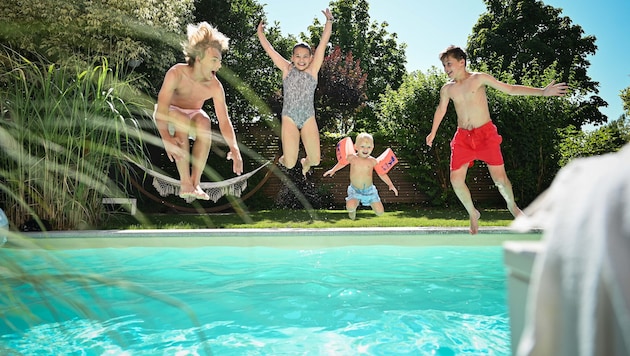



While wildfires are currently in full swing, Austria’s pools are overflowing again. With 200,000 pools, a water shortage is a real concern—so municipalities are pulling out all the stops. A pool tax is just one option.
 Kronen Zeitung als bevorzugte Google-Quelle hinzufügen
 As soon as temperatures rise, a very special ritual begins in Austria: Usually starting on May 1, people start scrubbing, hooking up—and, above all, filling their pools to the brim. What sounds like harmless summer fun, however, pushes water supplies to their limits in many places. After all, Austria has long been a true “land of pools”: According to the Chamber of Commerce, there are at least 200,000 private swimming pools in the country. And they’re quite something. A standard pool guzzles about 45,000 liters of water—roughly as much as a person needs to drink in a year.
The real problem isn’t the quantity
The main problem, however, is not consumption over the course of the year, but rather the few days in spring when everyone suddenly turns on the tap in their garden at the same time. If many of these pools are filled simultaneously, smaller supply systems in particular quickly reach their limits. Studies show that water demand in individual municipalities can rise to many times the normal level in the short term—in extreme cases, even to more than twenty times the normal daily consumption.
The consequences are no longer just theoretical. In Upper Austrian communities like Schwertberg, it has already been observed that elevated tanks can run dry when too many households fill their pools at the same time. Falling water pressure, supply problems, and—in the worst case—damage to the piping system are possible consequences.
Ban on pool filling “never needed this early”
Warnings are also coming from Styria and Burgenland; in Griffen, Carinthia, a regulation was issued just a few days ago prohibiting the watering of lawns or the filling of pools. This will remain in effect until there is sufficient rainfall and the drinking water supply is secured again. “We’ve had such regulations before, but what’s striking is that it’s never been necessary this early,” Mayor Josef Müller told ORF Carinthia.
For Johannes Pressl, head of the Association of Municipalities, it is clear that the situation must be taken seriously without resorting to alarmism: “Austria is fundamentally a water-rich country. But our infrastructure isn’t designed to handle enormous additional volumes being drawn within just a few days. It’s precisely these peaks that are the problem.” Pressl emphasizes that many municipalities are already responding—with simple but effective measures: “It’s not about bans, but about organization. If filling is coordinated, bottlenecks can be avoided in most cases.”
Here are the “tricks” municipalities are using
In fact, more and more municipalities are relying on pool filling schedules, appointment systems, or registration requirements for larger volumes of water. In Burgenland, for example, only a limited number of fillings are allowed per day, while other locations require registration several days in advance. Digital tools further facilitate planning. The principle behind it is simple: not all at once—but staggered over weeks.
Agriculture and Environment Minister Norbert Totschnig also sees coordination as the key lever: “There is sufficient water in Austria, but we must use it responsibly. Especially in times of increasing droughts, it is important to avoid consumption peaks and use resources wisely.” The minister also points out that 900 projects for Austria’s water infrastructure have been approved.

Clear rules are not meant to be a nuisance, but to ensure supply security. Drinking water and firefighting water take priority. Eventually, every pool will be filled.

Gemeindebund-Chef Johannes Pressl
Bild: Gemeindebund
Please coordinate with water suppliers or your municipality before filling your pools. Our infrastructure is capable, but its capacity is not limitless.
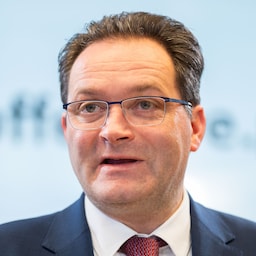
Wasserminister Norbert Totschnig
Bild: APA/GEORG HOCHMUTH
The situation is becoming more complex: While in some regions—such as throughout Lower Austria—there is already a risk of wildfires and the soil is drying out, water withdrawals in residential areas are simultaneously increasing. This contradiction highlights just how sensitive the system has become. Yet practice shows that solutions can work. In several municipalities, up to 90 percent of pool owners voluntarily participate in coordinated filling systems.
Pool tax “necessary and appropriate”
The fuss over a potential pool tax has also died down in the meantime—at least in Upper Austria. “People realize that it is necessary and appropriate,” says Josef Bleckenwegner, mayor of Eberschwang in Upper Austria, looking calmly toward the upcoming “filling days” in his municipality seven years after the introduction of Austria’s first pool tax. Depending on the pool’s size, the annual fee ranges from 37 to 72 euros. “The money is earmarked for the water supply,” says the municipality, which has built two additional elevated tanks to ensure a steady supply even during dry periods, such as the current one.
Eberschwang has since become a model for other municipalities. “Officials from other municipalities are constantly calling us to find out exactly how we do it,” say Eberschwang municipal employees, who are in high demand for information, especially at the start of the pool season. Incidentally, Eberschwang’s pool tax was also reviewed and approved by the state of Upper Austria. In Jennersdorf, Burgenland, a pool tax of up to 100 euros was introduced just this year—and here, too, there were protests following the announcement.
This article has been automatically translated,
read the original article here.











Willkommen in unserer Community! Eingehende Beiträge werden geprüft und anschließend veröffentlicht. Bitte achten Sie auf Einhaltung unserer Netiquette und AGB. Für ausführliche Diskussionen steht Ihnen ebenso das krone.at-Forum zur Verfügung. Hier können Sie das Community-Team via unserer Melde- und Abhilfestelle kontaktieren.
User-Beiträge geben nicht notwendigerweise die Meinung des Betreibers/der Redaktion bzw. von Krone Multimedia (KMM) wieder. In diesem Sinne distanziert sich die Redaktion/der Betreiber von den Inhalten in diesem Diskussionsforum. KMM behält sich insbesondere vor, gegen geltendes Recht verstoßende, den guten Sitten oder der Netiquette widersprechende bzw. dem Ansehen von KMM zuwiderlaufende Beiträge zu löschen, diesbezüglichen Schadenersatz gegenüber dem betreffenden User geltend zu machen, die Nutzer-Daten zu Zwecken der Rechtsverfolgung zu verwenden und strafrechtlich relevante Beiträge zur Anzeige zu bringen (siehe auch AGB). Hier können Sie das Community-Team via unserer Melde- und Abhilfestelle kontaktieren.