AK analysis shows:
Childcare for the youngest children remains an Achilles’ heel in Upper Austria
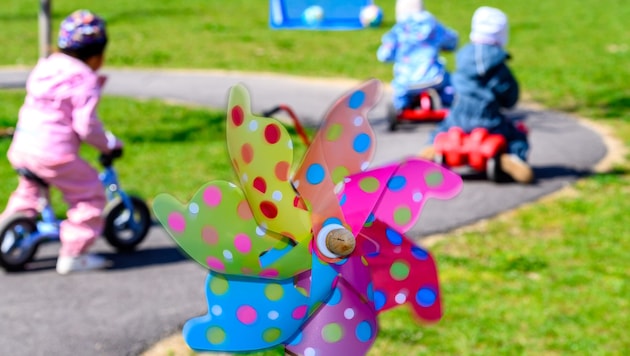

Opening and closing hours, lunch options, and overall availability: The Upper Austrian Chamber of Labor (AK) published this year’s Child Care Atlas on Tuesday. The—rather incomplete—report shows that the state still has urgent ground to make up, particularly when it comes to care for children under three.
 Kronen Zeitung als bevorzugte Google-Quelle hinzufügen
For 27 years, the AK has been surveying the general conditions of childcare in Upper Austria. In collaboration with the IFES Institute, this year’s Child Care Atlas once again examines parameters such as available services by age group, the facilities’ opening and closing times, and whether lunch is provided. Based on these criteria, municipalities are ranked in categories ranging from 1A (best) to D (worst).
AK President Andreas Stangl presented the latest study on Tuesday. His conclusion: Upper Austria has ground to make up in the area of early childhood education and care (KBB). “There are many dedicated municipalities and encouraging developments. However, we must not rest on our laurels with just a few showcase projects.” Especially when it comes to caring for the youngest children, there is still plenty of room for improvement in this region.

Good early childhood education and care is essential for parents to be able to work. The state must provide the necessary funding.
Andreas Stangl, Präsident AK OÖ
Only 31 Municipalities Top the List
According to the report, only 31 municipalities here achieved the top grade of 1A; 141 were rated A, 75 were rated B, and a total of 32 were rated C or D. However—and this applies to the entire publication: Only 279 of the 438 municipalities in Upper Austria participated in the survey; 159 municipalities (36 percent) did not provide any data. According to the office of Christine Haberlander (ÖVP), the deputy governor responsible for the KBB, the AK study is therefore “not representative.” The only meaningful data are the 2025/26 daycare statistics presented by Haberlander in May, whose findings regarding childcare availability are significantly more positive.
Call for Mandatory Needs Assessment
Stangl, on the other hand, criticizes the refusal of the 159 municipalities: The public has a right to know the state of child care in their municipality. In addition to comprehensive, needs-based, and full-time educational offerings, he therefore calls for, among other things, a “mandatory and professional needs assessment in municipalities and districts.”
This article has been automatically translated,
read the original article here.










Willkommen in unserer Community! Eingehende Beiträge werden geprüft und anschließend veröffentlicht. Bitte achten Sie auf Einhaltung unserer Netiquette und AGB. Für ausführliche Diskussionen steht Ihnen ebenso das krone.at-Forum zur Verfügung. Hier können Sie das Community-Team via unserer Melde- und Abhilfestelle kontaktieren.
Hinweis in eigener Sache: Das krone.at-Forum präsentiert sich ab sofort in neuem Design! Wir freuen uns über konstruktives Feedback. Damit die Diskussionen in den Kommentarbereichen beim jeweiligen Thema bleiben, können Sie uns Rückmeldungen hier hinterlassen.
User-Beiträge geben nicht notwendigerweise die Meinung des Betreibers/der Redaktion bzw. von Krone Multimedia (KMM) wieder. In diesem Sinne distanziert sich die Redaktion/der Betreiber von den Inhalten in diesem Diskussionsforum. KMM behält sich insbesondere vor, gegen geltendes Recht verstoßende, den guten Sitten oder der Netiquette widersprechende bzw. dem Ansehen von KMM zuwiderlaufende Beiträge zu löschen, diesbezüglichen Schadenersatz gegenüber dem betreffenden User geltend zu machen, die Nutzer-Daten zu Zwecken der Rechtsverfolgung zu verwenden und strafrechtlich relevante Beiträge zur Anzeige zu bringen (siehe auch AGB). Hier können Sie das Community-Team via unserer Melde- und Abhilfestelle kontaktieren.