June through August alone
Record-breaking summer claimed nearly 1,000 heat-related deaths

Austria sweltered during this year’s summer months. Temperatures as high as 41.3 degrees not only shattered all-time heat records nationwide. For many people, the high temperatures were too much to bear.
 Kronen Zeitung als bevorzugte Google-Quelle hinzufügen
 It was a summer that went down in the history books. As early as June, about half of the country’s 277 weather stations reached or exceeded the 35-degree mark; in July, Wieselburg (Lower Austria) broke the record that had stood since 1983 with a temperature of 40.3 degrees. August brought unprecedented temperatures, culminating in an all-time record of 41.3 degrees on August 5 in Bad Deutsch-Altenburg (Lower Austria).
Several heat waves, some lasting for weeks, pushed people and nature to the limits of what is bearable—and beyond. According to estimates by the Agency for Health and Food Safety (AGES), at least 995 people died as a result of the heat during this year’s record-breaking summer.
Including September, up to 1,276 deaths according to calculations
More than ever before—and that’s even before September is factored in. AGES estimates put the total, including September, at a staggering figure of up to 1,276 deaths.
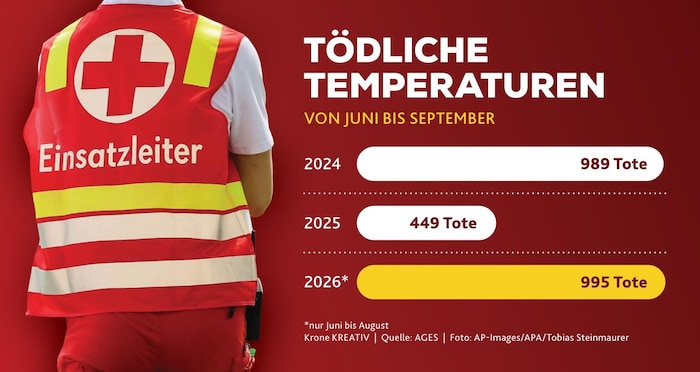
The previous sad record of 989 deaths in 2024 (though estimated for the period from June through September) was thus already surpassed this year in August, In 2025, 449 people paid for the high temperatures with their lives due to less intense heat waves. Of course, this is not a count but an estimate with 95 percent certainty.
Of 415 square kilometers of glaciers, only 285 remain
It is not only humans who suffer from heat waves and a lack of precipitation. Researchers from eleven institutions—including the Universities of Graz, Salzburg, and Innsbruck, as well as the Austrian Academy of Sciences and GeoSphere Austria—measured and mapped all of Austria’s ice surfaces for the new glacier inventory. The result is shocking: Of the 415 square kilometers that were covered by ice in the mid-2000s, only 285 (margin of error: ± 12 km²) remain.
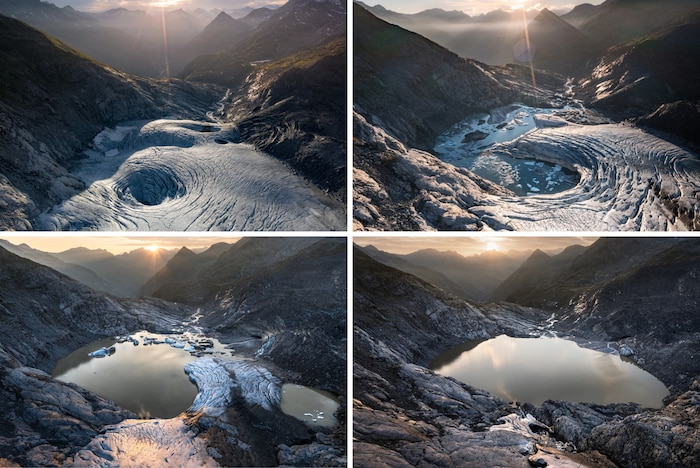
Glaciers have lost more than 80 percent of their ice
At 31 percent, nearly a third has disappeared since then, and 95 glaciers no longer exist at all. Incidentally, only nine of the 799 glaciers surveyed are larger than five square kilometers. The consequences are particularly catastrophic in low mountain ranges with small glaciers, such as the Rätikon in Vorarlberg or the Hochkönig in Salzburg—they have already lost more than 80 percent of their glacier area.

The loss of glacial area in recent years has been extreme. We are currently watching the glaciers disappear.
Lea Hartl vom Institut für Interdisziplinäre Gebirgsforschung
Bild: zVg
Researchers, by the way, expect glacier loss to accelerate further. As a result, one or two mountain ranges are likely to become completely ice-free in the coming years.
This article has been automatically translated,
read the original article here.









Willkommen in unserer Community! Eingehende Beiträge werden geprüft und anschließend veröffentlicht. Bitte achten Sie auf Einhaltung unserer Netiquette und AGB. Für ausführliche Diskussionen steht Ihnen ebenso das krone.at-Forum zur Verfügung. Hier können Sie das Community-Team via unserer Melde- und Abhilfestelle kontaktieren.
User-Beiträge geben nicht notwendigerweise die Meinung des Betreibers/der Redaktion bzw. von Krone Multimedia (KMM) wieder. In diesem Sinne distanziert sich die Redaktion/der Betreiber von den Inhalten in diesem Diskussionsforum. KMM behält sich insbesondere vor, gegen geltendes Recht verstoßende, den guten Sitten oder der Netiquette widersprechende bzw. dem Ansehen von KMM zuwiderlaufende Beiträge zu löschen, diesbezüglichen Schadenersatz gegenüber dem betreffenden User geltend zu machen, die Nutzer-Daten zu Zwecken der Rechtsverfolgung zu verwenden und strafrechtlich relevante Beiträge zur Anzeige zu bringen (siehe auch AGB). Hier können Sie das Community-Team via unserer Melde- und Abhilfestelle kontaktieren.