Hostile Takeover
Putin Has His Eye on Food Giant’s Business
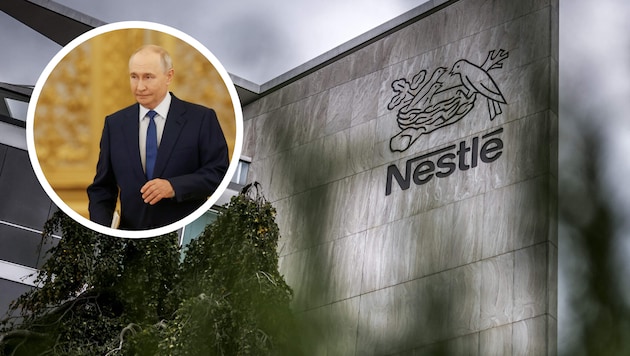

Vladimir Putin has apparently set his sights on the business giant Nestlé. A dubious Russian company has filed a petition for court-ordered receivership of Nestlé’s subsidiaries based there. The move against the Swiss company is reminiscent of the expropriation of other food giants ...
 Kronen Zeitung als bevorzugte Google-Quelle hinzufügen
 The Nestlé conglomerate could bitterly regret its decision not to withdraw from Russia following Putin’s invasion of Ukraine—and, above all, pay dearly for it.
The Russian company KS Logistika has called on President Putin to place five Russian Nestlé subsidiaries under temporary administration, as the Russian business newspaper “Kommersant” reported earlier this week. According to the newspaper, such a measure could be a first step toward a subsequent change in ownership.
Suspicions of a straw man arrangement are evident
The Russian government plans to “review” the demand by the end of the year. KS Logistika justifies the move, among other things, by pointing out that Nestlé is not expanding its production capacity and is no longer exporting goods manufactured in Russia.
Suspicions of a Front Company
- KS Logistika is a small Russian company founded in 2023 that officially reports “zero employees.”
- In 2025, the “logistics firm” reported annual revenue of just 1.6 million rubles—equivalent to about 16,000 euros.
- According to Russian media, the beneficiary of the company is a man named Gerasim Bogomolov from the banking sector.
- He has worked for institutions that have been involved in transactions involving the assets of foreign companies in the past.
It is considered likely that Kremlin-aligned oligarchic circles are behind the bureaucratic facade. This approach has become a common method for redistributing foreign assets within Russia via shell companies. After all, the beneficiaries of the Russian power apparatus must be kept happy.
New Companies in Exchange for “Voluntary” Donations
According to political scientists, significant segments of the Russian political and economic elite are dissatisfied with the course of the war and the resulting economic problems. This is especially true since the super-rich were recently compelled to “voluntarily” contribute to the war chest. “The Kremlin would therefore have a motive to lift spirits again by selling off a valuable company like Nestlé,” according to an analysis by Swiss television station SRF.
In the wake of a forced takeover, the new Russian operators would gain “an abundance of know-how—virtually for next to nothing”—about how Nestlé manufactures its products.
The approach is reminiscent of Danone and Carlsberg
Danone could serve as a model here: The French company was ultimately handed over for very little money to the inner circle of Chechen leader Ramzan Kadyrov. Kadyrov’s nephew even became the new managing director of Danone in Russia.
Danone eventually sold the business in 2024 for around 180 million euros and recorded a total loss of 1.2 billion euros.
The Danish brewing group Carlsberg faced a similar fate. Its Russian operations were also placed under state administration in 2023. At the end of 2024, Carlsberg completed its withdrawal with a management buyout worth $320 million (276.65 million euros). Heineken, for its part, sold its Russian subsidiary for the symbolic price of one euro and recorded a total loss of 300 million euros.
In recent years, Russia has tightened the regulatory framework for foreign companies. Among other measures, the regime created instruments to exert greater influence over companies.
For Nestlé, billions are at stake
Analysts at the U.S. bank JPMorgan now consider a loss on the Russian business a possibility. If Nestlé were forced to sell and generate virtually no proceeds in the process, this could reduce earnings per share (EPS) by about 3 to 4 percent.
The current reports alone are weighing heavily on the stock. The stock has lost more than 2.5 percent in recent days, making it the weakest blue-chip in Switzerland’s leading index, the SMI.
The food giant has long been criticized by Ukraine for its involvement in Russia and was included on a list of “war sponsors”:
Nestlé itself is now working to limit the damage. The company says it has not yet been contacted by government authorities regarding this matter. Its factories and offices continue to operate, and the company is fulfilling its obligations. A withdrawal from the country is not currently under consideration.
According to a company spokesperson, Nestlé generates about two percent of its consolidated revenue in Russia—that is, just under two billion Swiss francs. A lot of money is at stake, but existential fears are unlikely to take hold at the Swiss conglomerate. The company operates six production sites in Russia and manufactures, among other things, coffee, confectionery, baby food, and pet food.
This article has been automatically translated,
read the original article here.











Willkommen in unserer Community! Eingehende Beiträge werden geprüft und anschließend veröffentlicht. Bitte achten Sie auf Einhaltung unserer Netiquette und AGB. Für ausführliche Diskussionen steht Ihnen ebenso das krone.at-Forum zur Verfügung. Hier können Sie das Community-Team via unserer Melde- und Abhilfestelle kontaktieren.
User-Beiträge geben nicht notwendigerweise die Meinung des Betreibers/der Redaktion bzw. von Krone Multimedia (KMM) wieder. In diesem Sinne distanziert sich die Redaktion/der Betreiber von den Inhalten in diesem Diskussionsforum. KMM behält sich insbesondere vor, gegen geltendes Recht verstoßende, den guten Sitten oder der Netiquette widersprechende bzw. dem Ansehen von KMM zuwiderlaufende Beiträge zu löschen, diesbezüglichen Schadenersatz gegenüber dem betreffenden User geltend zu machen, die Nutzer-Daten zu Zwecken der Rechtsverfolgung zu verwenden und strafrechtlich relevante Beiträge zur Anzeige zu bringen (siehe auch AGB). Hier können Sie das Community-Team via unserer Melde- und Abhilfestelle kontaktieren.