
Dangers for Children
Online from an early age: “sharenting” and the consequences
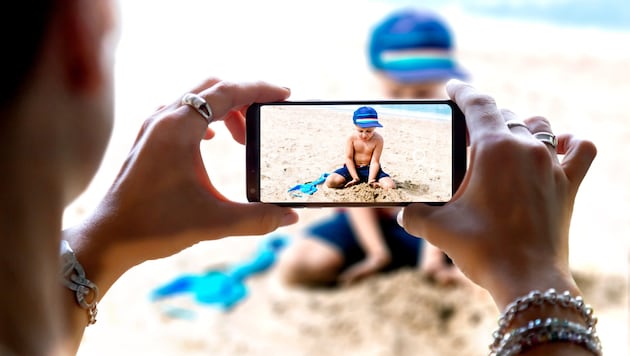

The best photos of children are often taken on vacation—and parents are only too eager to share them on Facebook, Instagram, and other social media platforms. This carries risks that can go far beyond the obvious.
 Kronen Zeitung als bevorzugte Google-Quelle hinzufügen
 For decades, photos of children were primarily kept in photo albums and were therefore a private “confidential matter.” Only a select few were printed and displayed on the wall or on a dresser, and only in the rarest of cases—usually on special occasions like holidays—did they leave the home in the form of a greeting or congratulatory card.
Today, things are different. The combination of smartphones with advanced cameras, social media, and many parents’ desire for recognition results in a constant stream of photos—and, increasingly, videos—capturing moments from the lives of the little ones—no matter how trivial they may be.
Online from an Early Age
“Sharenting,” a portmanteau of “share” and “parenting,” is the name given to this phenomenon—which, in fact, is hardly a phenomenon at all anymore. As early as 2017, a U.S. study pointed out that 90 percent of children under the age of two were already present online. In 2021, Child Protection Switzerland reported that parents shared an average of 100 photos of their children annually on Facebook, Instagram, and other platforms.
And the French association Observatoire de la Parentalité & de L’Éducation Numérique (OPEN) estimates that by the time an average child reaches age 13—the minimum age for most platforms—their photo has been shared 1,300 times on social media. Parents are primarily responsible for this—and they are usually unaware of the dangers to their children.


















Da dieser Artikel älter als 18 Monate ist, ist zum jetzigen Zeitpunkt kein Kommentieren mehr möglich.
Wir laden Sie ein, bei einer aktuelleren themenrelevanten Story mitzudiskutieren: Themenübersicht.
Bei Fragen können Sie sich gern an das Community-Team per Mail an forum@krone.at wenden.