He was 95 years old
Children’s book author Janosch dies in Tenerife
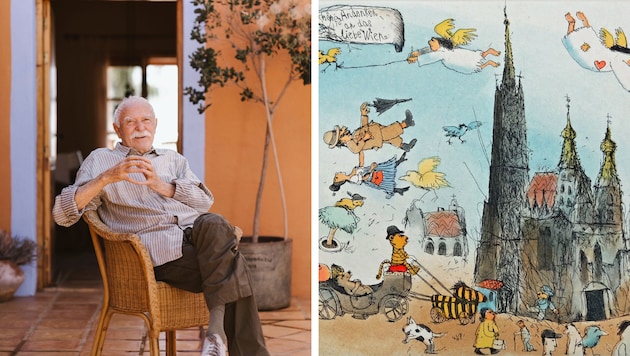

Janosch, the writer and illustrator best known for his unconventional, imaginative, and honest children’s and young adult books, has died.
 Kronen Zeitung als bevorzugte Google-Quelle hinzufügen
The author made a name for himself worldwide with his lovingly illustrated books, such as “Oh, How Beautiful Is Panama.” He passed away on Tuesday in Tenerife at the age of 95, according to his Tübingen-based publisher, Bernhard Feil.
Janosch was born on March 11, 1931, in the Upper Silesian mining town of Zabrze, now in Poland. Before adopting his pen name, he was known as Horst Eckert. His childhood was reportedly a living hell: he suffered from his father’s excessive drinking. His mother also drank, and both of them beat him when he didn’t behave as they had hoped. The Catholic Church added to his torment, fueling the child’s fear of burning in purgatory for his sins.
The Tiger and the Bear as an Act of Defiance
Tiger, Bear, and Tiger Duck were a kind of act of defiance. Janosch was furious. The Academy of Fine Arts in Munich had rejected him. And even his early books, such as *The Story of Valek the Horse*, hadn’t been very successful. So he set out to protest. “I wanted to make a kitsch book,” he once said in a documentary: “There has to be a cuddly bear in it, and the bear has to go on a journey, and he has to have a friend. And just like that, the women start crying.”
This “kitsch book” had an unexpected impact. “Oh, How Beautiful Is Panama” brought the artist his long-awaited breakthrough. Since its first publication in 1978, the book has sold more than two million copies worldwide, according to Beltz Publishing, and has been translated into countless languages. Other works such as “Kasper Mütze” and “Lari Fari Mogelzahn” cemented Janosch’s reputation as a sensitive and imaginative author and illustrator for children. His novels for adults are also well worth reading. In total, he wrote more than 150 books; some sources even mention around 300 works. And his works have been translated worldwide into around 40 languages.
To this day, his children’s books continue to enchant both children and adults alike. Tiger and Bear celebrate life’s little joys. Full of love, consideration, and respect, they care for one another. They indulge in compote made from wild berries they’ve gathered themselves or enjoy “fabulous broth” with potatoes. And when the tiger is sick, the bear tends to him with devotion until he recovers.
An idyll as a balm for the soul
For Janosch, this idyll was a kind of balm for the soul and a stark contrast to his own childhood. Yet the traumatic experiences of his childhood did not come without consequences. Dark thoughts tormented him, and he sought to numb them with copious amounts of alcohol. “I had to step out of my own mind,” he told his biographer Angela Bajorek, who wrote about him in 2016. The book’s title is a piece of wisdom typical of this artist, who cherishes modesty: “Those who need almost nothing have everything.”
This darker side came to the fore in his novels, which are aimed more at adults. In “Cholonek, or the Dear God of Clay,” for example, he tells the story—unflinchingly yet wistfully—of the gray working-class housing project where he spent his childhood. After World War II, the family fled their home in a hurry, eventually settling near Oldenburg. For Janosch, Zabrze remained, despite everything, a kind of place of longing. As he later wrote in the novel “Polski Blues”: “Poland is a land of homesickness.”
But his trademarks remained the tiger, the bear, and the tiger duck. “They adorn lunchboxes, mugs, and socks by the millions, or dangle as keychains from backpacks,” says Raabe. These cute characters had the potential to become mascots from the very beginning and were thus skillfully marketed. Janosch himself distanced himself from the lucrative licensing business of Janosch Film & Medien AG. “I have nothing to do with it; I don’t even see it—it’s too far removed. That’s a different matter,” he told the dpa ten years ago.
In recent years, Janosch stopped giving interviews, partly because his health was already declining. Until a few years ago, he still had a column in the weekly magazine “Zeit.” Writing as “Mr. Wondrak,” he reflected on life and world events, such as in 2015, when he addressed the topic of media addiction. “Mr. Janosch, what would have happened if the tiger and the bear had had smartphones?” he asked. The sobering answer: “They would have just Googled Panama and, by the way, would have stayed seated at the table.”
This article has been automatically translated,
read the original article here.











Willkommen in unserer Community! Eingehende Beiträge werden geprüft und anschließend veröffentlicht. Bitte achten Sie auf Einhaltung unserer Netiquette und AGB. Für ausführliche Diskussionen steht Ihnen ebenso das krone.at-Forum zur Verfügung. Hier können Sie das Community-Team via unserer Melde- und Abhilfestelle kontaktieren.
Hinweis in eigener Sache: Das krone.at-Forum präsentiert sich ab sofort in neuem Design! Wir freuen uns über konstruktives Feedback. Damit die Diskussionen in den Kommentarbereichen beim jeweiligen Thema bleiben, können Sie uns Rückmeldungen hier hinterlassen.
User-Beiträge geben nicht notwendigerweise die Meinung des Betreibers/der Redaktion bzw. von Krone Multimedia (KMM) wieder. In diesem Sinne distanziert sich die Redaktion/der Betreiber von den Inhalten in diesem Diskussionsforum. KMM behält sich insbesondere vor, gegen geltendes Recht verstoßende, den guten Sitten oder der Netiquette widersprechende bzw. dem Ansehen von KMM zuwiderlaufende Beiträge zu löschen, diesbezüglichen Schadenersatz gegenüber dem betreffenden User geltend zu machen, die Nutzer-Daten zu Zwecken der Rechtsverfolgung zu verwenden und strafrechtlich relevante Beiträge zur Anzeige zu bringen (siehe auch AGB). Hier können Sie das Community-Team via unserer Melde- und Abhilfestelle kontaktieren.