Are the vacations too long?
Many children “don’t speak German for weeks”
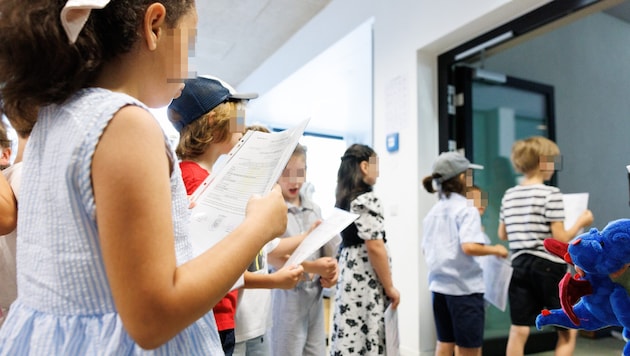


In eastern Austria, summer vacation begins today for half a million students. Once again, many are wondering whether nine weeks off from school are still appropriate or simply too long. The “Krone” discusses this and other pressing issues in the school system with education expert Andreas Salcher.
 Kronen Zeitung als bevorzugte Google-Quelle hinzufügen
 “Krone”: Are nine weeks of summer vacation too long?
Andreas Salcher: We’re always talking about the nine weeks of summer vacation. But if we look at the whole year, we actually have 14 weeks of vacation. There are fall breaks, Christmas breaks, Easter breaks, state holidays, and school-designated days off. This isn’t just a huge challenge for parents; it leads to massive learning losses, especially among so-called educationally disadvantaged groups.
While parents in higher-income groups take their children to museums or travel abroad, and the children attend soccer camps, horseback riding camps, language camps, and the like, children with an immigrant background are sent back to their countries of origin and don’t speak German for weeks on end.

Vienna parent representatives are calling for a shorter summer break. Heat is also an issue, which is why people are considering shortening the breaks—at least in the summer—because many schools aren’t air-conditioned. What do you think about that?
Fourteen weeks a year is unreasonable for many parents. I really think the fall break is a problem. The kids have barely gotten back to school when there’s another interruption. Then the Christmas break comes right after that. This disruption to the learning rhythm is a huge problem. And to be perfectly honest, we don’t lack for breaks.
How would you structure them? How could they best be spread out over the year?
I would shorten the summer break. For example, the last two weeks for students from educationally disadvantaged backgrounds. It’s very important that summer school offers something different from the normal school day. It shouldn’t just be traditional lecture-style instruction from 8 a.m. to 1 p.m. again. During those two weeks, the focus should be on the children carrying out a project. This could be an art project, a music project, or a sports project—anything that the children enjoy and through which they learn the language indirectly, so to speak. It’s easier to learn a language indirectly through social interaction than through rigid German lessons.
The summer school has been in existence since 2020, but this year it became mandatory for the first time for 16,000 non-regular students. By 2027, the summer school will be mandatory for 49,000 non-regular students in Austria. Will this pay off?
That’s absolutely correct. But the requirement should have been implemented much earlier. That’s the first point. And second, we must state this very clearly: Experience so far shows that it’s precisely those who need it most who may sign up for summer school but simply don’t show up. And we cannot accept that.
What can be done about it?
Many experts have long been calling for the same approach used with the Parent-Child Pass—namely, clearly linking social assistance to the obligation to participate. The school system offers many programs, but parents also have a certain responsibility to take the initiative.
Should grades be abolished?
I am very much in favor of grades. People need evaluations and feedback to improve. And most students want that, too. But they want to be assessed fairly. If a student doesn’t meet the standard, a failing grade must be a failing grade. Especially in Vienna, performances that are clearly negative are increasingly being assessed positively. This does students no favors. Many companies now administer entrance exams and identify shortcomings. This means that exam grades—and grades in general—must be realigned with reality. A failing grade must be a failing grade again.
You’re calling for curricula to be no more than 20 pages long instead of several thousand. What exactly can be left out?
I’m not a fan of centralized curricula. I’m in favor of creating certain broad areas of study, as the Americans or the British do, for example. For instance, you could combine the natural sciences. The future lies in individualized learning paths for each and every student. That’s possible. I know enough schools that are doing this successfully.
Schools in high-risk areas are a huge issue. Teachers report students rolling around on the floor or even injuring themselves with compasses. Can some middle schools even be saved?
Yes, with the right teaching methods and the right commitment, that would certainly be possible. However, we need to take a step back. The key is respect, but also clear consequences. We must tackle this major challenge in early childhood education—that is, in elementary schools—because that’s where we can still have a massive influence on children. That’s also where we can teach them that every action they take—every positive one, but also every negative one—has a corresponding consequence. By the time they reach middle school, it’s usually too late.
What will the school of the future look like?
It shouldn’t be a question of whether the school belongs to the states or the federal government. My solution is simpler. It belongs neither to the federal government nor to the states. It belongs to the schools. Autonomy means: delegating power. The power of a principal to manage a budget—a genuine educational budget—to select their own teachers, and to be able to part ways with unsuitable teachers—all of that belongs to the school. This has been called for for many years. The opposite is the case. We have a massive Ministry of Education, and on top of that, we have nine massive regional education offices.
Let’s take a look at another topic that’s causing a small or major revolution in the classroom: artificial intelligence. AI tools have already made their way into schools, whether we like it or not. What’s the situation in schools from your perspective? Are schools currently keeping up with these developments?
Artificial intelligence isn’t just revolutionizing the workplace—the work of journalists and authors—but also having a massive impact onschools. The big difference is that companies are already well prepared for AI and are working with it, whereas schools are not at all. Yet students are using it very intensively. Over the past two years, the percentage of students aged 12 to 18 who use AI daily has risen from 32 to 84 percent. Students—especially those in high school—are writing all their homework with AI and preparing for exams with AI. This can be a positive thing. But there’s also the danger that it will effectively eliminate the need for thinking and learning.
This article has been automatically translated,
read the original article here.











Willkommen in unserer Community! Eingehende Beiträge werden geprüft und anschließend veröffentlicht. Bitte achten Sie auf Einhaltung unserer Netiquette und AGB. Für ausführliche Diskussionen steht Ihnen ebenso das krone.at-Forum zur Verfügung. Hier können Sie das Community-Team via unserer Melde- und Abhilfestelle kontaktieren.
User-Beiträge geben nicht notwendigerweise die Meinung des Betreibers/der Redaktion bzw. von Krone Multimedia (KMM) wieder. In diesem Sinne distanziert sich die Redaktion/der Betreiber von den Inhalten in diesem Diskussionsforum. KMM behält sich insbesondere vor, gegen geltendes Recht verstoßende, den guten Sitten oder der Netiquette widersprechende bzw. dem Ansehen von KMM zuwiderlaufende Beiträge zu löschen, diesbezüglichen Schadenersatz gegenüber dem betreffenden User geltend zu machen, die Nutzer-Daten zu Zwecken der Rechtsverfolgung zu verwenden und strafrechtlich relevante Beiträge zur Anzeige zu bringen (siehe auch AGB). Hier können Sie das Community-Team via unserer Melde- und Abhilfestelle kontaktieren.