What to Watch Out For
Tax on Many Food Items Cut in Half Effective Immediately
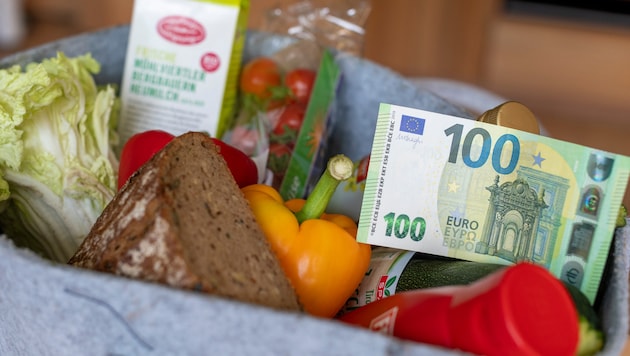

Grocery shopping is getting cheaper: The average family is expected to save a good 100 euros a year because, as of July 1, the value-added tax on many food items will be cut in half to 4.9 percent. Retailers promise to pass on every cent of this savings. But consumers need to be careful—there are some rather odd restrictions.
 Kronen Zeitung als bevorzugte Google-Quelle hinzufügen
 The goal of lowering the value-added tax on many products from the standard rate of 10 percent to just 4.9 percent—effective immediately—is to save an average family around 100 euros. One thing is certain: this will cost the government 200 million euros this year alone, and twice as much next year. Mathematically speaking, we’ll therefore pay this amount less when shopping.
Of course, consumers can only fully benefit if they adjust their diets to include the reasonably short list of discounted food items. Items such as milk and some dairy products, as well as fresh chicken eggs, will become cheaper. Also included are many types of vegetables—even if they’re frozen—mostly domestic fruit, bread and pastries, and regular table salt (see table below).
Depending on the supermarket chain, 4,000 to 16,000 items will be cheaper
Billa estimates that a total of around 4,000 items will be affected. Billa board member Erich Szuchy promises that the lower tax will be passed on to customers down to the last cent. In cases of non-round amounts, prices will be adjusted down to the nearest lower cent value in favor of consumers.
The organic Kaiser roll, for example, will now cost 0.42 euros instead of 0.45 euros—the exact price would be 0.429. Spar had to adjust nearly 16,000 items across its various brands. The cheapest liter of milk from S-Budget now costs seven cents less, and the store-brand roll costs two cents less.
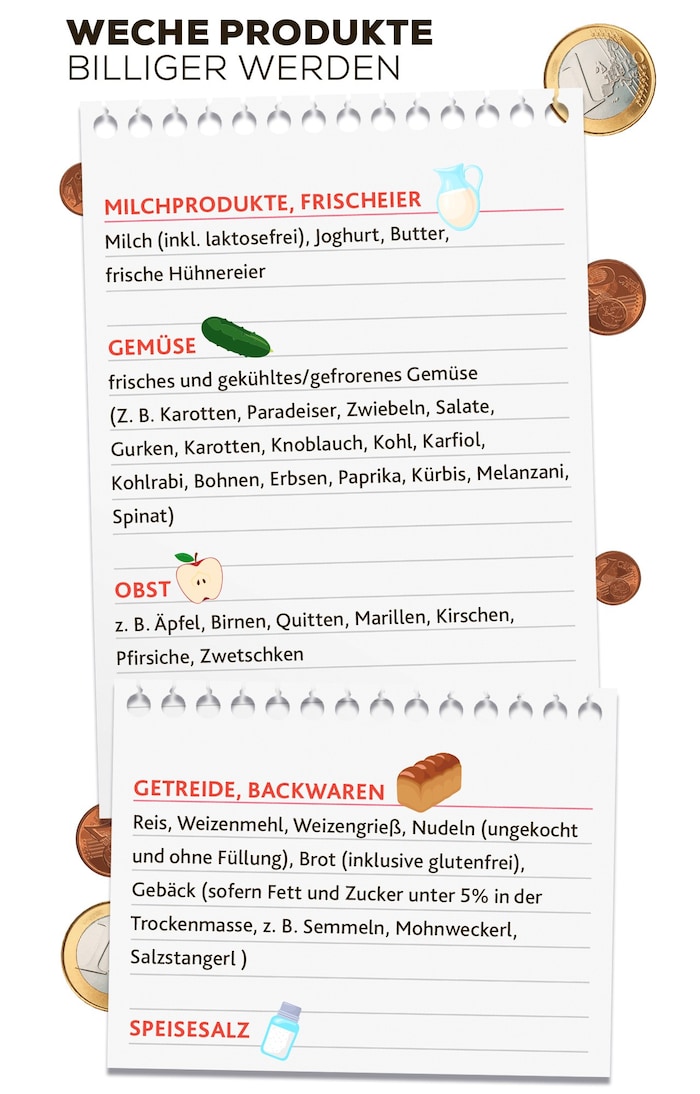
However, smaller retailers and food suppliers in particular are groaning under the burden of this regulation, which is highly complex in its details. Bakers, for example, criticize the fact that the tax break applies only to baked goods with a maximum of five percent fat or sugar content in the dry matter.
The result: If the dough contains additives such as nuts, sunflower seeds, poppy seeds, whole eggs, raisins, or honey, the product will often not meet the criteria and will still be subject to the 10 percent tax. Furthermore, only wheat flour—not rye or spelt—is on the list. The fact that quince, a fruit rarely purchased, is considered a staple food and receives preferential treatment is also not clear to everyone.
And anyone who buys a roll plus butter pays 4.9 percent for each. However, if you have the butter spread on the roll right there at the counter, the tax remains at ten percent. The same applies if you want to eat the roll and butter right there in the store and have them served at a snack table. So consumers need to be careful.
This article has been automatically translated,
read the original article here.










Liebe Leserin, lieber Leser,
die Kommentarfunktion steht Ihnen ab 6 Uhr wieder wie gewohnt zur Verfügung.
Mit freundlichen Grüßen
das krone.at-Team
User-Beiträge geben nicht notwendigerweise die Meinung des Betreibers/der Redaktion bzw. von Krone Multimedia (KMM) wieder. In diesem Sinne distanziert sich die Redaktion/der Betreiber von den Inhalten in diesem Diskussionsforum. KMM behält sich insbesondere vor, gegen geltendes Recht verstoßende, den guten Sitten oder der Netiquette widersprechende bzw. dem Ansehen von KMM zuwiderlaufende Beiträge zu löschen, diesbezüglichen Schadenersatz gegenüber dem betreffenden User geltend zu machen, die Nutzer-Daten zu Zwecken der Rechtsverfolgung zu verwenden und strafrechtlich relevante Beiträge zur Anzeige zu bringen (siehe auch AGB). Hier können Sie das Community-Team via unserer Melde- und Abhilfestelle kontaktieren.