Setback for the SVP
Swiss Reject Population Cap
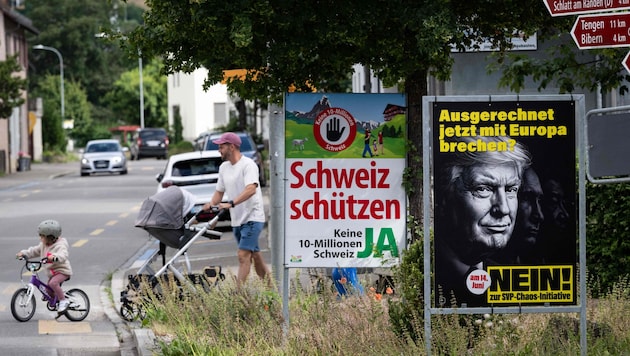

The Swiss have rejected a strict cap on the population. On Sunday, 54.8 percent of voters opposed the proposal by the right-wing conservative Swiss People’s Party (SVP) to cap the population at ten million.
 Kronen Zeitung als bevorzugte Google-Quelle hinzufügen
 In rural regions such as the canton of Appenzell Innerrhoden, where there are few foreigners, the initiative was approved by nearly 66 percent. In cities, however, projections indicated a clear rejection.
The SVP Fights Against Foreigners and the EU
For decades, the SVP has vehemently opposed foreigners and the European Union. It has failed in many referendums, but succeeded in others, such as the 2009 ban on minarets and the 2021 ban on face coverings (Burqa Initiative).
This time, it had presented the proposal as a “sustainability initiative” that, according to its portrayal, would conserve resources, prevent further overdevelopment, and combat overcrowded buses and trains as well as crime. It consistently made clear that the focus was on limiting the number of foreigners.
Why acceptance would have affected EU citizens as well
The SVP wanted to limit the population to ten million by 2050. To achieve this, as the limit approached, asylum and family reunification would first be restricted, and as a last resort, the freedom of movement for EU citizens as well. This would have made it more difficult for Austrians to live and work in Switzerland as well.
Stephanie Gartenmann, an SVP member of the Bern Cantonal Parliament and advocate of the 10-million-person initiative, described the 45 percent approval as a success. “This is a clear signal that we need to take action,” she told SRF. We must focus on “qualitative immigration” “so that we can keep Switzerland just as it is: a place worth living in, with prosperity and quality of life.”
How the Swiss system holds the SVP back
Although the SVP has been the party with the most voters since 1999, the four largest parties have governed in a coalition at the federal level for decades, which is why the SVP cannot fully implement its policies.
It currently holds two of the seven seats on the Federal Council, as do the Social Democrats and the Free Democrats; the centrist party holds one seat. Because the Federal Council rejected the initiative as a whole, the two SVP members also had to publicly argue against their own party.
What was proposed?
- The SVP proposal calls for two stages. Once the population reaches 9.5 million, the government must put the brakes on asylum seekers and family reunification for foreigners. According to a government estimate, this is likely to happen in 2031.
- The ten-million mark is then expected to be reached in 2042. Two years after crossing this threshold, Switzerland would have to terminate the Agreement on the Free Movement of Persons with the EU. This would likely also render a whole series of other agreements with its most important trading partner null and void.
- According to the government’s assessment, this could cost the country billions in revenue.
Immigration remains a difficult issue
Monika Rühl, head of the business association Economiesuisse, welcomed the result. “We still need access to skilled workers,” she said. “We need uncomplicated access through the Agreement on the Free Movement of Persons with the EU.” She also pointed to the looming aging of the population if immigration is restricted.
Nevertheless, parties and associations agree that the issue of immigration is a concern for the public. “We must make greater use of domestic potential,” said Yvonne Bürgin, a centrist member of parliament. This involves, for example, improving the skills of the resident population. The economy must grow in depth, not in breadth. This would increase per capita value added—“so that less immigration is needed,” she said.
This article has been automatically translated,
read the original article here.











Liebe Leserin, lieber Leser,
die Kommentarfunktion steht Ihnen ab 6 Uhr wieder wie gewohnt zur Verfügung.
Mit freundlichen Grüßen
das krone.at-Team
User-Beiträge geben nicht notwendigerweise die Meinung des Betreibers/der Redaktion bzw. von Krone Multimedia (KMM) wieder. In diesem Sinne distanziert sich die Redaktion/der Betreiber von den Inhalten in diesem Diskussionsforum. KMM behält sich insbesondere vor, gegen geltendes Recht verstoßende, den guten Sitten oder der Netiquette widersprechende bzw. dem Ansehen von KMM zuwiderlaufende Beiträge zu löschen, diesbezüglichen Schadenersatz gegenüber dem betreffenden User geltend zu machen, die Nutzer-Daten zu Zwecken der Rechtsverfolgung zu verwenden und strafrechtlich relevante Beiträge zur Anzeige zu bringen (siehe auch AGB). Hier können Sie das Community-Team via unserer Melde- und Abhilfestelle kontaktieren.