A Long and Painful Struggle After the Accident
A 13-Year Struggle: Marcel Sees Only One Option
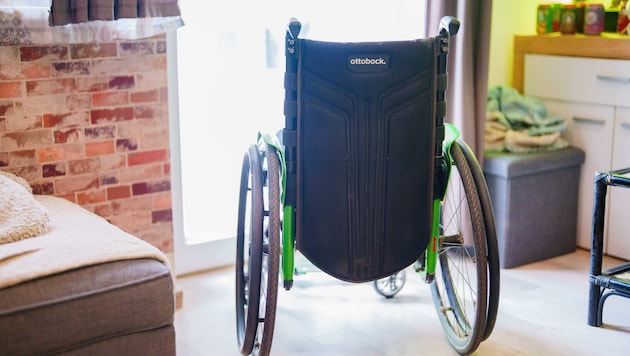

A terrible accident. A life in a wheelchair. Extreme pain. Marcel (*) has persevered for 13 years. At the end of April, he reached out to the “Krone.” He will die soon, but before that, he wants to tell his story.
 Kronen Zeitung als bevorzugte Google-Quelle hinzufügen
 “He will take his own life in June. The medical process for this will be initiated at the end of May. Please listen to his story.”
This email from a contact of Marcel’s (*name changed by the editors) landed in my inbox at the end of April. Assisted suicide, I thought, and immediately thought of Niki Glattauer. He, too, had opted for a living will and assisted suicide—as did 98 other people in 2023, with the trend on the rise.
The Glattauer case sparked an ethical debate
Following the publication of an interview with the well-known teacher and journalist (he also worked for the “Krone” for eight years), an ethical debate erupted in Austria—according to Point 12 of the Code of Ethics for the Austrian Press, “great restraint is required. Responsible journalism refrains from sensationalist reporting—also due to the risk of imitation.”
However, assisted suicide has been permitted in Austria since 2022. Thus, reporting on it is a form of engagement with a form of euthanasia provided for by law. The right to it, we at the “Krone” felt, should apply not only to celebrities, but also to Marcel.
Spinal cord severed by a machine
His story begins on a spring day in 2013 at a metalworking plant. Marcel is in his mid-20s; he works there on a stranding machine. As he leans forward to blow away metal shavings, the machine catches his jacket and pulls him between the steel cables. His spine is severed; in addition to paraplegia, he also suffers severe internal injuries. His kidneys, liver, and diaphragm are torn apart; on his upper body, the machine has ripped away his skin along with his nipple. Marcel experiences all of this while fully conscious.
The man from Lower Austria has been in a wheelchair ever since; in February, it marked 13 years. Safety precautions for the machines at his former workplace were significantly increased after the horrific accident. For Marcel, these measures came too late. To this day, he suffers from extreme pain; he can only use his arms to a limited extent. Spasmodic twitches in his numb legs also strain his paralyzed internal organs. Marcel requires a catheter for bladder drainage and must adhere to strict schedules for bowel movements.
Marcel’s ordeal is a story repeated thousands of times in Austria
For a long time, good and bad phases alternate. Then the bad phases become longer and longer. The modified car is still parked in front of the house, but he can no longer drive it. His wheelchair is in front of the patio, but he can barely make it inside. Marcel spends his days in front of a giant flat-screen TV; he’s even made a few new friends through anonymous online games. They don’t know that he can’t move.
His freedom of movement is shrinking. Two years ago, Marcel admitted to himself that he could no longer live like this.
Asomewhat bearable life with cannabis
Marcel’s story is also a story about medical cannabis, which is only available on a limited basis in Austria. Patient organizations criticize that access to cannabis-based therapy is too restricted, too expensive, and difficult to navigate. Unlike in our neighboring countries, there are no comprehensive regulations for medical cannabis flowers available at pharmacies.
Marcel first came into contact with cannabis during his rehab. At the time, a bed-sore on his back had kept him bedridden for many months. He could barely eat and lost a lot of weight. Extreme pain also kept him awake at night. One day, the nurse asked him if he knew about cannabis. Marcel said yes; he had smoked it occasionally as a teenager.
“Arge Canna” Association
“Arge Canna” advocates for a rational, medically sound approach to cannabis. The focus is on patient protection, medical supervision, affordable access, and the right to safety for people who use cannabis for medical reasons. The association is a non-profit organization and therefore relies on donations.
Name: ARGE CANNA
IBAN: AT874666010000011013
BIC/SWIFT Code: SVIEAT21XXX
At the time, he wasn’t aware that he could also benefit from it as a patient. He began smoking joints and recounts that the cramps in his legs stopped almost immediately. That his appetite returned, that his will to live came back. He speaks of a “somewhat bearable life going forward.” He is even able to return to work at his former job—in a wheelchair and with severe limitations. The doors, his employer assured him, would always be wide open for him.
What follows is a chapter dealing with drug investigations, criminal prosecution, and an indictment. Marcel had initially obtained cannabis on the black market and then grew it himself at home—for personal use and to alleviate his pain. He made cannabis oil from the plants, which he inhaled, thereby achieving an even stronger and longer-lasting effect against his pain.
He considers the criminal prosecution he faced for this to be “unworthy” and advocates for making natural cannabis flowers accessible to the seriously ill in Austria. He is supported by “Arge Canna,” a nonprofit, donation-dependent association that supports people who use cannabis medication.
The Legal Situation in Austria
Law:Assisted suicide has been permitted in Austria since 2022. To apply for a living will, the person concerned must be suffering from an incurable, life-threatening illness or a severe, chronic illness with persistent symptoms. Two doctors, one of whom must be qualified in palliative care, must provide information. The directive must be drawn up in writing before a notary or a patient advocate.
Statistics: Every year in Austria, more than three times as many people take their own lives as die in traffic accidents. In 2023, there were 1,212 such cases, including 98 assisted suicides—54 among women and 44 among men.
Help: Information on suicidal thoughts related to depression, warning signs, and emergency assistance:
Telephone Counseling: Tel.: 142, daily 24/7 www.telefonseelsorge.at
www.kriseninterventionszentrum.at Tel: 01 406 95 95
www.suizid-praevention.at (24-hour help)
Marcel is eventually prescribed dronabinol, one of the few cannabis-based medications permitted in Austria. It helps him far less than natural cannabis, is much more expensive (not only for the patient but also for the state), and has been proven to damage the liver.
Since the end of last year, Marcel has been unable to work. He no longer feels able to manage the task of obtaining the cannabis flowers that are essential to his survival. Furthermore, he would have recently had to undergo surgery to create a colostomy. For him, that was always a line he did not want to cross. An attempt to end his life fails. He is subsequently admitted to the psychiatric ward of a hospital and tells the psychiatrist about his seemingly hopeless situation, explaining that he sees no other option. And he learns from this doctor that in Austria, there is the option of assisted suicide for patients who are seriously or terminally ill. When he asks if the doctor would understand if he were to take advantage of this option, the psychiatrist replies, “Yes.”
The interview with Marcel will be published after his deathat
. I visited Marcel twice at his home and listened to his story. Our conversations revolved around patient rights and human dignity, around happiness and suffering, and also around the suffering of family members and friends. Around life and death, around a tragedy that happens thousands of times in Austria.
We respect Marcel’s express wish that the interview be published only after his death.
This article has been automatically translated,
read the original article here.











Liebe Leserin, lieber Leser,
die Kommentarfunktion steht Ihnen ab 6 Uhr wieder wie gewohnt zur Verfügung.
Mit freundlichen Grüßen
das krone.at-Team
User-Beiträge geben nicht notwendigerweise die Meinung des Betreibers/der Redaktion bzw. von Krone Multimedia (KMM) wieder. In diesem Sinne distanziert sich die Redaktion/der Betreiber von den Inhalten in diesem Diskussionsforum. KMM behält sich insbesondere vor, gegen geltendes Recht verstoßende, den guten Sitten oder der Netiquette widersprechende bzw. dem Ansehen von KMM zuwiderlaufende Beiträge zu löschen, diesbezüglichen Schadenersatz gegenüber dem betreffenden User geltend zu machen, die Nutzer-Daten zu Zwecken der Rechtsverfolgung zu verwenden und strafrechtlich relevante Beiträge zur Anzeige zu bringen (siehe auch AGB). Hier können Sie das Community-Team via unserer Melde- und Abhilfestelle kontaktieren.