Manninger's Death Touches People
This is how (un)safe the railroad crossings in the state are
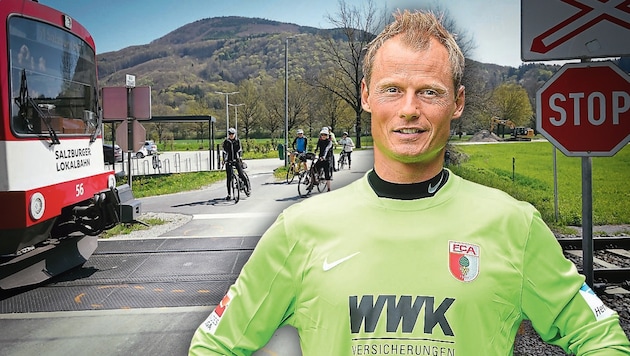

Following the tragic accident involving former international top goalkeeper Alexander Manninger from Salzburg, the debate over the lack of barriers at railroad crossings across Austria has reignited. The “Krone” asked the Ministry, the ÖBB, and transportation experts for their views...
 Kronen Zeitung als bevorzugte Google-Quelle hinzufügen
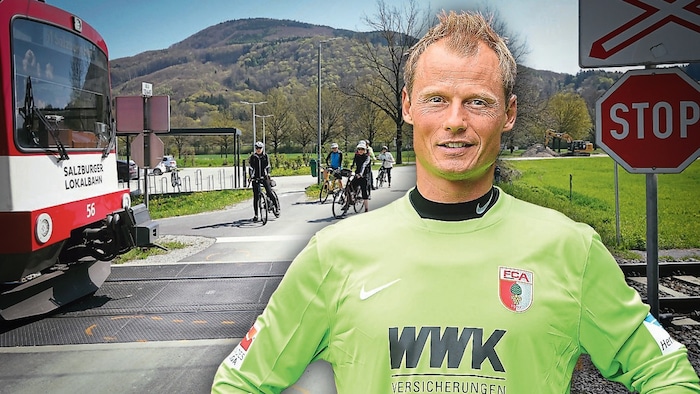
 At Salzburg’s regulars’ tables and sports fields, people still talk a lot about Alex from the Lehen neighborhood while watching soccer together—some have memories of their time playing soccer together in their youth, and everyone is shocked by how the beloved Mozart City native was torn from life. The 48-year-old was killed at an unguarded railroad crossing in Nußdorf am Haunsberg near Salzburg. Only a St. Andrew’s cross “secured” the tracks.
The car of the father of two, who had enjoyed international success, was struck by a local train and dragged along the tracks. Manninger was killed instantly. And experts agree that a barrier at that location could have saved his life (see also the interview below).
“Authorities decide based on criteria”
But why aren’t barriers mandatory at every railroad crossing? “Not every railroad crossing needs barriers because safety measures in Austria are determined by law depending on the situation. According to the Railway Act and the Railway Crossing Ordinance, the authorities decide on a case-by-case basis based on criteria such as train speed, traffic volume, visibility, and local conditions,” the Ministry of Mobility, headed by Peter Hanke (SPÖ), stated in response to an inquiry from the “Krone.”
Facts & Figures
There are currently around 3,000 railroad crossings in Austria, exactly 2,916 of which are on the ÖBB rail network.
Twenty-five years ago, there were still more than 6,000 railroad crossings.
According to statistics, there were 43 accidents at railroad crossings in Austria in 2024.
Only two occurred at crossings with barriers.
Four people lost their lives in these accidents.
Most of the accidents occurred in Lower Austria (15) and Upper Austria (12 accidents).
ÖBB spokesperson Daniel Pinka commented: “The shared goal of the federal government, the states, and the ÖBB is to gradually reduce the number of railroad crossings in Austria. Each year, the ÖBB invests between 25 and 30 million euros in improving safety at railroad crossings.” Pinka added: “All railroad crossings in the ÖBB network are secured, either technically or non-technically. So there isn’t a single railroad crossing in the ÖBB network that isn’t secured.” Currently, there are 2,916.

I frequently drive across unguarded railroad crossings—reduced speed and careful observation are crucial.
Verkehrsminister Peter Hanke (SPÖ)
Lower Austria State Councilor Launches Safety Campaign
In total, there are around 3,000 railroad crossings from Vorarlberg to Burgenland. Freedom Party Provincial Transport Minister Udo Landbauer has launched a safety campaign at railroad crossings in Lower Austria: “We want to protect people from dangerous situations.” While just under 375,000 euros were spent on barrier systems in 2024, the figure was 1.3 million euros last year. The trend is upward.
INTERVIEW with VCÖ expert Christian Gratzer
“Krone”:What danger lurks when I, as a road user, approach an unguarded railroad crossing? What is the best way to behave?
Christian Gratzer: Road trafficalways has the right of way at railroad crossings! The tragic accident involving Alexander Manninger serves as a reminder that at railroad crossings without barriers, we must always check first to see if a train is coming. It can come from either the left or the right. Always come to a complete stop at a stop sign. If the traffic light is red, then of course you must stop. Disregarding a stop sign or a red light at railroad crossings is life-threatening. Due to its mass, a train has a braking distance more than ten times longer than that of a car.
Why do serious accidents keep happening despite good visibility?
Distraction and inattention are unfortunately common causesofserious traffic accidents, including those involving railroad crossings. That is why it is so important to drive attentively and with full concentration. If the sun is blinding, reduce your speed accordingly so you can check whether a train is coming or if the traffic light is red. For local residents who cross railroad crossings daily, the belief that they know the schedule can be dangerous. Schedules can change; delays, unscheduled trips, or additional freight trains can have fatal consequences if you don’t check to make sure a train is coming before crossing.
If you get stuck between the barriers in your car, step on the gas! The barriers are designed to give way when driven through.
Christian Gratzer vom Verkehrsclub Österreich (VCÖ)
Why aren’t all railroad crossings equipped with barriers?
There are nearly 3,000 railroad crossings in Austria. In recent years, efforts have been made to continuously improve safety at railroad crossings; every year, additional crossings are equipped with barriers, underpasses are built, or, for example, crossings on dirt roads are closed. These measures are working, as accident statistics show. In 2024, four people lost their lives in accidents at railroad crossings in Austria; in 2010, the figure was 14—more than three times as many. This makes it all the more important for road maintenance authorities to invest more heavily in upgrading those railroad crossings that do not yet have barriers.
Do barriers save lives?
Yes, the accident statistics show this very clearly. In 2024, there were 43 accidents at railroad crossings, only two of which occurred at crossings with barriers. Twenty-one happened at crossings with traffic lights and 20 at crossings without technical safety devices. Furthermore, however, it is extremely important to raise awareness that you must always make sure no train is coming before crossing a railroad crossing.
What should I do if I arrive too late and get trapped between the barriers?
In this case,you really need to step on the gas! The barriers are designed to yield when a vehicle passes through. After passing through the barrier, the damage must be reported to the police and your auto insurance company.
This article has been automatically translated,
read the original article here.









Willkommen in unserer Community! Eingehende Beiträge werden geprüft und anschließend veröffentlicht. Bitte achten Sie auf Einhaltung unserer Netiquette und AGB. Für ausführliche Diskussionen steht Ihnen ebenso das krone.at-Forum zur Verfügung. Hier können Sie das Community-Team via unserer Melde- und Abhilfestelle kontaktieren.
User-Beiträge geben nicht notwendigerweise die Meinung des Betreibers/der Redaktion bzw. von Krone Multimedia (KMM) wieder. In diesem Sinne distanziert sich die Redaktion/der Betreiber von den Inhalten in diesem Diskussionsforum. KMM behält sich insbesondere vor, gegen geltendes Recht verstoßende, den guten Sitten oder der Netiquette widersprechende bzw. dem Ansehen von KMM zuwiderlaufende Beiträge zu löschen, diesbezüglichen Schadenersatz gegenüber dem betreffenden User geltend zu machen, die Nutzer-Daten zu Zwecken der Rechtsverfolgung zu verwenden und strafrechtlich relevante Beiträge zur Anzeige zu bringen (siehe auch AGB). Hier können Sie das Community-Team via unserer Melde- und Abhilfestelle kontaktieren.