Expert on “Timmy”:
“Even a dead whale has its place in nature”
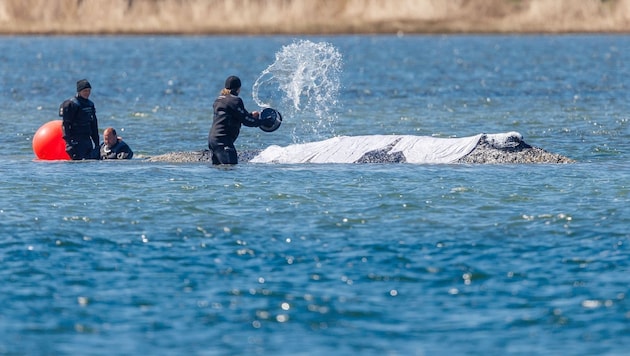


The weeks-long drama surrounding the humpback whale off the Baltic Sea coast has moved many people—but not everyone wants to save it anymore. According to a recent survey by “Bild,” five percent even want to kill the massive animal—perhaps by detonating explosives. In an interview with “Krone,” Viennese marine biologist Daniel Abed-Navandi offers his thoughts on why the whale “Timmy” has stranded so often and how we can prevent such scenarios in the future.
 Kronen Zeitung als bevorzugte Google-Quelle hinzufügen
 “Krone”: How do you assess “Timmy’s” situation?
Daniel Abed-Navandi: In my opinion, there are two options: One possibility is that the animal swims out to deeper, saltier water and may recover naturally, and the other is that the animal, as has been the case in recent weeks, will remain in poor condition and die there.
What do you think happened to the whale?
It’s possible that it collided with a freighter and lost its sense of direction as a result. After all, it has swum in circles several times and repeatedly gotten caught in fishing nets.
How long can an animal survive in such a condition?
Large animals die more slowly—small animals more quickly. But the condition of its skin doesn’t look good. It might even have pneumonia. These are just guesses, though.
What is your general take on the rescue efforts?
Well, I’m quite certain that the scientists and veterinarians on site are doing the right thing to figure out exactly what’s wrong with the animal.
When is it justifiable to stop trying to save an animal or perhaps to euthanize it?
It’s not easy to euthanize such a large animal. Administering the medication can cause the whale to convulse, putting the veterinarian’s life at risk. Stranded whales generally don’t have a good prognosis, and I wouldn’t euthanize him right now, but rather let him go his natural way.
What can we learn from cases like this?
If you examine the dead whale, you can see whether its navigational system was damaged. It’s also important to inform the public that this is a natural process—that sick whales die. Even a dead whale has its place in nature, because it serves as a foundation for many other organisms.
Why does this whale evoke so much empathy?
Large animals are more likable than small ones, and anything larger evokes empathy.
How can such situations be prevented?
Marine exploitation is increasing, and cargo ships are the number-one problem. We should reroute shipping lanes to avoid collisions with whales and prioritize habitat protection, because these problems arise from human use of the oceans.
“Krone” animal expert Maggie Entenfellner on “Timmy” and her call to better protect marine mammals.
A stranded whale has been making headlines for weeks. In Germany, in Europe, and around the world, everyone knows him by now: “Timmy”—the mighty marine mammal. The images of him tug at the heartstrings: the whale lying on the beach, so helpless and exhausted, closer to death than to life. And yes, it’s right to look. It is right to feel compassion. But it is also necessary to be honest. Because while we fret over this one whale, tremble, and debate its rescue, something is happening in the world’s oceans that hardly moves anyone. Every year, hundreds, even thousands of whales are killed—completely legally. Countries like Norway, Iceland, and Japan hunt them mercilessly.
And even that is only part of the mass die-off! Thousands more perish silently, as bycatch in nets, from plastic, or in collisions with ships. More and more often, whales wash ashore disoriented, lost, weakened. The reason: military sonar, cargo ships, industrial activity. All of this disrupts the whales’ communication. They can no longer hear where they are swimming and lose their bearings.
So “Timmy” is not an isolated case. He is a symbol, a mirror of a world that loves animals and stands up for them as long as they touch us emotionally. As long as we have a connection to them, give them names. We don’t need short-lived outrage. We need action: less noise, more protection! Otherwise, we’ll be standing on a beach again tomorrow, debating whether and how to save a weakened animal.
This article has been automatically translated,
read the original article here.











Liebe Leserin, lieber Leser,
die Kommentarfunktion steht Ihnen ab 6 Uhr wieder wie gewohnt zur Verfügung.
Mit freundlichen Grüßen
das krone.at-Team
User-Beiträge geben nicht notwendigerweise die Meinung des Betreibers/der Redaktion bzw. von Krone Multimedia (KMM) wieder. In diesem Sinne distanziert sich die Redaktion/der Betreiber von den Inhalten in diesem Diskussionsforum. KMM behält sich insbesondere vor, gegen geltendes Recht verstoßende, den guten Sitten oder der Netiquette widersprechende bzw. dem Ansehen von KMM zuwiderlaufende Beiträge zu löschen, diesbezüglichen Schadenersatz gegenüber dem betreffenden User geltend zu machen, die Nutzer-Daten zu Zwecken der Rechtsverfolgung zu verwenden und strafrechtlich relevante Beiträge zur Anzeige zu bringen (siehe auch AGB). Hier können Sie das Community-Team via unserer Melde- und Abhilfestelle kontaktieren.