A comparison of countries shows
Diesel costs significantly more here than abroad
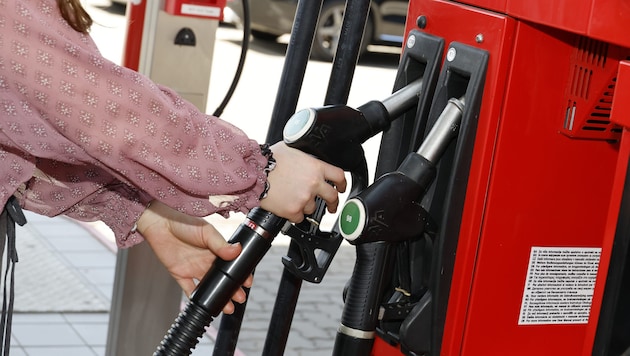

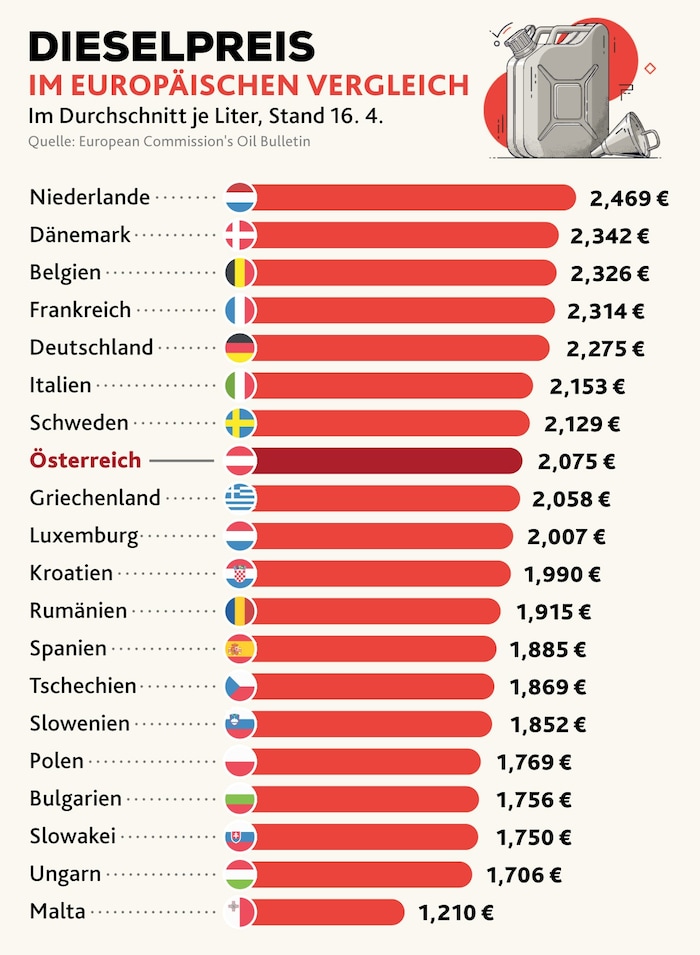
Even though fuel prices have fallen slightly in Austria recently, a country-by-country comparison shows that Austria ranks in the upper middle range in Europe for diesel. In many neighboring countries, commuters and business owners pay significantly less. With regard to supply security, Economy Minister Wolfgang Hattmannsdorfer is trying to reassure the public.
 Kronen Zeitung als bevorzugte Google-Quelle hinzufügen
 “We take the situation seriously, but there is no reason for alarm,” says Economy Minister Wolfgang Hattmannsdorfer, seeking to reassure the public on the fuel price front. Recently, the EU Commission caused concern with the announcement that, in addition to jet fuel for aircraft, diesel could also become scarcer starting in May. Both issues affect Europe, but not Austria, Hattmannsdorfer emphasizes. Specifically, Brussels stated that it expects five percent less diesel and 15 percent less jet fuel to be available for Europe starting next month.
90 percent of the jet fuel for Vienna International Airport comes from the OMV refineryin
. This is because, in addition to OMV—which, for example, covers 90 percent of Vienna International Airport’s jet fuel needs via a direct pipeline from its refinery in Schwechat—our oil imports do not pass through the disputed Strait of Hormuz. For example, we source 57 percent of our imports from Kazakhstan, 14 percent from Libya, and another 12 percent from Saudi Arabia. So far, there have been no problems here.
And if all else fails, Austria also has a so-called “mandatory emergency reserve” of oil, diesel, and gasoline that can supply the country for 90 days. A small portion of this (11 days’ worth) has already been released, but has not yet been “called up” by OMV.
Fuel prices have recently fallen
At the pump, prices were slightly down on Thursday. Nevertheless, we rank in the upper middle range in a comparison of countries (see chart above). The main reason for this is our high taxes and duties. Half of the money spent on gasoline and diesel goes to the government. In addition, countries like Hungary and Croatia have price caps. Malta, on the other hand, has always heavily intervened in fuel prices (including through subsidies) and also has low taxes.
Transportation Industry Under Pressure
High fuel costs are putting increasing pressure not only on commuters but also on transport companies and are affecting all kinds of goods. “This is an inflationary turbo,” warns Markus Fischer, WKO chairman of the transporters. Since the beginning of the year, diesel prices have risen by around 40 percent. In practical terms, this translates to additional costs of around 17,500 euros per truck per year.
To ease the burden on the industry, Fischer is calling for, among other things, a reduction in the mineral oil tax and the CO₂ tax.
This article has been automatically translated,
read the original article here.










Willkommen in unserer Community! Eingehende Beiträge werden geprüft und anschließend veröffentlicht. Bitte achten Sie auf Einhaltung unserer Netiquette und AGB. Für ausführliche Diskussionen steht Ihnen ebenso das krone.at-Forum zur Verfügung. Hier können Sie das Community-Team via unserer Melde- und Abhilfestelle kontaktieren.
Hinweis in eigener Sache: Das krone.at-Forum präsentiert sich ab sofort in neuem Design! Wir freuen uns über konstruktives Feedback. Damit die Diskussionen in den Kommentarbereichen beim jeweiligen Thema bleiben, können Sie uns Rückmeldungen hier hinterlassen.
User-Beiträge geben nicht notwendigerweise die Meinung des Betreibers/der Redaktion bzw. von Krone Multimedia (KMM) wieder. In diesem Sinne distanziert sich die Redaktion/der Betreiber von den Inhalten in diesem Diskussionsforum. KMM behält sich insbesondere vor, gegen geltendes Recht verstoßende, den guten Sitten oder der Netiquette widersprechende bzw. dem Ansehen von KMM zuwiderlaufende Beiträge zu löschen, diesbezüglichen Schadenersatz gegenüber dem betreffenden User geltend zu machen, die Nutzer-Daten zu Zwecken der Rechtsverfolgung zu verwenden und strafrechtlich relevante Beiträge zur Anzeige zu bringen (siehe auch AGB). Hier können Sie das Community-Team via unserer Melde- und Abhilfestelle kontaktieren.