The Battery Storage Boom
There’s a gold rush atmosphere in this industry
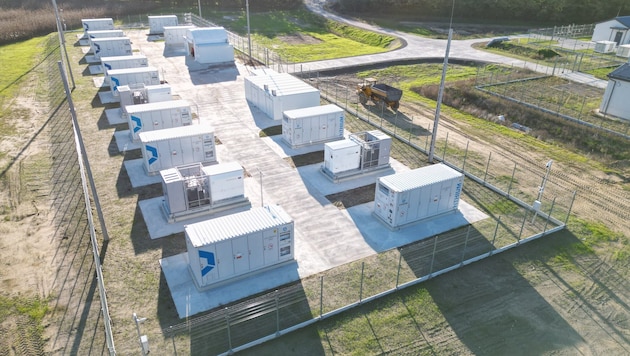

Just last September, the largest battery storage facility to date went into operation in Wagenham in the Innviertel region—and now a project more than three times that size is planned in Molln (also in Upper Austria). Energy expert Robert Tichler explains the boom.
 Kronen Zeitung als bevorzugte Google-Quelle hinzufügen
There’s a real gold rush atmosphere surrounding so-called battery storage systems right now. They can store electricity that isn’t currently needed and release it at a later time.
A few examples of the boom:
This past spring, the logistics company Schachinger built a large-scale battery storage facility with a capacity of 30 megawatts in Hörsching to charge its electric truck fleet—at the time, the largest storage facility in the state. In September, it was surpassed by the 85-megawatt battery storage facility built by the energy company NGEN in Wagenham. But even this record won’t last long: A large-scale storage facility with a capacity of 300 megawatts is now planned in Molln.
Price Differential as a Business Model
The operators of such large-scale storage facilities make money by purchasing electricity when prices are low, storing it, and then reselling it at a higher price. “There aren’t many storage facilities yet, so now is the best time to take advantage of this,” says Robert Tichler, managing director of the Energy Institute at JKU Linz, explaining the current boom.

We’ve calculated that Upper Austria will need approximately 140 soccer fields’ worth of large-scale battery storage by 2040 to relieve the strain on the power grid.
Robert Tichler, Chef des Energieinstituts an der JKU
Already, 44,000 households have small storage systems
For the expert, this is a positive development: “This makes it possible to provide energy more cheaply at certain times, and under normal circumstances, a battery storage system also relieves the strain on the power grid”—because instead of feeding excess PV electricity into the already overloaded grid at midday, it can be temporarily stored. For this reason, the demand for storage systems is high: “We’ve calculated that Upper Austria will need an area equivalent to about 140 soccer fields filled with large-scale battery storage systems by 2040 to relieve the strain on the power grid,” says Tichler.
The expansion of battery storage isn’t limited to large-scale projects: The grid operator Netz OÖ has already recorded more than 44,000 households in Upper Austria that have installed small storage systems for their PV systems.
This article has been automatically translated,
read the original article here.









Willkommen in unserer Community! Eingehende Beiträge werden geprüft und anschließend veröffentlicht. Bitte achten Sie auf Einhaltung unserer Netiquette und AGB. Für ausführliche Diskussionen steht Ihnen ebenso das krone.at-Forum zur Verfügung. Hier können Sie das Community-Team via unserer Melde- und Abhilfestelle kontaktieren.
Hinweis in eigener Sache: Das krone.at-Forum präsentiert sich ab sofort in neuem Design! Wir freuen uns über konstruktives Feedback. Damit die Diskussionen in den Kommentarbereichen beim jeweiligen Thema bleiben, können Sie uns Rückmeldungen hier hinterlassen.
User-Beiträge geben nicht notwendigerweise die Meinung des Betreibers/der Redaktion bzw. von Krone Multimedia (KMM) wieder. In diesem Sinne distanziert sich die Redaktion/der Betreiber von den Inhalten in diesem Diskussionsforum. KMM behält sich insbesondere vor, gegen geltendes Recht verstoßende, den guten Sitten oder der Netiquette widersprechende bzw. dem Ansehen von KMM zuwiderlaufende Beiträge zu löschen, diesbezüglichen Schadenersatz gegenüber dem betreffenden User geltend zu machen, die Nutzer-Daten zu Zwecken der Rechtsverfolgung zu verwenden und strafrechtlich relevante Beiträge zur Anzeige zu bringen (siehe auch AGB). Hier können Sie das Community-Team via unserer Melde- und Abhilfestelle kontaktieren.