Sharp Price Increases
Austrian Households Now Face a Gas Price Shock
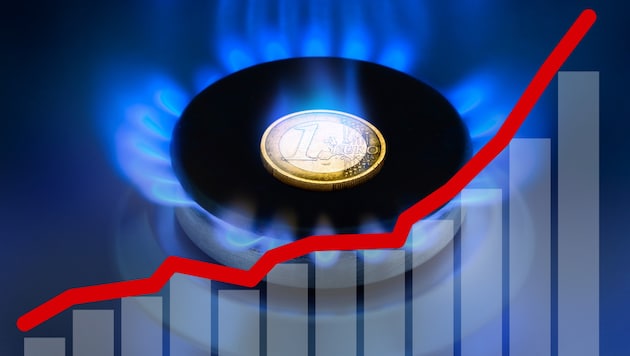

The Strait of Hormuz is only a few kilometers wide—yet this year it has become the most expensive bottleneck for Austrian households. Since the Iran War and the blockade of the strait, the wholesale price of gas has more than tripled: from under 30 euros to around 100 euros per megawatt-hour.
 Kronen Zeitung als bevorzugte Google-Quelle hinzufügen
What many people don’t know: The conflict affects not only fuel and oil, but also gas—because Qatar, one of the world’s largest suppliers of liquefied natural gas, can no longer supply its facilities, and tankers are often unable to pass through the strait.
A price shock is now heading toward households
And this price shock is only now really hitting households. “Gas suppliers pass on wholesale prices with a delay,” says expert Leo Lehr from the regulatory authority E-Control. In other words: What has long been a reality on the exchange is only now being reflected in customers’ rates.
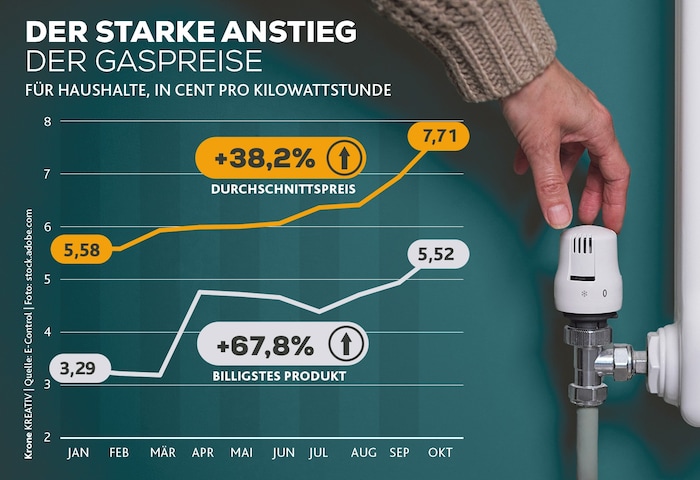
The figures are dramatic. This year, the average gas price for Austrian households has already risen from 5.58 to 7.71 cents per kilowatt-hour (see chart). And even for those actively seeking a low-cost plan: the cheapest offer for new customers has climbed from 3.22 to 5.52 cents. “If wholesale prices stay at 100 euros, even 10 cents per kilowatt-hour is possible for households,” warns Lehr.
Who Is Hit Especially Hard
Three groups are being hit particularly hard.
- First: everyone with “floating-rate” plans, which become more expensive as the market rises.
- Second: everyone who has never switched providers. Their existing contracts are becoming slowly but steadily more expensive due to index adjustments.
- Third: everyone who switched a year ago—and whose price guarantee is now expiring.
Fall is traditionally the peak time for switching providers, and once the twelve months are up, rates often spike. “Many end up with a flexible contract that automatically adjusts to the market,” says Lehr. The result: a creeping price shock that catches many off guard.

Still, there are currently rates available at around 6 cents per kilowatt-hour. Lehr strongly advises comparing rates and switching now—“because then you’ll have a price guarantee for the next twelve months.” The willingness to switch is already at record levels this year: In the first half of 2026, 42,387 households looked for a new gas supplier—more than ever before.
Gas network costs will also continue to rise next year
But even those who save on the gas price alone will be asked to pay up in 2027. Grid costs are rising by an average of 7.2 percent across Austria—and in Carinthia and Lower Austria, by as much as 20 percent. The reason: Fewer and fewer households are heating with gas, and transit through Austria has plummeted. As a result, fixed costs are being spread across fewer and fewer households.
In any case, relief on the actual energy price is only possible if the war in Iran ends and the Strait of Hormuz becomes freely passable again. Until then, Austria’s roughly one million gas customers should: check their bills, compare rates, and switch providers again once any price guarantee expires!
This article has been automatically translated,
read the original article here.










Willkommen in unserer Community! Eingehende Beiträge werden geprüft und anschließend veröffentlicht. Bitte achten Sie auf Einhaltung unserer Netiquette und AGB. Für ausführliche Diskussionen steht Ihnen ebenso das krone.at-Forum zur Verfügung. Hier können Sie das Community-Team via unserer Melde- und Abhilfestelle kontaktieren.
Hinweis in eigener Sache: Das krone.at-Forum präsentiert sich ab sofort in neuem Design! Wir freuen uns über konstruktives Feedback. Damit die Diskussionen in den Kommentarbereichen beim jeweiligen Thema bleiben, können Sie uns Rückmeldungen hier hinterlassen.
User-Beiträge geben nicht notwendigerweise die Meinung des Betreibers/der Redaktion bzw. von Krone Multimedia (KMM) wieder. In diesem Sinne distanziert sich die Redaktion/der Betreiber von den Inhalten in diesem Diskussionsforum. KMM behält sich insbesondere vor, gegen geltendes Recht verstoßende, den guten Sitten oder der Netiquette widersprechende bzw. dem Ansehen von KMM zuwiderlaufende Beiträge zu löschen, diesbezüglichen Schadenersatz gegenüber dem betreffenden User geltend zu machen, die Nutzer-Daten zu Zwecken der Rechtsverfolgung zu verwenden und strafrechtlich relevante Beiträge zur Anzeige zu bringen (siehe auch AGB). Hier können Sie das Community-Team via unserer Melde- und Abhilfestelle kontaktieren.