Only 79 centimeters left
Attersee: Water Level Becomes a Problem for Lenzing AG
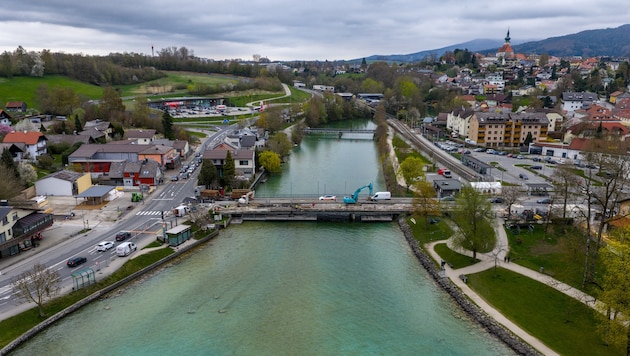

Despite recent rainfall, the water level of Lake Attersee continues to drop. Now the situation could become critical for industry as well. While Lenzing AG believes it is prepared, Provincial Councilor Stefan Kaineder (Greens) warns of production losses and environmental risks.
 Kronen Zeitung als bevorzugte Google-Quelle hinzufügen
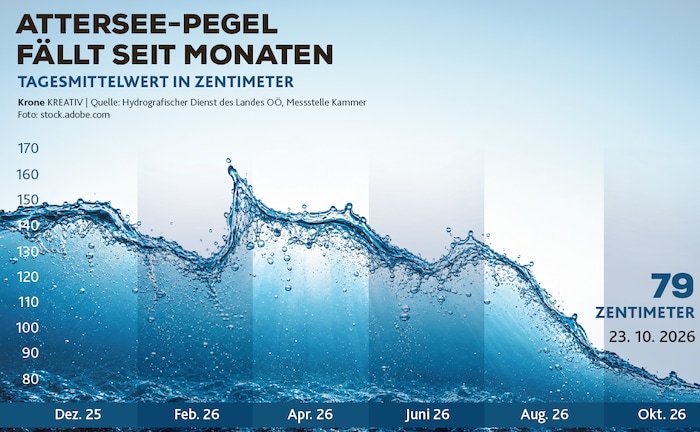
The light rain was not enough to alleviate the situation: The water level of Lake Attersee has been falling steadily for months. On Friday, it stood at just 79 centimeters at the Kammer measuring station. By way of comparison: exactly one year ago to the day, the water level at the same location was still 140 centimeters. The level is thus 61 centimeters lower than last year.
Things Get Critical at 59 Centimeters
State experts have now calculated when the situation will become truly critical. Specifically, this occurs when the water level drops to 59 centimeters. Up to this mark, the state government’s intervention in the weir operating regulations calls for a water discharge of 4.5 cubic meters per second. If the water level drops further, the discharge rate will be reduced to 2.2 cubic meters per second.
And then the situation could become serious, as the responsible state councilor, Stefan Kaineder (Greens), warns: “In the worst-case scenario, we face not only severe ecological damage—including fish kills—but also production losses and job losses if the water supply needed to cool an industrial facility can no longer be adequately guaranteed.”

We find ourselves in a situation where we must balance the protection of Lake Attersee against that of the Ager River.

Landesrat Stefan Kaineder, Grüne
Bild: FOTOKERSCHI / WERNER KERSCHBAUMM
Lenzing AG Considers Itself Prepared
Specifically, Kaineder is referring to Lenzing AG, whose plant relies on water from the Ager River. In response to an inquiry from the “Krone,” the company describes the situation as challenging, “but one that can be managed well through adjustments.”
The plant uses water from the Ager River for cooling and as process water. After this water is treated in biological wastewater treatment plants, 97 percent of it flows back into the river, according to the company.
In any case, the company considers itself prepared for a further worsening of the situation: “Lenzing AG has various measures in place to respond to limited water availability. These include, for example, operational adjustments or bringing forward planned maintenance measures.”
This article has been automatically translated,
read the original article here.










Willkommen in unserer Community! Eingehende Beiträge werden geprüft und anschließend veröffentlicht. Bitte achten Sie auf Einhaltung unserer Netiquette und AGB. Für ausführliche Diskussionen steht Ihnen ebenso das krone.at-Forum zur Verfügung. Hier können Sie das Community-Team via unserer Melde- und Abhilfestelle kontaktieren.
Hinweis in eigener Sache: Das krone.at-Forum präsentiert sich ab sofort in neuem Design! Wir freuen uns über konstruktives Feedback. Damit die Diskussionen in den Kommentarbereichen beim jeweiligen Thema bleiben, können Sie uns Rückmeldungen hier hinterlassen.
User-Beiträge geben nicht notwendigerweise die Meinung des Betreibers/der Redaktion bzw. von Krone Multimedia (KMM) wieder. In diesem Sinne distanziert sich die Redaktion/der Betreiber von den Inhalten in diesem Diskussionsforum. KMM behält sich insbesondere vor, gegen geltendes Recht verstoßende, den guten Sitten oder der Netiquette widersprechende bzw. dem Ansehen von KMM zuwiderlaufende Beiträge zu löschen, diesbezüglichen Schadenersatz gegenüber dem betreffenden User geltend zu machen, die Nutzer-Daten zu Zwecken der Rechtsverfolgung zu verwenden und strafrechtlich relevante Beiträge zur Anzeige zu bringen (siehe auch AGB). Hier können Sie das Community-Team via unserer Melde- und Abhilfestelle kontaktieren.