Shocking Discovery in a Cookbook
Are the Germans Now Challenging Us Over the Schnitzel?


The Wiener Schnitzel is considered Austria’s culinary icon. But a new historical lead is now causing a stir: The roots of this breaded specialty may lie much further north—in Germany.
 Kronen Zeitung als bevorzugte Google-Quelle hinzufügen
An Austrian culinary historian examined cookbooks, recipe collections, and historical sources spanning several centuries. In the process, she came across evidence that the technique of breading was already well known north of the Alps long before the Wiener Schnitzel became Austria’s national dish.
Breading Technique Described as Early as 1691
As reported by the German newspaper “Bild,” corresponding references can already be found in historical German cookbooks. According to the “Complete Nuremberg Cookbook” from 1691, poultry and fish were coated with a mixture of breadcrumbs and flour and then fried in lard. However, there was no mention of a schnitzel at that time.
The evidence becomes even clearer nearly 100 years later. The “New Lexicon of French, Saxon, Austrian, and Bohemian Culinary Arts” from 1785 includes recipes for so-called “Karbonaden.” These are slices of meat or cutlets.
The Crumb Coating and Preparation
According to the study, the key difference lies in the preparation. The German karbonaden were drizzled with butter, breaded with breadcrumbs, and then fried. The Austrian versions, however, were not prepared this way. Instead, they were served with beef broth or doused in it.
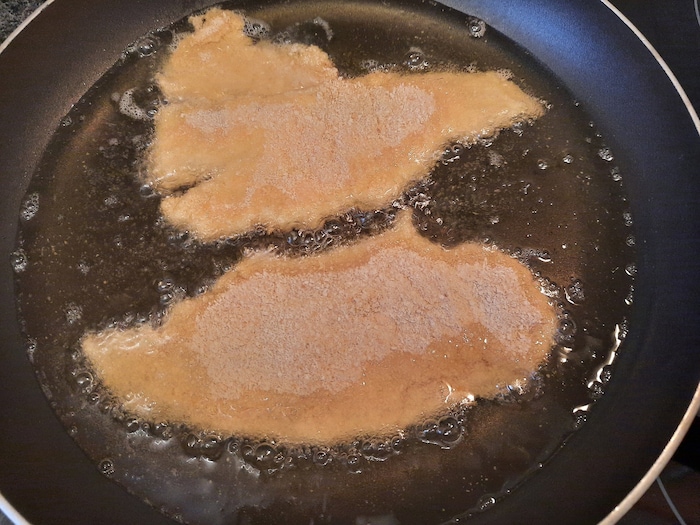
For culinary historian Sabine Flöcklmüller, this is an important clue to the origin of the preparation method. The combination of meat and breading is found in the historical recipes from Germany examined in the study, while comparable Austrian dishes were still prepared differently at that time.
Another clue leads to a cook from Bavaria
A historical trail also leads to Bavaria in the development of the schnitzel as we know it today. According to Flöcklmüller, the first Wiener Schnitzel in its current form can be traced back to the Bavarian cook Anna Maria Neudecker.
Neudecker reportedly worked in the Bohemian spa towns of Karlsbad and Franzensbad and described her recipe as early as 1831. The term “Viennese schnitzel” finally appeared for the first time in a Viennese cookbook in 1886.
History Is More Complex Than You Might Think
However, this does not mean that Austria’s most famous meat dish can simply be dismissed as “German.” The Wiener Schnitzel has long been closely associated with Austrian cuisine and has become a culinary classic here.
Rather, historical research suggests that the oldest known precursors to breaded meat dishes can be found in German cookbooks. The history of the Wiener Schnitzel is thus likely more complex than its name might initially suggest.
This article has been automatically translated,
read the original article here.










Willkommen in unserer Community! Eingehende Beiträge werden geprüft und anschließend veröffentlicht. Bitte achten Sie auf Einhaltung unserer Netiquette und AGB. Für ausführliche Diskussionen steht Ihnen ebenso das krone.at-Forum zur Verfügung. Hier können Sie das Community-Team via unserer Melde- und Abhilfestelle kontaktieren.
Hinweis in eigener Sache: Das krone.at-Forum präsentiert sich ab sofort in neuem Design! Wir freuen uns über konstruktives Feedback. Damit die Diskussionen in den Kommentarbereichen beim jeweiligen Thema bleiben, können Sie uns Rückmeldungen hier hinterlassen.
User-Beiträge geben nicht notwendigerweise die Meinung des Betreibers/der Redaktion bzw. von Krone Multimedia (KMM) wieder. In diesem Sinne distanziert sich die Redaktion/der Betreiber von den Inhalten in diesem Diskussionsforum. KMM behält sich insbesondere vor, gegen geltendes Recht verstoßende, den guten Sitten oder der Netiquette widersprechende bzw. dem Ansehen von KMM zuwiderlaufende Beiträge zu löschen, diesbezüglichen Schadenersatz gegenüber dem betreffenden User geltend zu machen, die Nutzer-Daten zu Zwecken der Rechtsverfolgung zu verwenden und strafrechtlich relevante Beiträge zur Anzeige zu bringen (siehe auch AGB). Hier können Sie das Community-Team via unserer Melde- und Abhilfestelle kontaktieren.