Problems in Schools
Nearly one in ten new teachers quits
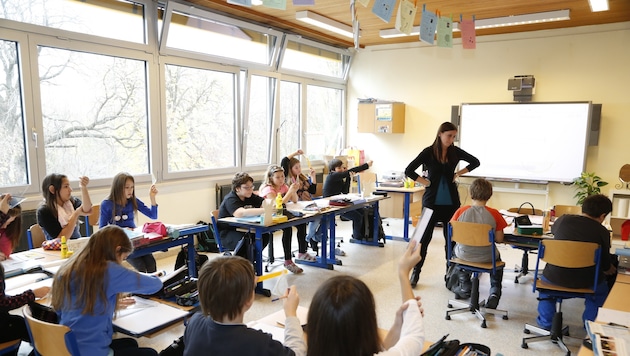

By international standards, Austrian teachers are particularly satisfied; very few (80 percent, or 6 percent) are considering a career change. The situation is different for new teachers, however: Nine percent of those new to the profession with traditional teacher training have quit their jobs.
 Kronen Zeitung als bevorzugte Google-Quelle hinzufügen
 Overall, in Austria during the 2024–25 school year, 3 percent of fully qualified teachers left the profession, and more than two-thirds of them were new teachers with less than five years of professional experience. This is according to the new edition of the OECD study “Education at a Glance,” published on Tuesday.
In Luxembourg and the French-speaking part of Belgium, too, new teachers account for a good two-thirds of those leaving the profession—twice as many as the average among the 14 OECD countries that reported relevant data. The study cites workload, (insufficient) support when starting their careers, and, more generally, the attractiveness of a teaching career to young people as possible reasons.
Young Teachers Often End Up in Challenging Classes
In Austria, earlier surveys have already shown that young teachers face particular stress on the job: they are assigned to challenging classes more often than their more experienced colleagues. Yet only four out of ten feel well-prepared for their job after completing their training, as the OECD’s TALIS teacher survey showed just last year.
In recent years, the teacher shortage has also meant that young teachers have had to spend many hours in the classroom or take on additional responsibilities, such as serving as homeroom teachers, even while still pursuing their degrees. As a result, new protective measures have been in place since last school year to prevent overwork.
More People Leaving the Profession
According to “Education at a Glance,” the number of teachers leaving the profession has been on the rise since the 2017–18 school year, even among those other than new teachers. Austria belongs to the group of industrialized nations with a comparatively small increase (rising from two to three percent); in Estonia, meanwhile, the rate has doubled to just under seven percent, and in French-speaking Belgium, it has tripled to nearly ten percent. At the same time, in other countries such as Latvia, Lithuania, New Zealand, Norway, and Sweden, the number of teachers leaving the profession has remained the same or even declined.
Recruitment Is Becoming More Difficult
Problems with staff recruitment have also tended to increase in OECD countries compared to the 2017–18 school year. In 2024/25, in the 20 industrialized countries with available data, up to three percent of positions could not be filled; in some countries, such as Latvia or Luxembourg, the figure was as high as four percent. For Austria, the study reports a gap of one percent .
“Continue to improve working conditions”
On Tuesday, Education Minister Christoph Wiederkehr (NEOS) spoke of a “good starting point” in Austria in light of the international teacher shortage. “At the same time, we must ensure that young teachers remain in the profession long-term. That is why we must continue to improve working conditions and keep the teaching profession attractive.”
Taking Absences into Account
When it comes to the teacher shortage, according to the authors of “Education at a Glance,” longer-term staff absences should also be taken into account: In the 2024–25 school year, 10 percent of fully qualified teachers in Austria were absent from the classroom for at least two months. A large proportion of these absences were due to parental leave, but over 20 percent were attributed to unpaid leave and 10 percent to sabbaticals. Among the eleven countries with comparable data, Austria ranks first, ahead of South Korea (9) and Ireland (8); in Estonia and Slovakia, the figure is just under two percent.
Many Educators Without Teacher Training
The proportion of educators in Austria without traditional teacher training has risen once again: Compared to 2017/18, the proportion of teachers without full teaching certification has doubled and most recently stood at just under seven percent in both elementary school and secondary school (middle school, AHS, vocational middle and high schools/BMHS). Compared to the 2022–23 school year, the figures have thus risen once again; at that time, the figures were five and six percent, respectively. The most recent OECD average showed that eight percent of teachers lacked traditional teacher training.
According to the OECD study, seven percent of secondary school teachers in Austria are now career changers who are obtaining their teaching credentials through part-time training while working. Previously, this model was common only in vocational subjects at vocational schools and BMHS; it was not until 2022 that the model was extended to include individuals with relevant degrees and professional experience teaching general education subjects (including German and history) throughout the entire secondary level.
Appreciation and Support Called for
The authors of “Education at a Glance” recommend that OECD countries take additional measures—such as providing more support, greater decision-making autonomy, career options, and, above all, greater recognition for the teaching profession—if it is to remain attractive despite growing competition for skilled workers. Currently, barely one-fifth of teachers feel sufficiently valued by society. However, professional recognition is a key factor in whether teachers consider changing careers.
At the same time, the OECD calls for strategies to better manage the smaller number of teachers available to schools during times of a general shortage of skilled workers: Digital solutions, more support staff, and less paperwork should free them up to focus on their core tasks.
Countries should also use the expected decline in the number of compulsory-school-age students—an average of nine percent by 2033—to redirect resources to where they are most urgently needed. Even between 2015 and 2024, student enrollment grew only minimally (up two percent in elementary schools), while the number of teachers there rose by 13 percent. Austria, however, has less leeway in this regard than other countries: It is one of only four countries where the number of teachers has not grown faster than the number of students (11 percent versus 12 percent).
This article has been automatically translated,
read the original article here.











Willkommen in unserer Community! Eingehende Beiträge werden geprüft und anschließend veröffentlicht. Bitte achten Sie auf Einhaltung unserer Netiquette und AGB. Für ausführliche Diskussionen steht Ihnen ebenso das krone.at-Forum zur Verfügung. Hier können Sie das Community-Team via unserer Melde- und Abhilfestelle kontaktieren.
User-Beiträge geben nicht notwendigerweise die Meinung des Betreibers/der Redaktion bzw. von Krone Multimedia (KMM) wieder. In diesem Sinne distanziert sich die Redaktion/der Betreiber von den Inhalten in diesem Diskussionsforum. KMM behält sich insbesondere vor, gegen geltendes Recht verstoßende, den guten Sitten oder der Netiquette widersprechende bzw. dem Ansehen von KMM zuwiderlaufende Beiträge zu löschen, diesbezüglichen Schadenersatz gegenüber dem betreffenden User geltend zu machen, die Nutzer-Daten zu Zwecken der Rechtsverfolgung zu verwenden und strafrechtlich relevante Beiträge zur Anzeige zu bringen (siehe auch AGB). Hier können Sie das Community-Team via unserer Melde- und Abhilfestelle kontaktieren.