Bureaucratic Madness
First Retailers Stop Shipping to EU Countries
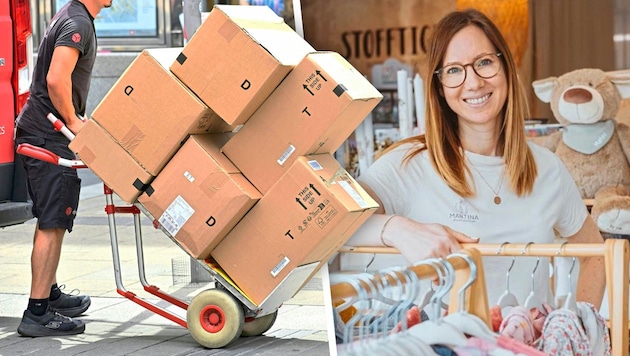

The new EU regulation is intended to make packaging more sustainable, but in practice it has turned out to be an opaque bureaucratic jungle. “We simply don’t have the time or financial resources for this,” says a retailer from Lower Austria.
 Kronen Zeitung als bevorzugte Google-Quelle hinzufügen
 Teddy bears with names and birthdates, wooden toys, keepsake boxes: Martina Wächter ships up to 15,000 packages annually from Großweikersdorf in Lower Austria through her company “Stofftiger.” Normally, her goods—some of which are handmade—end up all over Europe—but that’s over now. The culprit is the new EU Packaging Regulation (“PPWR”), which took effect on August 12. “We’d have to obtain a license for each of the 27 countries and appoint an authorized representative, without knowing how many orders we’d actually receive,” explains the mother of two.
Instead of shipping to Luxembourg, Italy, and Belgium, she now ships only to Germany—“it’s worth the effort”—and to Switzerland. “Every other country costs me about 300 euros in bureaucratic red tape,” explains Wächter. “We simply don’t have the time or financial resources for that.” Other companies are in the same boat.
The EU Packaging Regulation is actually intended to make these practices more sustainable and environmentally friendly. For example, new limits apply to “forever chemicals” such as PFAS, and in the future, empty space in a package will also be limited to 50 percent. However, implementation is “yet another bureaucratic stress test for tens of thousands of local retail businesses,” according to the Retail Association.
Every Piece of Packaging Means Additional Bureaucratic Work
Martina Wächter, for example, has to obtain a declaration of conformity from the supplier for each of the 16 different types of packaging she uses. “Most of the time, you just have to download it, but that still takes half a day. You can’t make money that way. We have to work!” What particularly annoys the Lower Austrian businesswoman is that the rules are almost the same for large corporations and small businesses like hers—and so are the costs. “That could be the economic death blow.”

Only Two Employees Hired Under a Special Permit
In Saaz, Styria, online retailer Niceshops operates on a different scale. With an 88 percent export rate, goods worth 160 million euros are shipped abroad. “The Packaging Ordinance is making the European single market more difficult,” says Managing Director Christoph Schreiner. “The main burden is the documentation. Two colleagues are fully occupied with setting up the new system and figuring out what needs to be done.”
Schreiner says he isn’t worried about his own company. “But I am concerned about the economy in general. Bureaucracy is increasing. We’re digging our own grave.”
This article has been automatically translated,
read the original article here.











Willkommen in unserer Community! Eingehende Beiträge werden geprüft und anschließend veröffentlicht. Bitte achten Sie auf Einhaltung unserer Netiquette und AGB. Für ausführliche Diskussionen steht Ihnen ebenso das krone.at-Forum zur Verfügung. Hier können Sie das Community-Team via unserer Melde- und Abhilfestelle kontaktieren.
User-Beiträge geben nicht notwendigerweise die Meinung des Betreibers/der Redaktion bzw. von Krone Multimedia (KMM) wieder. In diesem Sinne distanziert sich die Redaktion/der Betreiber von den Inhalten in diesem Diskussionsforum. KMM behält sich insbesondere vor, gegen geltendes Recht verstoßende, den guten Sitten oder der Netiquette widersprechende bzw. dem Ansehen von KMM zuwiderlaufende Beiträge zu löschen, diesbezüglichen Schadenersatz gegenüber dem betreffenden User geltend zu machen, die Nutzer-Daten zu Zwecken der Rechtsverfolgung zu verwenden und strafrechtlich relevante Beiträge zur Anzeige zu bringen (siehe auch AGB). Hier können Sie das Community-Team via unserer Melde- und Abhilfestelle kontaktieren.