Helmet Requirement for Those Under 18
Minister Plans Even Stricter Rules for E-Scooters
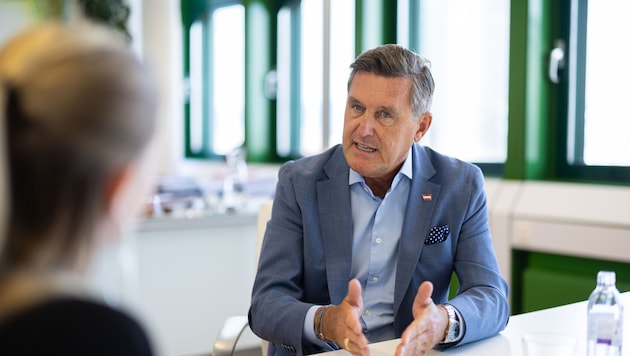

Stricter rules for e-scooters have been in effect since May. However, Transportation Minister Peter Hanke (SPÖ) is already considering further tightening of the regulations: Following an initial assessment, he intends to discuss expanding the helmet requirement. In an interview with “Krone,” Hanke also responds to criticism from Burgenland, talks about the “long road” ahead in climate protection, and reveals what the next steps are regarding the Brenner issue in Tyrol.
 Kronen Zeitung als bevorzugte Google-Quelle hinzufügen
 “Krone”: Minister, is Hans Peter Doskozil right in saying that ten ministers would be enough to run Austria?
Peter Hanke: I believe that the division of ministries is entirely appropriate. There is intensive work to be done in the coming years. In my area, examples include the reform of the ÖBB, the industrial strategy, traffic calming in town centers, and much more. On all these issues, this federal government is delivering significantly more and better results than the Turquoise-Green coalition
Doskozil also said that the federal government’s performance is so poor that Herbert Kickl wouldn’t have to do anything at all to win the election. Do you feel affected by this criticism?
Doskozil is a critical thinker, and it’s perfectly fine to open certain issues up for discussion. I believe this coalition and the SPÖ have proven that we can implement positive changes and find compromises even in difficult situations. That’s why I consider what has been achieved so far to be something to be proud of. One thing is clear: We must always aim higher and never be satisfied with the status quo. That’s why we need to work day in and day out to ensure that both the economy and the social system continue to evolve.

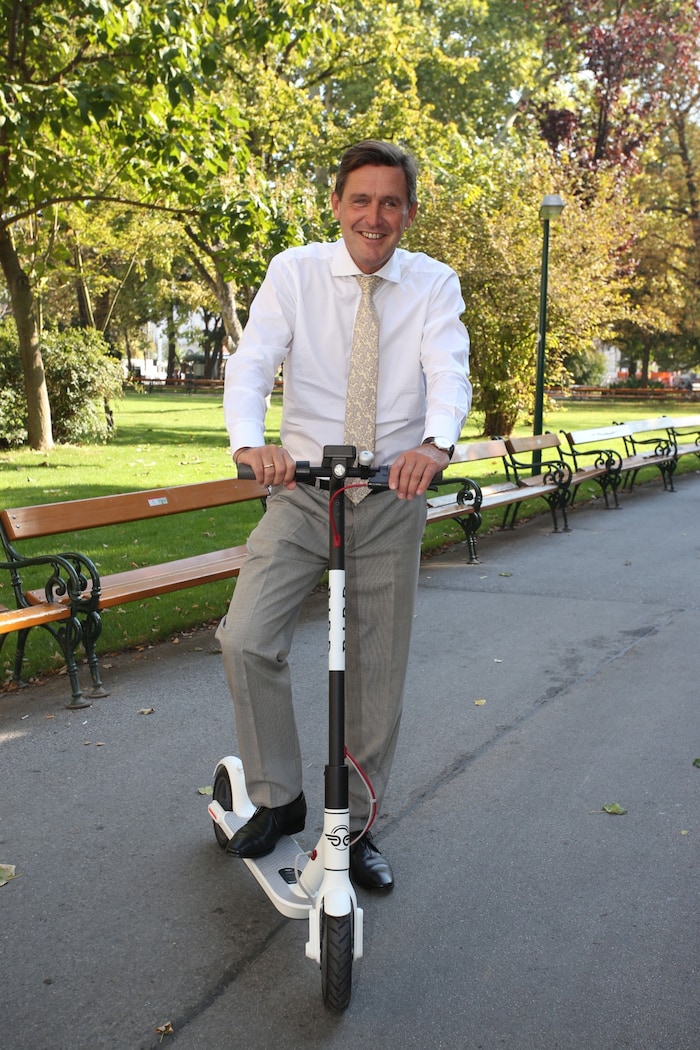
I would then like to put forward for discussion the idea of extending the helmet requirement until the age of majority, that is, until age 18.
Peter Hanke plant weitere Verschärfungen für E-Scooter-Fahrer
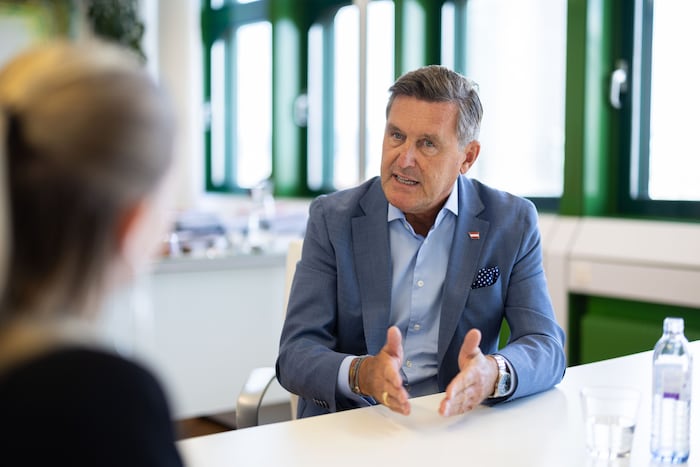
The new e-scooter rules have been in effect for three months now. Is there an initial assessment yet? Have any fines been issued? Have many souped-up scooters been discovered?
There are a lot of inspections. I myself have been present at one or two of them, along with the Minister of the Interior. This is important because a law is only as good as its enforcement. That’s why it’s so important to me that the police conduct consistent checks. We all know there are e-scooters on the road that exceed legal limits. This must be severely curtailed. There are several reports of e-scooter accidents every week. As Minister of Transportation, I will work together with the Minister of the Interior to ensure that this “reckless behavior” is curbed. I also believe—and this is important to me—that I have taken an important step forward with the amendment to the Road Traffic Regulations (StVO). Young people need to be protected. That is why I feel it is important to reiterate: Helmets are mandatory for riders up to age 16, there are new requirements for e-scooter equipment, and the blood alcohol limit has been lowered to 0.5. Mobility is changing, so we must also adapt our behavior. But one thing is particularly important to me: The law has been in effect since May 1. I plan to conduct an initial assessment in the spring of 2027. By then, we’ll have a good year’s worth of experience with the new rules and will be able to assess their impact and determine what conclusions to draw from them. I would then propose extending the helmet requirement until the age of majority—that is, until age 18.
So, further tightening of the rules?
If we see that the new regulations aren’t having a sufficient effect, then I can certainly imagine further tightening of the rules.
There have also been changes to the vehicle inspection sticker. The Greens criticize that the first inspection after four years comes too late and could cause safety issues.
This regulation is also common in many countries internationally. It’s always a question of technology—how new cars are equipped, and which driver-assistance and warning systems are available. A lot has changed in this area over the past few decades. We’ve eliminated the grace period after the sticker expires because it repeatedly caused problems during trips abroad. Many of our neighboring countries do not have this grace period. As a result, Austrians were often fined abroad if their sticker had expired, which is naturally unpleasant. We have therefore ensured that drivers can apply for a sticker renewal as early as four months before it expires. All in all, we’ve found a reasonable solution.
The Danube is currently at an extremely low water level. What are the implications of this?
There are, of course,implications. The Danube is a major transportation route in Austria. It is frequently used as a transport route, particularly in the agricultural and heavy-haul sectors. Due to the low water levels, there are restrictions. Let me remind you: During the last two major droughts in 2003 and 2018, freight volume declined by up to 25 percent. Unfortunately, a decline is also expected this year. The good news is that passenger shipping is generally still operating. The Twin City Liner is also still running from Vienna to Bratislava, even though the navigable channel has been significantly reduced. We currently have a water level of around 1.80 meters to the east and around two meters toward the Wachau region. That is significantly lower than usual. As a result, docking in some parts of the Wachau region is difficult or no longer possible at all. Nevertheless, we have managed to keep the navigation channel open to traffic.
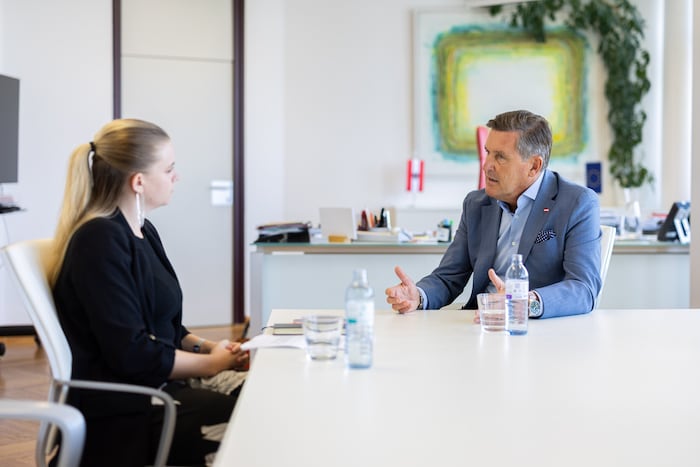
Due to climate change, this will happen more frequently in the future. How do we address this?
In addition to ongoing maintenance work, we’ve been running research programs with viadonau for many years, which we carry out through the Danube Region Strategy in collaboration with the riparian states. There is a pilot project involving flexible infrastructure. The aim is to maintain an adequate navigation channel during low-water periods while also taking environmental aspects into account. viadonau has done pioneering work in this area for all of Europe. Together with the Brigittenau Hydraulics Laboratory, we have provided intensive support for these experiments in recent years. We have allocated 30 million euros annually in the biennial budget. Approximately 17 million go toward maintenance for flood and low-water protection. In addition, we support international cooperation extending all the way to the Black Sea. A Danube Declaration will be signed in Brussels in September. This is intended to further deepen research collaboration and the exchange of information. The overarching goal is to ensure that we have reliable infrastructure available along the entire length of the Danube.
You can’t say we’ve done enough.
SPÖ-Minister Peter Hanke über die Klima-Politik in Österreich
Experts have been calling for more measures, such as river restoration, for years. Has Austria done enough in terms of climate policy?
I believe a great deal has already been done for climate protection, but we still have a long way to go. You can’t say you’ve done enough. We see that the heat and severe storms are taking a toll on people, cities, and agriculture. That’s why we need to take massive countermeasures here. When it comes to road construction, I place great importance on ensuring that ASFINAG creates compensation areas for every square meter of road built. Of course, this is complex and costly, but in my view, it’s absolutely necessary. This is how we show people that we’re serious about climate protection.
One of the biggest points of criticism is land consumption. Road construction contributes significantly to this. Isn’t that a contradiction?
We are a modern society. We won’t get anywhere with extreme positions—climate protection versus the economy or society. We need to consider these areas together. When we see that we have an average of over five hours of traffic congestion daily on the Southeast Bypass, we also know what that means in terms of additional CO₂ emissions—that can’t possibly be what we want. I am fundamentally in favor of using green spaces very sparingly in road construction. But where it is necessary, we must adapt our infrastructure to a modern Austria. This also includes public transportation: We are setting clear priorities for the ÖBB and for rail expansion. By investing 19.5 billion euros over six years, we’re demonstrating our commitment to environmental responsibility. At the same time, however, growing cities also need adequate road connections. The key here is to strike the right balance.
Climate experts are proposing a legal cap on land use. Can you envision that?
I am not a specialist in regional planning, and I do not wish to offer any over-the-top advice here. In principle, I believe we should let the experts have their say so they can prepare sound decision-making frameworks that policymakers can use as a guide.
The Advocate General at the European Court of Justice has largely ruled that the Tyrolean measures at the Brenner Pass violate EU law. What happens next?First and foremost, I want to make it clear: I stand behind the people of Tyrol.I say this quite deliberately. We are familiar with the topography of Tyrol, and we know just how heavy the traffic burden is on the Brenner route. This issue can only be resolved together with our neighbors. Now that the Advocate General has spoken, I would like to await the ECJ’s ruling. After that, we must seek common ground—but not at the expense of the people of Tyrol. With the Brenner Base Tunnel, we have the greatest project of the century ahead of us. At the same time, it’s important that Germany also expand its infrastructure toward Munich. I’m in constant contact with all stakeholders and will hold talks with the new German transportation minister as soon as possible to clearly lay out Austria’s concerns.
This article has been automatically translated,
read the original article here.











Willkommen in unserer Community! Eingehende Beiträge werden geprüft und anschließend veröffentlicht. Bitte achten Sie auf Einhaltung unserer Netiquette und AGB. Für ausführliche Diskussionen steht Ihnen ebenso das krone.at-Forum zur Verfügung. Hier können Sie das Community-Team via unserer Melde- und Abhilfestelle kontaktieren.
User-Beiträge geben nicht notwendigerweise die Meinung des Betreibers/der Redaktion bzw. von Krone Multimedia (KMM) wieder. In diesem Sinne distanziert sich die Redaktion/der Betreiber von den Inhalten in diesem Diskussionsforum. KMM behält sich insbesondere vor, gegen geltendes Recht verstoßende, den guten Sitten oder der Netiquette widersprechende bzw. dem Ansehen von KMM zuwiderlaufende Beiträge zu löschen, diesbezüglichen Schadenersatz gegenüber dem betreffenden User geltend zu machen, die Nutzer-Daten zu Zwecken der Rechtsverfolgung zu verwenden und strafrechtlich relevante Beiträge zur Anzeige zu bringen (siehe auch AGB). Hier können Sie das Community-Team via unserer Melde- und Abhilfestelle kontaktieren.