The end seems near
Bitter tears for Messi: Will it be different this time?
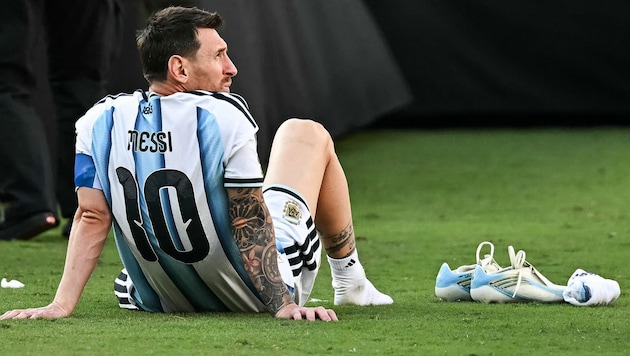

Standing before the massive light blue and white wall, Lionel Messi could no longer hold back his tears. Argentina’s superstar wept after losing the World Cup final, while the fans celebrated him. It was a moving scene. Was it a farewell? There’s a lot to suggest so.
 Kronen Zeitung als bevorzugte Google-Quelle hinzufügen
 Messi left the stadium in East Rutherford without a word after the well-deserved 0–1 loss in extra time to the new world champions, Spain. But all around him, the farewell to the 39-year-old had already begun.
Argentina’s soccer federation, its president, and Messi’s eldest son, Thiago—they all paid tribute to him. So did coach Lionel Scaloni. “He is the best player to ever step onto the field,” said the South American team’s coach about the eight-time World Player of the Year. Everyone is proud of him. But the 48-year-old explained that he hadn’t spoken with Messi about his future.

He is the best player to ever step onto the field.
Lionel Scaloni über Lionel Messi
A short time later, he himself cut the press conference short, in tears. On his way to the team bus parked in front of the stadium, Scaloni stopped several times—wiping his teary eyes again and again.
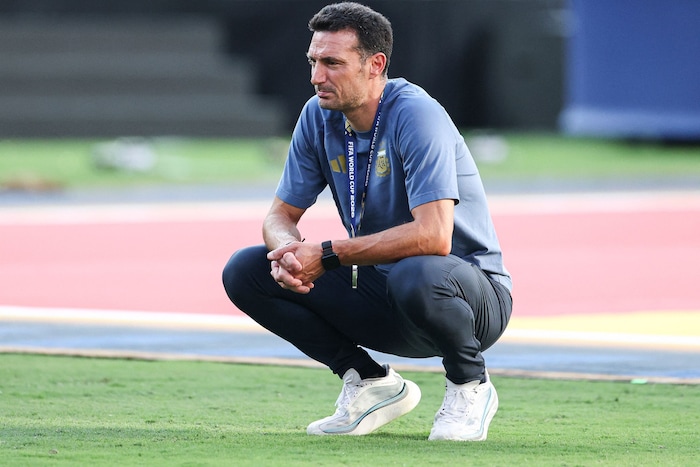
Even before that, Scaloni had raved about his team. “It’s a great team. I hope that future generations will be inspired by it.” Scaloni initially remained tight-lipped about his own future. Recently, there had been reports that the 2022 World Cup-winning coach had agreed with the federation to extend his expiring contract through 2030. He said he would speak with the federation president. “I’m grateful to him for allowing me to be here in this position,” Scaloni said—and wept.
Final Highlights Argentina’s Reliance on Messi
The shattered dream of a title has hit the Argentines hard. Especially Messi, who had led them to the final in the first place. It was largely thanks to this exceptional player that the South Americans nearly repeated their triumph from Qatar four years ago. They were just one win away, having narrowly avoided an early exit in the knockout stage on several occasions. But the final also showed just how dependent the Albiceleste is on its star player. It was downright alarming. Messi was virtually a non-factor against Spain—and Argentina, accordingly, stood no chance.
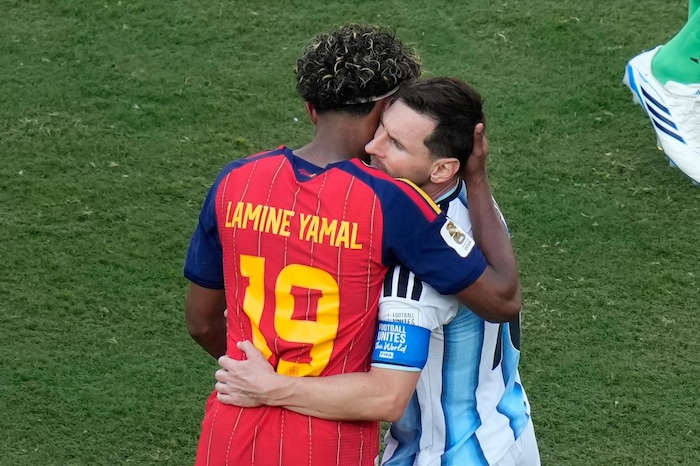
Messi’s 207th international match had just ended when Spain’s youngster Lamine Yamal approached the Argentine captain, who was sitting on the field, completely disillusioned. Messi stood up, and a long embrace followed. It seemed as though one global superstar was now handing the stage over to the other. Nearly 19 years ago, a legendary photo was taken of Messi and Yamal—one already a pro, the other still a baby—together by a small bathtub. Now, after their showdown in the World Cup final, we have new, memorable images. Was this a turning point?
In any case, Claudio Tapia, president of the Argentine Football Association, paid tribute to Messi—who scored eight goals and provided four assists in the tournament—on social media: “There are no words in the dictionary that would be enough to thank you for everything you’ve given us, Captain. Thank you for every moment of joy you’ve etched into our souls, for every tear of pride, and for carrying our flag to the very top of the world. You are immortal, Leo. You are a giant. You’ve made our country the happiest in the world. Thank you for everything. Forever one of us.”
Had already stepped down once after a defeat in East Rutherford
Argentina’s soccer federation also thanked Messi separately for his dedication, for the “magic,” and “for giving it your all until the very last second.” Thiago, the oldest of Messi’s three sons, wrote to his father on Instagram: “We love you, Leo.” He’s the best player of all time. Indeed, Messi has shaped the past two decades like no other soccer player—with the exception of his longtime Portuguese rival, Cristiano Ronaldo. The little boy from Rosario became one of the all-time greats.
Many say that, with his World Cup triumph four years ago, he’s even greater than Argentine soccer legend Diego Maradona, who died in 2020. Add to that his successes at the 2021 and 2024 Copa América, not to mention all the club-level titles—especially during his many years at FC Barcelona—not to mention. Messi has played in six World Cups and scored 125 goals for the national team. By the time the 2030 World Cup rolls around, the magician with the ball would already be 43 years old.
Messi had already retired from the national team once before, in 2016—after the penalty shootout loss to Chile in the Copa América final, which was also held at what is now the World Cup final stadium in East Rutherford. Back then, he was back on the team after just a few weeks. This time, things might be different. Messi’s tears spoke volumes. Argentina’s hero, overwhelmed by the love of an entire nation. In front of the light blue and white wall. The end seems near.
This article has been automatically translated,
read the original article here.











Willkommen in unserer Community! Eingehende Beiträge werden geprüft und anschließend veröffentlicht. Bitte achten Sie auf Einhaltung unserer Netiquette und AGB. Für ausführliche Diskussionen steht Ihnen ebenso das krone.at-Forum zur Verfügung. Hier können Sie das Community-Team via unserer Melde- und Abhilfestelle kontaktieren.
Hinweis in eigener Sache: Das krone.at-Forum präsentiert sich ab sofort in neuem Design! Wir freuen uns über konstruktives Feedback. Damit die Diskussionen in den Kommentarbereichen beim jeweiligen Thema bleiben, können Sie uns Rückmeldungen hier hinterlassen.
User-Beiträge geben nicht notwendigerweise die Meinung des Betreibers/der Redaktion bzw. von Krone Multimedia (KMM) wieder. In diesem Sinne distanziert sich die Redaktion/der Betreiber von den Inhalten in diesem Diskussionsforum. KMM behält sich insbesondere vor, gegen geltendes Recht verstoßende, den guten Sitten oder der Netiquette widersprechende bzw. dem Ansehen von KMM zuwiderlaufende Beiträge zu löschen, diesbezüglichen Schadenersatz gegenüber dem betreffenden User geltend zu machen, die Nutzer-Daten zu Zwecken der Rechtsverfolgung zu verwenden und strafrechtlich relevante Beiträge zur Anzeige zu bringen (siehe auch AGB). Hier können Sie das Community-Team via unserer Melde- und Abhilfestelle kontaktieren.