Protest from Austria
EU Sticks to Plan for 2,500 New Civil Servants Despite Crisis
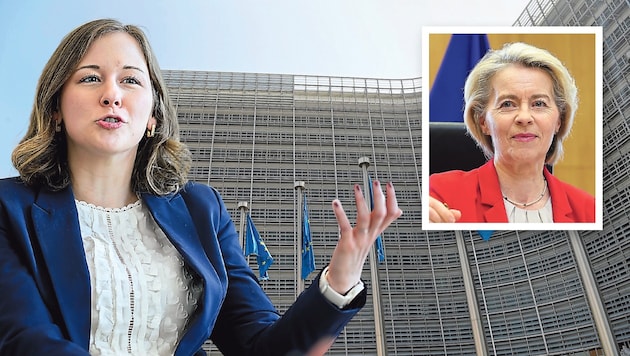

An urgent message from Vienna reached the EU Commission in Brussels about two months ago: European Affairs Minister Claudia Bauer and other counterparts openly criticized the Commission’s plans to hire 2,500 new civil servants. For now, at least, Brussels is not backing down—as can be seen from the reply letter obtained by the “Krone.”
 Kronen Zeitung als bevorzugte Google-Quelle hinzufügen
 Everyone has to cut back—except Brussels. This impression became increasingly apparent when it was revealed that the EU Commission intends to create 2,500 new administrative posts in the next financial framework—while simultaneously increasing administrative spending by nearly 40 percent. Nine net contributor countries, including Austria, strongly opposed this.
European Affairs Minister Claudia Bauer and State Secretary Alexander Pröll (both ÖVP) sent a letter directly to EU Budget Commissioner Piotr Serafin, together with their counterparts from Germany, the Netherlands, Sweden, and other countries. Their appeal: Those who demand reforms and cuts from member states must also start with their own house.
The “Krone” now has the response from Brussels—and it amounts to a slap in the face for all advocates of austerity. Budget Commissioner Piotr Serafin coolly dismisses the criticism. His message: more tasks, more money—and thus, more civil servants. “There is a clear correlation between the amount of funds managed and the staff required to do so,” he states succinctly.
Unstable staffing levels
The crises of recent years—the war in Ukraine, the energy crisis, new EU competences—are simply “no longer compatible with a stable staffing level.” The fact that there are currently around 33,000 Commission staff working for 450 million citizens, and that cuts were even made in the past, is apparently meant to serve as a free pass for the next expansion.
Bauer: “This is about the EU’s credibility”
In Vienna, they won’t stand for that. Bauer counters: “More tasks must not automatically mean more administration. This is exactly where reforms are needed.” And even more clearly: “This is about the EU’s credibility. The strict austerity measures must, of course, also apply internally.” In short: Those who lecture others must first take a good look at themselves.
The minister is not alone in this. Germany, as well as the Nordic and Baltic states, stand united behind the initiative. What began as a polite letter is turning into a full-blown budget dispute. Bauer’s challenge is unmistakable: “Europe needs more efficiency, not more bureaucracy.” It remains to be seen whether this will impress Serafin. The financial framework is supposed to be in place by mid-2027—until then, negotiations will continue over the addition of some 2,500 new civil servants.
This article has been automatically translated,
read the original article here.











Willkommen in unserer Community! Eingehende Beiträge werden geprüft und anschließend veröffentlicht. Bitte achten Sie auf Einhaltung unserer Netiquette und AGB. Für ausführliche Diskussionen steht Ihnen ebenso das krone.at-Forum zur Verfügung. Hier können Sie das Community-Team via unserer Melde- und Abhilfestelle kontaktieren.
User-Beiträge geben nicht notwendigerweise die Meinung des Betreibers/der Redaktion bzw. von Krone Multimedia (KMM) wieder. In diesem Sinne distanziert sich die Redaktion/der Betreiber von den Inhalten in diesem Diskussionsforum. KMM behält sich insbesondere vor, gegen geltendes Recht verstoßende, den guten Sitten oder der Netiquette widersprechende bzw. dem Ansehen von KMM zuwiderlaufende Beiträge zu löschen, diesbezüglichen Schadenersatz gegenüber dem betreffenden User geltend zu machen, die Nutzer-Daten zu Zwecken der Rechtsverfolgung zu verwenden und strafrechtlich relevante Beiträge zur Anzeige zu bringen (siehe auch AGB). Hier können Sie das Community-Team via unserer Melde- und Abhilfestelle kontaktieren.