“No question about it...”
Food prices are likely to rise even further soon
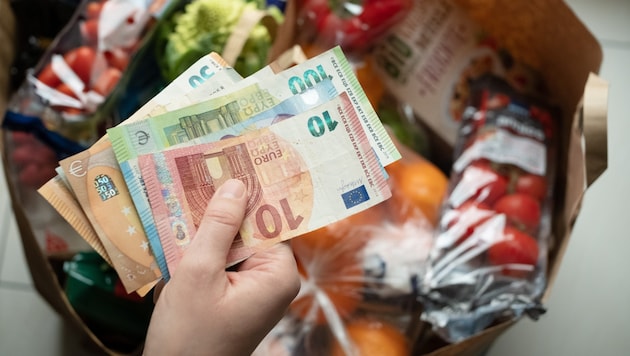

Higher energy costs due to the war in the Middle East are likely to soon affect our food prices as well. “Prices will rise—no question about it,” warns Stephan Büttner, chairman of the domestic food industry at the Chamber of Commerce. The only open question is how steep the increase will be.
 Kronen Zeitung als bevorzugte Google-Quelle hinzufügen
 Geopolitical crises, rising costs, and increasing regulation—the domestic food industry is under massive pressure. Rising energy prices are currently having the most significant impact. They are not only driving up production costs but also significantly increasing the costs of transportation and packaging. “What do you think are the main costs for a transportation company? Fuel,” says Büttner. If fuel prices rise by 30 or 40 percent, passing those costs along the supply chain is inevitable.
The first effects are already becoming apparent. For instance, container shipping costs have skyrocketed in a very short time. In addition, energy-intensive products such as glass, aluminum, and plastic have become more expensive. Even packaging materials (such as plastic film) have, in some cases, doubled in price. Fertilizers for agriculture have also become significantly more expensive. About a third of global demand comes via the Strait of Hormuz, which is currently blocked.
All these developments are affecting the entire industry. “This ripples through the entire supply chain, from raw materials to the finished product,” says Büttner. What is particularly critical is that many of these cost increases are beyond the control of companies: energy, raw materials, and global logistics are external factors.
Inflation comes from outside—and affects food with a delay
Katharina Koßdorff, managing director of the German Food Industry Association, also emphasizes that this is a case of “imported inflation.” Recently, food prices themselves have even slowed inflation to some extent—but that is likely to change. Many costs take time to filter through. Energy prices first affect transportation and production before becoming visible in the supermarket. “This is gradually making its way into the market,” says Büttner.

Industry Losing Competitiveness
The situation for domestic food producers is already tense. Production volume has stagnated at around 12 billion euros for the past three years. At the same time, however, costs have risen massively. Wages alone have gone up by around 25 percent.
“We are losing our price competitiveness,” says Koßdorff. This is also evident in foreign trade: export volumes are declining, while the trade deficit in the agricultural sector has risen significantly.
Industry claims policy is exacerbating the situation
Industry representatives view current political measures with particular concern. They are especially critical of the planned margin controls across the entire food supply chain—from agriculture to retail. Companies would be required to disclose their margins and could face sanctions for “excessive” profits. Büttner: “That would be an unprecedented intervention in the market economy. Who would still invest under such conditions?”

We are losing our price competitiveness.

Katharina Koßdorff, Fachverband der Lebensmittelindustrie in der WKO
Bild: Foto Wilke
There is also criticism of the planned plastic tax, which is to be paid by companies in the future (rather than from the general tax pool) and will simultaneously be increased by 50 percent. It is particularly problematic that products already subject to a plastic deposit are also to be included. “This hits precisely those who have already invested in recycling,” says Koßdorff.
No options to absorb increased costs internally
According to the industry, the ability to absorb the higher costs internally has largely been exhausted. “In recent years, we’ve implemented enough cost-cutting programs,” says Büttner. Further measures would inevitably cut into the company’s core operations—for example, through staff reductions or a freeze on investments. At the same time, many companies have had difficult years. Particularly in certain sectors, such as sugar production, there have been significant losses. “No one came knocking and said, ‘We’ll make up for that,’” notes Büttner, who is also CEO of the sugar giant Agrana.
Threat of Relocation Abroad
If the framework conditions in Austria do not change, there is a risk of companies relocating abroad. “One has to wonder how long companies will put up with this,” warns Büttner. Production can also take place in other countries—especially for standardized products. However, the experiences from the pandemic have shown how important a functioning domestic food production sector is.
Next Weeks and Months Will Be Decisive
The coming weeks and months will determine exactly how food prices develop. But one thing is already clear to the industry: price increases cannot be avoided. The only question remaining is how steep they will be and how long they will last.
This article has been automatically translated,
read the original article here.











Willkommen in unserer Community! Eingehende Beiträge werden geprüft und anschließend veröffentlicht. Bitte achten Sie auf Einhaltung unserer Netiquette und AGB. Für ausführliche Diskussionen steht Ihnen ebenso das krone.at-Forum zur Verfügung. Hier können Sie das Community-Team via unserer Melde- und Abhilfestelle kontaktieren.
Hinweis in eigener Sache: Schon bald erwartet Sie auf krone.at ein rundum erneuerter Forenbereich mit vielen neuen Features! Mehr Informationen finden Sie hier.
User-Beiträge geben nicht notwendigerweise die Meinung des Betreibers/der Redaktion bzw. von Krone Multimedia (KMM) wieder. In diesem Sinne distanziert sich die Redaktion/der Betreiber von den Inhalten in diesem Diskussionsforum. KMM behält sich insbesondere vor, gegen geltendes Recht verstoßende, den guten Sitten oder der Netiquette widersprechende bzw. dem Ansehen von KMM zuwiderlaufende Beiträge zu löschen, diesbezüglichen Schadenersatz gegenüber dem betreffenden User geltend zu machen, die Nutzer-Daten zu Zwecken der Rechtsverfolgung zu verwenden und strafrechtlich relevante Beiträge zur Anzeige zu bringen (siehe auch AGB). Hier können Sie das Community-Team via unserer Melde- und Abhilfestelle kontaktieren.