"Bibi" vs. Eisenkot
Netanyahu Now Faces an Uncertain Future
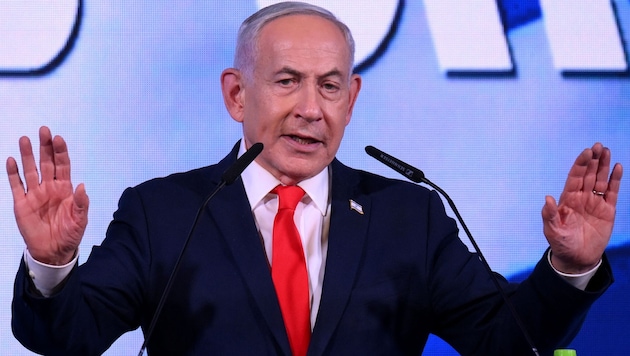


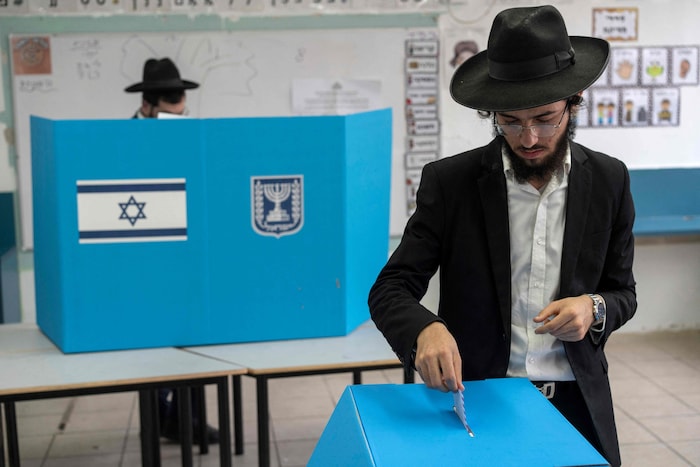
Polling stations in Israel closed at 9 p.m. (CET) on Tuesday evening following record turnout. Initially, all three of the country’s major television networks had projected that the opposition camp led by Gadi Eisenkot would be ahead of Benjamin “Bibi” Netanyahu’s coalition. A few hours later, however, the picture changed dramatically.
 Kronen Zeitung als bevorzugte Google-Quelle hinzufügen
In Israel’s parliamentary election, Benjamin Netanyahu’s camp has lost its majority according to projections, yet the prime minister remains confident of victory: Over the course of the night, his camp steadily gained ground. A stalemate began to emerge. According to the television station N12, after just over 10 percent of the votes had been counted, the Netanyahu camp actually held 52 of the 120 seats in the Knesset—three seats ahead of the Eisenkot camp. Netanyahu’s coalition, which had most recently relied on far-right and ultra-Orthodox parties, had won 64 seats in the last election at the end of 2022.
“Loss of confidence in the Netanyahu government
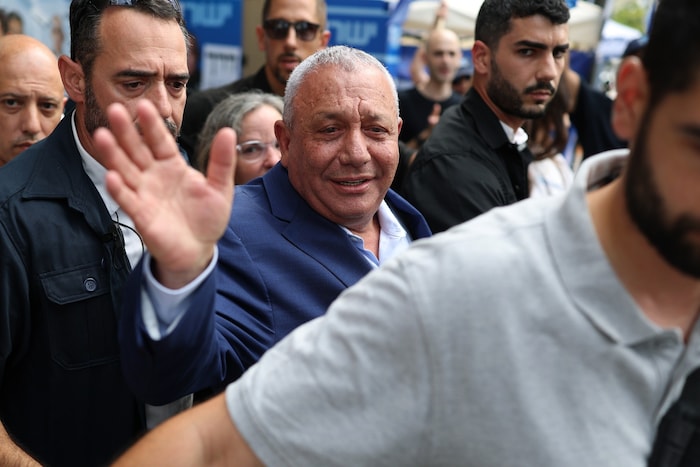
Eisenkot called on Netanyahu to resign, arguing that his coalition had “lost the confidence of the people.” Netanyahu, however, said the election had shown that the right-wing camp held a clear majority among the Jewish population. He added that it was necessary to wait for the final vote count.
To form a government, Eisenkot would need the support of Arab parties, which made significant gains. They could either serve as coalition partners or tolerate a minority government. Mathematically speaking, the opposition could also form a government with the help of the Arab parties. However, not all factions within the opposition camp are willing to do so.
Netanyahu called for the formation of a strong right-wing government. “We must not form a government that relies on Arab, anti-Zionist parties,” he said. He accused the Arab parties of agitating against Israel’s existence, describing the Palestinian terrorist organization Hamas as a charitable organization, and denigrating Israeli soldiers as war criminals.
At the same time, Netanyahu warned that the threat posed by arch-enemy Iran has not yet been averted. “As long as the fanatical regime exists, they will continue to try to destroy us.” Together with the U.S., Israel must “eliminate this threat once and for all.” Since last year, Israel and the U.S. have already waged two wars against Iran; the most recent one began with their attacks in February.
There is speculation as to whether the imminent start of a new war against the Islamic Republic is now to be expected. The “Wall Street Journal” reported, citing informed sources, that the U.S. had called on several Arab Gulf states to prepare for a short, intense military operation following the U.S. midterm elections, which are scheduled for November 3.
Will war with Iran break out again?
U.S. President Donald Trump has not yet made a final decision, but is leaning toward a large-scale attack after the midterm elections, the U.S. newspaper reported, citing people familiar with his thinking. A joint attack with ally Israel could, according to the report, target Iran’s infrastructure and nuclear facilities. An alternative would be to attempt to reach an agreement with the leadership in Tehran. However, diplomatic efforts by regional mediators have so far failed to bear fruit.
Israel Could Face a New Prolonged Crisis
If efforts to form a government fail, Netanyahu could initially remain in office at the head of a transitional government. Israel would thus face the threat of a prolonged political crisis marked by a succession of parliamentary elections, as the country has experienced in the past. Between 2019 and 2022, Israelis went to the polls five times because no stable majorities could be formed.
Another political deadlock could paralyze the country for months. Moreover, even three years after the start of the Gaza War, many conflicts in the region remain unresolved, and Israel faces major security challenges, particularly with regard to its arch-enemy, Iran.
“Krone” Background
The election campaign in Israel was dominated by the Hamas terrorist attack on October 7, 2023, and its aftermath—security was the only relevant issue. Even before the election, a neck-and-neck race had emerged between incumbent Prime Minister Netanyahu and his main rival, former Army Chief Eisenkot. On one side, then, are those who see long-time Prime Minister Netanyahu and his uncompromising approach as the only guarantee of Israel’s security. On the other side are those who accuse Netanyahu of failure and hold him partly responsible for the fact that the Hamas attack was able to happen in the first place. And then there are those who, after a good two decades of Netanyahu, have simply had enough of him.
High Voter Turnout – A Divided Society
The parliamentary election mobilized Israeli voters more strongly than at any time in recent memory. According to the Central Elections Committee, voter turnout stood at 77.7 percent, reaching its highest level since 1999. This high turnout underscores the importance many Israelis attach to the first parliamentary election since the devastating Hamas massacre of October 7, 2023, and the subsequent war in Gaza.
In addition to the security situation, the campaign was dominated by the future of Israeli democracy, the controversial judicial reform, the dispute over mandatory military service for ultra-Orthodox Jews, and Netanyahu’s personal responsibility for the Hamas terrorist attack on October 7. Israeli society is deeply divided on all these issues, and they have all sparked ongoing mass protests.

Tension as votes are counted through Wednesday
The votes of hundreds of thousands of Israeli soldiers and reservists are counted one day later, starting on Wednesday. This voter group is believed to strongly support right-wing parties.
Preliminary final results are expected on Thursday. The official results are scheduled to be released eight days after the election. Afterward, President Isaac (Yitzhak) Herzog will task the candidate deemed most likely to succeed with forming a government. That candidate will initially have four weeks to form a coalition.
This article has been automatically translated,
read the original article here.










Willkommen in unserer Community! Eingehende Beiträge werden geprüft und anschließend veröffentlicht. Bitte achten Sie auf Einhaltung unserer Netiquette und AGB. Für ausführliche Diskussionen steht Ihnen ebenso das krone.at-Forum zur Verfügung. Hier können Sie das Community-Team via unserer Melde- und Abhilfestelle kontaktieren.
Hinweis in eigener Sache: Das krone.at-Forum präsentiert sich ab sofort in neuem Design! Wir freuen uns über konstruktives Feedback. Damit die Diskussionen in den Kommentarbereichen beim jeweiligen Thema bleiben, können Sie uns Rückmeldungen hier hinterlassen.
User-Beiträge geben nicht notwendigerweise die Meinung des Betreibers/der Redaktion bzw. von Krone Multimedia (KMM) wieder. In diesem Sinne distanziert sich die Redaktion/der Betreiber von den Inhalten in diesem Diskussionsforum. KMM behält sich insbesondere vor, gegen geltendes Recht verstoßende, den guten Sitten oder der Netiquette widersprechende bzw. dem Ansehen von KMM zuwiderlaufende Beiträge zu löschen, diesbezüglichen Schadenersatz gegenüber dem betreffenden User geltend zu machen, die Nutzer-Daten zu Zwecken der Rechtsverfolgung zu verwenden und strafrechtlich relevante Beiträge zur Anzeige zu bringen (siehe auch AGB). Hier können Sie das Community-Team via unserer Melde- und Abhilfestelle kontaktieren.