Data Blind Spot
Communities Are Running Out of Water, but There’s No Clear Picture
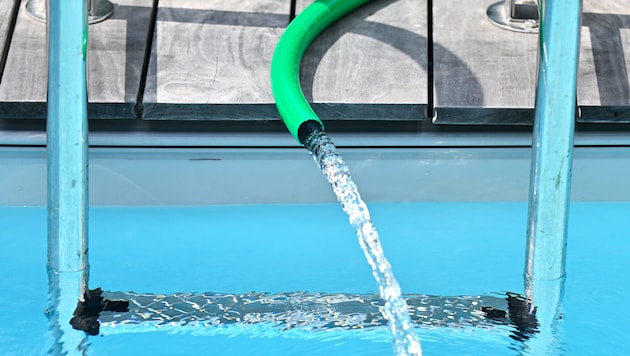

The ongoing drought is pushing local water supply systems to their limits. For the most part, efforts still rely on voluntary action—according to “Krone” research, 111 municipalities have already called for water conservation—and in some isolated cases, bans have even been imposed. Yet neither the federal government nor the states know exactly where specific measures are in effect.
 Kronen Zeitung als bevorzugte Google-Quelle hinzufügen
 Austria sits on a vast water treasure. At least, normally. After weeks of heat and barely any substantial rain, it is now becoming clear that even this treasure is not available everywhere and at all times in unlimited quantities. Although there is no official figure on how many municipalities have implemented conservation measures (see below for more on this), *Krone*’s research shows that people in at least 111 municipalities are already being urged to use this precious resource sparingly.
In Pöggstall, the mere threat was enough
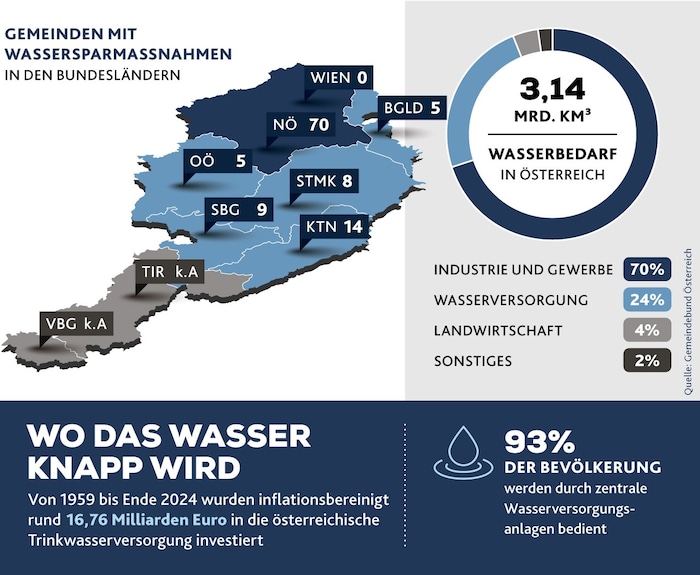
Lower Austria is the hardest hit—due to its size. Around 70 municipalities are urging residents to refrain from watering lawns, washing cars, and filling pools. Only the municipality of Weinzierl am Walde issued a legally binding ordinance. Pöggstall briefly threatened to shut off the drinking water supply between 10 p.m. and 4 a.m.—the threat worked, and consumption dropped.
In Salzburg, authorities are relying on voluntary compliance. In Koppl, Seeham, Anthering, Hallwang, Eugendorf, Dorfbeuern, and Berndorf, not a single liter should be wasted. St. Georgen and Puch also published similar appeals from their water cooperatives.
The measures are stricter in Carinthia. In Köttmannsdorf, Gurk, Griffen, Steuerberg, and Klein St. Paul, water conservation has even been mandated by law—meaning that violations are subject to fines. In addition, the entire Wolfsberg district is participating in a joint call for conservation.
Fountains and Nighttime Drinking Water Shut Off
In Bad Tatzmannsdorf, Burgenland, public fountains were also shut off as a conservation measure. In the Styrian municipality of Gaishorn, drinking water had to be shut off at night in July so that elevated storage tanks could refill. In Vienna, however, no restrictions are currently in place. “The water supply is fully guaranteed,” the city administration reports.
The Upper Austrian Drinking Water Authority recently received around 40 reports from utilities experiencing problems. However, the state does not know exactly how many municipalities are actually affected—though at least five municipalities have publicly appealed for water conservation. Vorarlberg and Tyrol were unable to provide specific details.
Data Gap: No One Knows Exactly Where Measures Are in Effect
And Upper Austria is not alone in this. There is actually no shortage of data on Austria’s water resources: water levels, precipitation amounts, and groundwater reserves are continuously measured, analyzed, and published—for example, on the government portal eHYD. Around 700 monitoring stations provide up-to-date readings, and data is collected at several thousand locations in total.
Added to this are the ministry’s water balance reports, the Austrian Water Information System, and European drought maps. Yet no one can fully answer a seemingly simple question: Where do people need to conserve water right now? There is no central, continuously updated overview of municipal appeals, restrictions, and bans.
“I’ll have to refer you to the federal states”—and they pass the buck
Neither the responsible ministry (“Unfortunately, I have to refer you to the federal states”) nor the individual states: “The state does not have comprehensive data on all municipal water supply systems,” says Tyrol, for example. The state of Upper Austria explains that “shortages in volume” do not have to be reported. And in Vorarlberg, too, “responsibility for water supply lies with the municipalities.” Thus, responsibility shifts from the federal government to the states and from there on to the municipalities and water suppliers.
In its investigation, the “Krone” identified 111 municipalities where measures were implemented—most of them in Lower Austria:
“Not a Land of Constant Restrictions”
Incidentally, Johannes Pressl, president of the Association of Municipalities, speaks out against permanent bans: “In Austria, we have always been a land of possibilities, not a land of constant restrictions,” said the municipal representative, who would rather see fewer losses due to old pipes, new wells, and emergency connections between suppliers.
This article has been automatically translated,
read the original article here.











Willkommen in unserer Community! Eingehende Beiträge werden geprüft und anschließend veröffentlicht. Bitte achten Sie auf Einhaltung unserer Netiquette und AGB. Für ausführliche Diskussionen steht Ihnen ebenso das krone.at-Forum zur Verfügung. Hier können Sie das Community-Team via unserer Melde- und Abhilfestelle kontaktieren.
User-Beiträge geben nicht notwendigerweise die Meinung des Betreibers/der Redaktion bzw. von Krone Multimedia (KMM) wieder. In diesem Sinne distanziert sich die Redaktion/der Betreiber von den Inhalten in diesem Diskussionsforum. KMM behält sich insbesondere vor, gegen geltendes Recht verstoßende, den guten Sitten oder der Netiquette widersprechende bzw. dem Ansehen von KMM zuwiderlaufende Beiträge zu löschen, diesbezüglichen Schadenersatz gegenüber dem betreffenden User geltend zu machen, die Nutzer-Daten zu Zwecken der Rechtsverfolgung zu verwenden und strafrechtlich relevante Beiträge zur Anzeige zu bringen (siehe auch AGB). Hier können Sie das Community-Team via unserer Melde- und Abhilfestelle kontaktieren.