Is this happening to you, too?
New Scandal! ORF Cuts Off 64,000 License Fee Payers
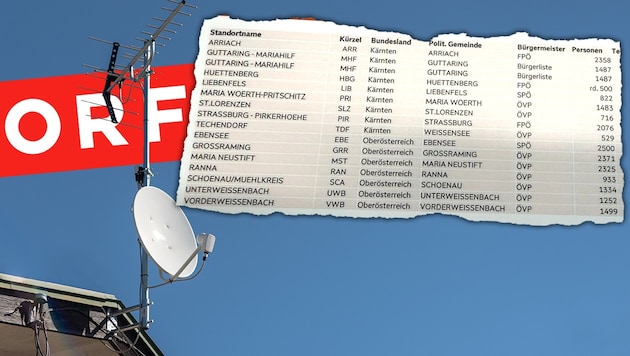

The string of ORF scandals continues: 64,000 mandatory license fee payers will simply have their TV and radio service cut off by the end of the year. Instead of cutting costs by reducing top salaries, the public broadcaster is shutting down terrestrial reception stations that transmit via antennas. Viewers and listeners, however, are still expected to dutifully continue paying their license fees. Check for yourself whether your town is also on the secret list of stations to be cut off.
 Kronen Zeitung als bevorzugte Google-Quelle hinzufügen
 Cutting off the signal! This is the latest controversy in the long list of scandals plaguing the media giant, which has been severely tarnished in the public eye. Specifically, it concerns the so-called “shutdown plan” implemented in several phases by the Technical Directorate. What this means is that public broadcasting is simply cutting off service to eight federal states.
Public broadcasters have a legal mandate to provide service
So the current slogan “ORF for Everyone” does not apply to many people. As the FPÖ has revealed, MUX A and FM systems for television and radio (see info box below) are affected. And this is despite the fact that, according to the ORF Act, public broadcasting actually has a universal service obligation to distribute its programs via terrestrial transmission as well.
Furthermore, the ORF and its subsidiaries must, within the limits of their technical capabilities—and, of course, for an appropriate fee—allow private radio stations and multiplex operators to share the use of the transmission facilities.
Cuts are being made in all federal states—except Vienna
Back to the secret cost-cutting plan. The list of cuts—which is being implemented in four phases—already began with the so-called “Phase 0” as a test in May in Upper Austria. According to reports, 2,500 viewers and listeners were the first guinea pigs. On August 18, the reduction in transmission sites will continue, also in Upper Austria and Carinthia. There, 23,700 mandatory license fee payers will be affected.
- Terrestrisches Fernsehen läuft über Zimmer- und Dachantennen.
- Im Radiobereich wird der Umstieg von UKW-Frequenzen auf Digitalempfang vorangetrieben.
- MUX A oder Mulitplex A ist das nationale terrestrische Sendernetz in Österreich für den digitalen Antennenempfang (DVB-T2). Es wird von der ORS (Österreichische Rundfunksender) betrieben und strahlt unverschlüsselt bzw. kostenfrei öffentlich-rechtliche Programme des ORF sowie ausgewählte Radiosender aus.
- Die ausgestrahlten TV-Programme sind: ORF 1 HD, ORF2 HD (mit Bundesländervarianten der jeweiligen Landesstudios), ORF III HD, ORF SPORT+ und 3sat HD.
- Um MUX A empfangen zu können, braucht der Haushalt ein DVB-T2-fähiges Empfangsgerät mit ORF-Karten, die man bei der Umstellung auf Digital damals auch extra zahlen musste.
- Ein UKW-Sender (Ultrakurzwelle) strahlt analoge Audiosignale über Frequenzmodulation (FM) aus. Er dient der drahtlosen Übertragung von Hörfunkprogrammen an klassische Radioempfänger. Alle Sender strahlen ihr Programm so aus.
Next, in September, Styrian municipalities will follow; Lower Austria will be affected in October; and in November, the “Green Mark” region, along with Tyrol and Vorarlberg, will be next. All in all, the transmitters will be shut down for nearly 64,000 Austrians who receive TV and radio via in-home antennas. In total, almost one-fifth of the network will be decommissioned. All federal states are affected—except Vienna.
You can check here yourself whether and when your municipality will be affected:
No Warnings Possible in the Event of a Disaster
In addition to the blank screen on the TV, this has particularly dangerous consequences for ORF listeners. In the event of a disaster, the Civil Defense Association always asks people to turn on the radio. This is because federal and state warning centers relay their information—some of which is life-saving—to public broadcasters for transmission.
As is well known, in the event of a blackout—in addition to a flashlight and canned food supplies—a battery-powered radio that doesn’t rely on electricity is also recommended. This is because, in an emergency, only such a radio works via FM reception. However, by ceasing broadcasts, the state-run radio station is simply depriving tens of thousands of Austrians of this vital warning tool.
The cuts aren’t being made at Küniglberg, but at the transmission tower in the valley
For Christian Hafenecker, Secretary-General of the Freedom Party, this is the ORF’s next major transgression: “On August 11, the Board of Trustees meets, discusses more funding, and hands out thirteen top positions. A week later, the transmitters in Carinthia and Upper Austria go dark. They’re cutting costs at the transmission tower in the valley, but handing out positions at Küniglberg.”

The ORF is sacrificing Austria’s last crisis-proof warning system—and no one even bothered to inform the affected communities.
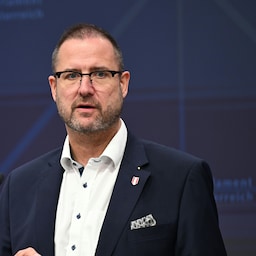
FPÖ-Generalsekretär Christian Hafenecker
Bild: APA/HELMUT FOHRINGER
Once again, the Freedom Party heavyweight is calling for the abolition of the mandatory license fee. The Freedom Party leader is also upset that the federal capital is exempt. “People living in rural areas pay exactly the same 15.30 euros as residents of downtown Vienna—but starting this fall, they won’t receive a signal anymore. Same mandatory fee, half the service. Under this system, rural areas are apparently just payers now, no longer part of the audience,” he criticized.
Hundreds of thousands continue to use technology on ORF’s “sidelined” service
The public broadcaster justifies the cancellation of terrestrial broadcasts by arguing that hardly anyone uses terrestrial TV anymore. This isn’t true: Five percent of Austrians use this technology, and eight percent when including secondary devices—that’s hundreds of thousands of customers.
According to the FPÖ, the argument that satellite and streaming are substitutes also falls flat. Both require electricity, and streaming additionally requires broadband, which is spotty precisely in these valleys. And both, of course, cost households money: satellite dishes, receivers, equipment, and contracts. “The ORF is cutting costs, but citizens are paying twice.” Ultimately, they say, cuts are being made in the wrong places: not among the expensive executives, committees, and perks at ORF headquarters.
Secret List Revealing Mayors’ Party Affiliations
Another concerning aspect of the revealed cut list “for technical optimization” is that, in addition to the municipalities, the mayors’ party affiliations are also listed. The ÖVP is by far the most affected, but so are the Citizens’ Lists. Local leaders from the FPÖ and SPÖ are more of an exception.
This article has been automatically translated,
read the original article here.











Willkommen in unserer Community! Eingehende Beiträge werden geprüft und anschließend veröffentlicht. Bitte achten Sie auf Einhaltung unserer Netiquette und AGB. Für ausführliche Diskussionen steht Ihnen ebenso das krone.at-Forum zur Verfügung. Hier können Sie das Community-Team via unserer Melde- und Abhilfestelle kontaktieren.
User-Beiträge geben nicht notwendigerweise die Meinung des Betreibers/der Redaktion bzw. von Krone Multimedia (KMM) wieder. In diesem Sinne distanziert sich die Redaktion/der Betreiber von den Inhalten in diesem Diskussionsforum. KMM behält sich insbesondere vor, gegen geltendes Recht verstoßende, den guten Sitten oder der Netiquette widersprechende bzw. dem Ansehen von KMM zuwiderlaufende Beiträge zu löschen, diesbezüglichen Schadenersatz gegenüber dem betreffenden User geltend zu machen, die Nutzer-Daten zu Zwecken der Rechtsverfolgung zu verwenden und strafrechtlich relevante Beiträge zur Anzeige zu bringen (siehe auch AGB). Hier können Sie das Community-Team via unserer Melde- und Abhilfestelle kontaktieren.