Interview with the Chancellor
Stocker: “In the event of a conflict, we too will become a target”
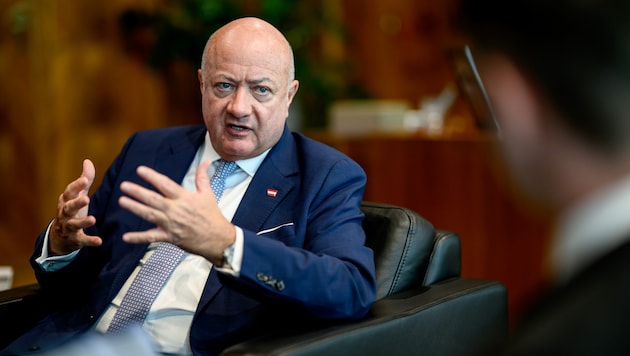

Chancellor Christian Stocker (ÖVP) wants to work with his party colleague Klaudia Tanner to strengthen Austria’s defense capabilities. Neither neutrality nor our NATO neighbors would protect us in times of drone threats, he explains in an interview with “Krone.”
 Kronen Zeitung als bevorzugte Google-Quelle hinzufügen
 “Krone”: Mr. Chancellor, do you actually still remember the Spannocchi Doctrine?
Christian Stocker: Of course I remember it, from the ’70s and ’80s. That was the concept of area defense back then.
This defense strategy against both the Soviets and NATO served as a guiding principle for our entire national defense for decades. Do we lack such a roadmap today?
We will definitely need something like that. The current security strategy is currently being updated. The threats have changed, and the responses to them must be more comprehensive. This also includes the issue of extending military service and mandatory militia drills.
What has changed, then?
War itself. Drones were not yet part of the Spannocchi Doctrine, but they have since become a key technology. In addition, individual states now control reconnaissance data and communication channels. Satellite sovereignty is a new dimension. Added to this are hybrid threats and terrorism aimed at destabilizing democracies.
Do the historically established alliances no longer help in this regard?
The transatlantic relationship no longer offers the security that many have relied on in the past. This means, especially for a militarily neutral country in the heart of Europe, that we must rethink our security architecture.
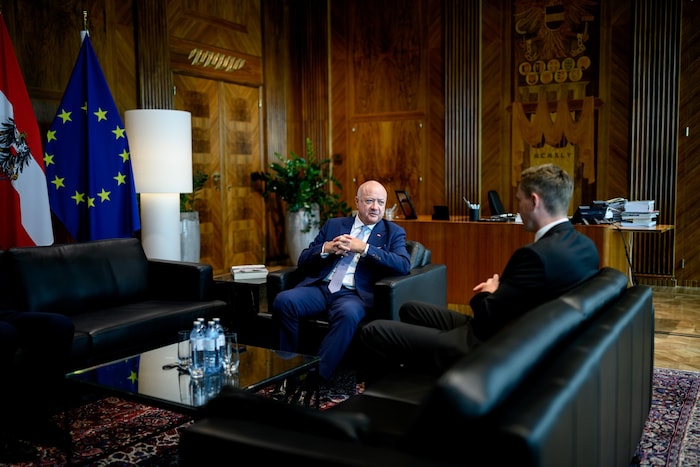
In which direction?
We must not be a blind spot in Europe’s defense landscape. Anyone who looks at the developments of recent months can see how important joint procurement and the Sky Shield air defense program are. This is fully in line with our neutrality. The same applies to the mutual assistance obligation in Europe. It was triggered once, following the terrorist attack in France. At that time, we deployed Austrian soldiers to relieve French contingents in Mali so that they could return home to assist in France. We have always made our contribution, even as a neutral country.
We’re not free riders?
No, currently around 170 Austrian blue helmets are serving in a highly dangerous environment in Lebanon. The same applies in Bosnia and Herzegovina. We will not be free riders in the future either. Instead, we will make our contribution within the framework of neutrality and our existing laws.
The new threats you’re talking about—the ones that are supposed to be incorporated into the new security strategy—are all already included in the risk assessment, the National Defense Report, and the development plan. What are we waiting for?
It is good that they are all accounted for there, because that is the compass for our actions. What you say is correct, but now we must bring the development plan to life step by step, and we must do so at a time of limited budgetary resources. One thing is certain: we must do more for our defense and the defense of Europe than we have in the past.
In the past, these development plans—even under Spannocchi—were often implemented in the Grillparzer style: half-hearted efforts were made with half the resources to achieve half the goals. Why should it be any different this time?
The goal is certainly that we do not follow the Grillparzer path this time. Because we must also bid farewell to a convenient untruth: “Neutrality protects us.” For that is not the case. Nor does the fact that we are surrounded by NATO countries protect us. We see that drones can cross borders very quickly. On top of that, Austria lies at the crossroads of transport routes through Europe. This means that in the event of a conflict, we automatically become a target. And we must have answers to that.
Is one of them to extend military service?
The Commission has presented a clearly preferred model here with 8+2 months of service. I find that very appealing. Civilian service must be taken into account, so a two-thirds majority is required for the decision. I hear that positions in Parliament are converging, but we are not there yet.
What contribution should women make?
A voluntary one.
Do you still intend to hold a referendum?
I still believe it is a good idea to involve the public in the issue of military service. We do not yet have a majority in Parliament. Against this backdrop, a referendum can be a very effective tool for quickly bringing clarity to the matter. In any case, the goal is to introduce a new conscription model on January 1, 2027.
This article has been automatically translated,
read the original article here.











Willkommen in unserer Community! Eingehende Beiträge werden geprüft und anschließend veröffentlicht. Bitte achten Sie auf Einhaltung unserer Netiquette und AGB. Für ausführliche Diskussionen steht Ihnen ebenso das krone.at-Forum zur Verfügung. Hier können Sie das Community-Team via unserer Melde- und Abhilfestelle kontaktieren.
User-Beiträge geben nicht notwendigerweise die Meinung des Betreibers/der Redaktion bzw. von Krone Multimedia (KMM) wieder. In diesem Sinne distanziert sich die Redaktion/der Betreiber von den Inhalten in diesem Diskussionsforum. KMM behält sich insbesondere vor, gegen geltendes Recht verstoßende, den guten Sitten oder der Netiquette widersprechende bzw. dem Ansehen von KMM zuwiderlaufende Beiträge zu löschen, diesbezüglichen Schadenersatz gegenüber dem betreffenden User geltend zu machen, die Nutzer-Daten zu Zwecken der Rechtsverfolgung zu verwenden und strafrechtlich relevante Beiträge zur Anzeige zu bringen (siehe auch AGB). Hier können Sie das Community-Team via unserer Melde- und Abhilfestelle kontaktieren.