A clear warning
Trump backs down, Xi threatens the U.S. with war rhetoric
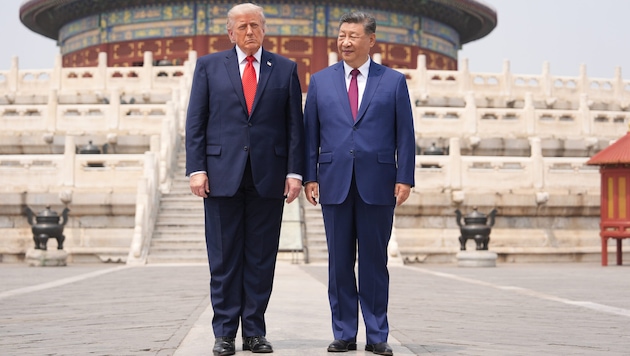

What these two men discuss has consequences for the entire globe! U.S. President Donald Trump and his counterpart Xi Jinping exchanged pleasantries in Beijing—and clearly staked out their geopolitical positions.
 Kronen Zeitung als bevorzugte Google-Quelle hinzufügen
 China’s head of state and party leader Xi Jinping and U.S. President Donald Trump began their highly anticipated talks in Beijing on Thursday. During the public portion of the meeting, the Republican in particular appeared remarkably subdued and flattered his “friend” Xi incessantly.
The U.S. and China have a “fantastic” shared future, Trump said at the start of the talks. The U.S. president praised his host as a “great leader.” “Sometimes people don’t like it when I say that, but I say it anyway because it’s true,” Trump continued. “It is an honor to be your friend.”
Xi endured Trump’s praise with his usual stoicism—and struck a tougher tone himself. He said he was convinced that the shared interests between the U.S. and China outweighed their differences. However, the Chinese president immediately followed this by threatening his guest with a war metaphor.
Beijing threatens the U.S. with war metaphor
Xi raised the question of whether China and the U.S. could create a “new model for relations between major powers.” In doing so, he addressed the “Thucydides Trap,” named after a historian of ancient Greece. This refers to the danger that an emerging power and an established leading power could fall into a dangerous rivalry.
To explain: American political scientist Graham Allison coined the analogy. In a book published several years ago, the Harvard professor alluded to the rivalry between Athens and Sparta and applied it to the rivalry between Washington and Beijing.
The ancient historian Thucydides wrote at the time: When an established power (Sparta = the U.S.) encounters a rising challenger (Athens = China), war becomes inevitable.
Trump remains silent on Taiwan
Xi outlined what he meant by this shortly afterward. If the Taiwan issue is not handled appropriately, the two countries would clash, he said, according to the Chinese state news agency Xinhua. This would bring relations between China and the U.S. to “a very dangerous point,” the Chinese president said.
Background
- The status of Taiwan, which is recognized as independent by only a few countries, is one of the main points of conflict between the U.S. and China.
- Like many other countries, the U.S. does not maintain formal diplomatic relations with Taiwan out of deference to the People’s Republic of China.
- However, they support it with military equipment and are its most important supplier of arms.
- Taiwan has been self-governing since 1949. At that time, Mao Zedong’s communists defeated the nationalist Kuomintang under Chiang Kai-shek in the Chinese Civil War; the Kuomintang subsequently retreated to the island of Taiwan, where they ruled authoritatively for decades.
- Today, Taiwan is democratically governed and considers itself the independent Republic of China.
According to the report, Xi described Taiwan as the most important issue in relations between China and the U.S. He said that Taiwanese independence was as incompatible with peace “as fire and water.” Stable Sino-American relations, he added, were “good for the world.” It was not immediately known whether or how Trump responded to Xi’s remarks.
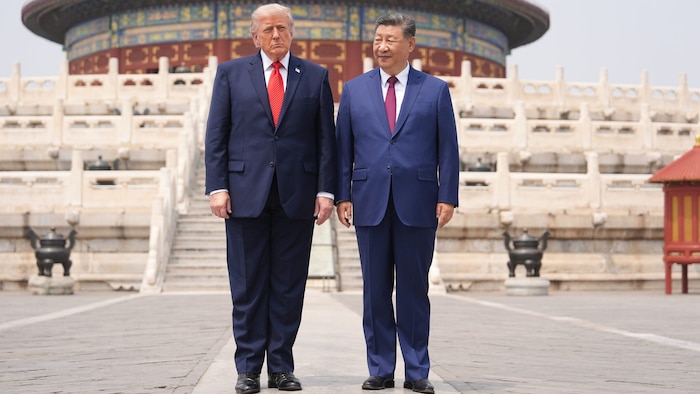
After the first meeting—which lasted about two hours—the two stepped out before the assembled journalists and posed for photos at the Temple of Heaven. Trump heeded Xi’s words and remained silent when asked about Taiwan’s fate, reiterating how “beautiful” China is (see tweet below).
A remark made by the U.S. president in the Oval Office shortly before his departure for Beijing also contributed to the nervousness prevailing in Taiwan regarding the summit: The U.S. is 15 kilometers away from Taiwan, whereas China is only 100. “That’s quite a difference.” Trump has so far left open exactly what he meant by that.
At the same time, Xi knew how to charm Trump time and again. The reception for the U.S. president was lavish and tailored to the preferences of the American, who is known for his penchant for pomp and glory. The Republican was visibly flattered, and Trump applauded children who were cheering and waving small U.S. flags and flowers high in the air.
For the U.S., the focus is on the economy
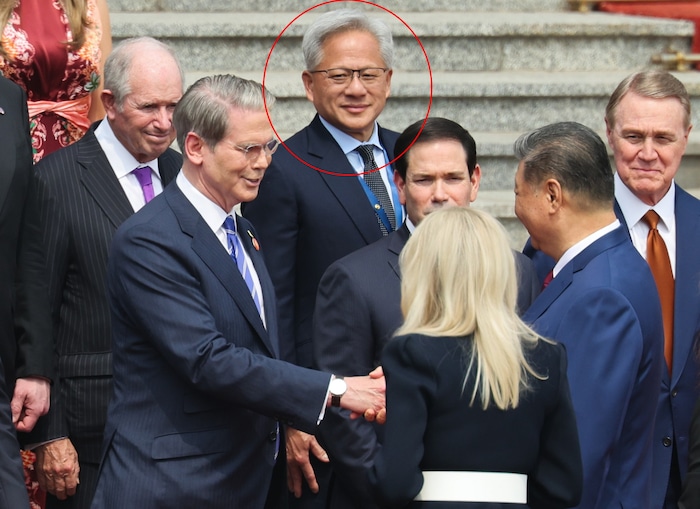
Beijing’s tactics seem to be paying off. So far, Trump has not uttered a single negative word about the Chinese leadership. From China’s perspective, economic interests are the primary focus of the meeting. Trump’s entourage includes corporate executives such as Apple CEO Tim Cook and Tesla founder Elon Musk, as well as government officials like Treasury Secretary Scott Bessent, Secretary of State Marco Rubio, and Secretary of Defense Pete Hegseth.
During a meeting with high-ranking business representatives, Xi stated that “China’s open doors” would continue to open wider. Beijing welcomes increased cooperation with the U.S. and expressed optimism that U.S. companies would have better prospects in China.
While this is music to Trump’s ears, the reality is quite different. In fact, the People’s Republic is increasingly restricting market access for foreign companies.
Further talks during Trump’s state visit are therefore likely to continue to be dominated by trade issues—including in the context of the Iran conflict and the Strait of Hormuz. Here, Trump is hoping for a more proactive mediating role from Beijing. According to a White House statement, both sides emphasized that the strait, above all, must “remain open.” An afternoon tea and a working lunch are scheduled for Friday before the U.S. president begins his journey home.
This article has been automatically translated,
read the original article here.











Liebe Leserin, lieber Leser,
die Kommentarfunktion steht Ihnen ab 6 Uhr wieder wie gewohnt zur Verfügung.
Mit freundlichen Grüßen
das krone.at-Team
User-Beiträge geben nicht notwendigerweise die Meinung des Betreibers/der Redaktion bzw. von Krone Multimedia (KMM) wieder. In diesem Sinne distanziert sich die Redaktion/der Betreiber von den Inhalten in diesem Diskussionsforum. KMM behält sich insbesondere vor, gegen geltendes Recht verstoßende, den guten Sitten oder der Netiquette widersprechende bzw. dem Ansehen von KMM zuwiderlaufende Beiträge zu löschen, diesbezüglichen Schadenersatz gegenüber dem betreffenden User geltend zu machen, die Nutzer-Daten zu Zwecken der Rechtsverfolgung zu verwenden und strafrechtlich relevante Beiträge zur Anzeige zu bringen (siehe auch AGB). Hier können Sie das Community-Team via unserer Melde- und Abhilfestelle kontaktieren.