Iran Slows Down Its Economy
Energy Shock from the Middle East Hits Austria
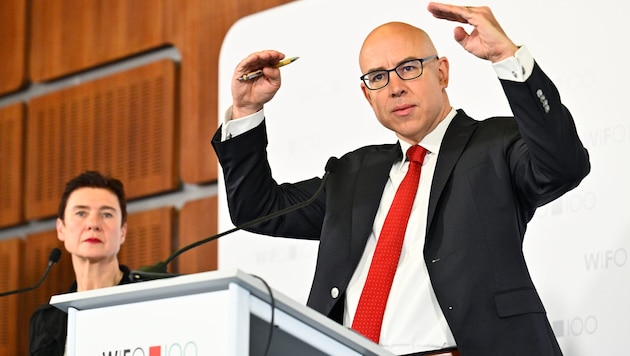

Austria’s economic situation remains tense: The war in Iran, rising energy prices, and weak growth are slowing the economy—while the budget situation is deteriorating significantly. New forecasts indicate not only lower growth prospects but also increasing pressure on public finances. The central question now is how much the government must cut spending.
 Kronen Zeitung als bevorzugte Google-Quelle hinzufügen
 The assessments by WIFO and the Institute for Advanced Studies form the basis for the ongoing negotiations on the 2027/28 biennial budget under Finance Minister Markus Marterbauer (SPÖ).
Growth remains weak – energy as a drag
The economy is picking up momentum only slowly. For 2026, the institutes expect economic growth of between 0.5 and 0.9 percent, and for 2027 between 0.8 and 1.3 percent. This means the recovery is lagging significantly behind previous upturns.
Economists cite uncertainty surrounding the war in Iran as the main reason. Soaring energy prices are driving up production and transportation costs, while companies are postponing investments and households are becoming more cautious in their spending.
Inflation is falling—but more slowly than hoped
Inflation is also showing only a tentative easing. While inflation continues to fall, it remains above the European Central Bank’s target of 2 percent.
For 2026, the institutes forecast 2.7 to 2.9 percent, and for 2027, 2.3 to 2.4 percent. The decline is thus proceeding more slowly than expected just a few months ago—primarily due to higher energy prices.
High deficit, debt continues to rise
The budget situation also remains tense. The general government deficit—that is, new borrowing by the federal government, the states, and social security—remains well above the EU limit of 3 percent. Specifically, the institutes expect:
- 2026: around 4.1 to 4.2 percent
- 2027: only a slight decline to about 4.0 to 4.1 percent
By comparison: in 2024, the deficit was already at 4.7 percent. Austria thus remains subject to the EU deficit procedure.

At the same time, government debt continues to rise and could climb to around 85 percent of GDP by 2027.
Economists call for a larger austerity package
Against this backdrop, pressure on policymakers is mounting significantly. Both institutes see a need for additional consolidation. The IHS puts it particularly clearly: The planned austerity package of around two billion euros is not enough—it must be “larger.”
In addition to spending cuts, far-reaching reforms are also being called for, for example in federalism or the healthcare system. WIFO Director Gabriel Felbermayr also emphasizes the need for a consistent austerity course, but at the same time points out that the state must remain capable of acting in crises.
Government under pressure
Finance Minister Marterbauer himself confirms the need for additional consolidation beyond the measures already planned. While the government remains committed to the fiscal consolidation course, the economic conditions have deteriorated: weaker growth and higher inflation further complicate the budget targets.
The new forecasts now form the central basis for negotiations on the 2027/28 biennial budget. One thing is clear: without additional measures, it will be difficult to return below the EU deficit limit.
This article has been automatically translated,
read the original article here.











Willkommen in unserer Community! Eingehende Beiträge werden geprüft und anschließend veröffentlicht. Bitte achten Sie auf Einhaltung unserer Netiquette und AGB. Für ausführliche Diskussionen steht Ihnen ebenso das krone.at-Forum zur Verfügung. Hier können Sie das Community-Team via unserer Melde- und Abhilfestelle kontaktieren.
Hinweis in eigener Sache: Das krone.at-Forum präsentiert sich ab sofort in neuem Design! Wir freuen uns über konstruktives Feedback. Damit die Diskussionen in den Kommentarbereichen beim jeweiligen Thema bleiben, können Sie uns Rückmeldungen hier hinterlassen.
User-Beiträge geben nicht notwendigerweise die Meinung des Betreibers/der Redaktion bzw. von Krone Multimedia (KMM) wieder. In diesem Sinne distanziert sich die Redaktion/der Betreiber von den Inhalten in diesem Diskussionsforum. KMM behält sich insbesondere vor, gegen geltendes Recht verstoßende, den guten Sitten oder der Netiquette widersprechende bzw. dem Ansehen von KMM zuwiderlaufende Beiträge zu löschen, diesbezüglichen Schadenersatz gegenüber dem betreffenden User geltend zu machen, die Nutzer-Daten zu Zwecken der Rechtsverfolgung zu verwenden und strafrechtlich relevante Beiträge zur Anzeige zu bringen (siehe auch AGB). Hier können Sie das Community-Team via unserer Melde- und Abhilfestelle kontaktieren.