PISA Results
Students Perform Worse in Almost Every Subject
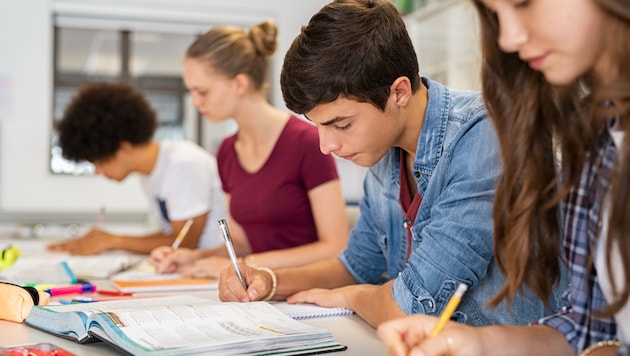

For the first time since the test was introduced, the performance of students in this country is significantly above the OECD average in all subjects. However, this is only because performance in other OECD countries has declined even more sharply. There are, however, some positive exceptions.
 Kronen Zeitung als bevorzugte Google-Quelle hinzufügen
 It had been a long wait, but on Tuesday the moment finally arrived: the PISA study was published. The trend observed for the first time following the COVID-19 pandemic continues—a decline in performance was once again noted among 15- to 16-year-old students in reading and mathematics.
In reading, Ireland is now the only country in Europe to still reach the original average of 500 points. With 467 points, Austria now ranks behind Turkey (472), though it is in good company with Switzerland (470) and Germany (465). Finland, too, ranks only slightly ahead—at least in reading—with 474 points.
Gains in Science
Austrian students performed particularly well in this year’s main test area, science, scoring 497 points. This represents an increase of six points compared to the last test in 2022 and is above the OECD average (482; 2022: 485). In reading, Austrian students scored 467 points—which is also slightly above the OECD average (461), but represents another decline of 13 points. Across the OECD, reading scores fell by roughly the same margin, down 14 points.
The same applies to mathematics. Here, Austrian 15- and 16-year-olds scored 477 points. This is clearly above the OECD average (463), but represents a decline of ten points—roughly the same drop as seen across the OECD (a decline of nine points). In the “Learning in the Digital World” category, which was tested for the first time, Austrian students also scored above the OECD average with 509 points.
South Korea and Japan Topthe List
As usual, South Korea andJapanperformed best across the OECD, while in Europe, Estonia (science, math, digital literacy) and Ireland (reading) achieved the highest scores. The absolute best results were achieved by the four Chinese provinces—Beijing, Shanghai, Jiangsu, and Zhejiang—which were evaluated separately (Science: 597, Reading: 527, Math: 612), as well as Singapore (Science: 560, Reading: 535, Math: 563).
Wiederkehr Identifies “Troubling Trends”
Education Minister Christoph Wiederkehr (NEOS) saw “both positives and negatives” in the PISA results. On the one hand, he noted, Austria remains “among the international leaders” and has improved in science. In reading and math, however, there has been a “significant decline in basic skills.” These are “troubling trends that we are seeing globally,” the minister told reporters.
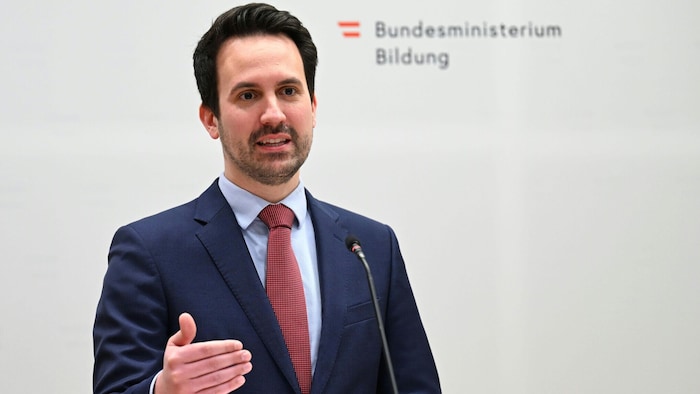
Wiederkehr sees a need for action in two areas: On the one hand, there continues to be an above-average correlation in Austria between academic performance and students’ social background. Steps have already been taken here with the expansion of summer school, changes to German language support programs, and the introduction of the “opportunity bonus.” However, a reversal of this trend will not happen overnight.
Learning Outcomes Decline with Early Screen Time
The second point concerns digitalization: This must “take place later and be done better,” according to Wiederkehr. There is a link between early screen time and declining learning outcomes. “Unsupervised digitalization in schools leads to poorer results.” While children who use digital devices too early and for too long may become better at scrolling, they struggle to understand more complex texts.
Consequence: “We must not neglect hands-on learning.” The foundations of early childhood education must be strengthened, and parents, too, should reduce their own screen time to set a good example for their children. As a first step, the minister announced—as he had done shortly after the budget was finalized—that the distribution of discounted or free digital devices would be postponed from the fifth to the sixth grade, specifically to the end of the second semester.
This article has been automatically translated,
read the original article here.











Liebe Leserin, lieber Leser,
die Kommentarfunktion steht Ihnen ab 6 Uhr wieder wie gewohnt zur Verfügung.
Mit freundlichen Grüßen
das krone.at-Team
Hinweis in eigener Sache: Das krone.at-Forum präsentiert sich ab sofort in neuem Design! Wir freuen uns über konstruktives Feedback. Damit die Diskussionen in den Kommentarbereichen beim jeweiligen Thema bleiben, können Sie uns Rückmeldungen hier hinterlassen.
User-Beiträge geben nicht notwendigerweise die Meinung des Betreibers/der Redaktion bzw. von Krone Multimedia (KMM) wieder. In diesem Sinne distanziert sich die Redaktion/der Betreiber von den Inhalten in diesem Diskussionsforum. KMM behält sich insbesondere vor, gegen geltendes Recht verstoßende, den guten Sitten oder der Netiquette widersprechende bzw. dem Ansehen von KMM zuwiderlaufende Beiträge zu löschen, diesbezüglichen Schadenersatz gegenüber dem betreffenden User geltend zu machen, die Nutzer-Daten zu Zwecken der Rechtsverfolgung zu verwenden und strafrechtlich relevante Beiträge zur Anzeige zu bringen (siehe auch AGB). Hier können Sie das Community-Team via unserer Melde- und Abhilfestelle kontaktieren.