No Absolute
What if no one really wants to form a government with the AfD?
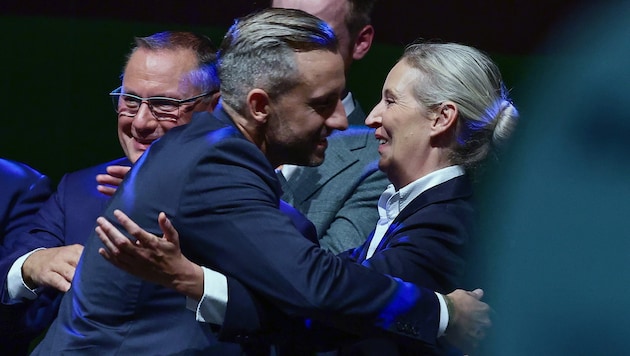

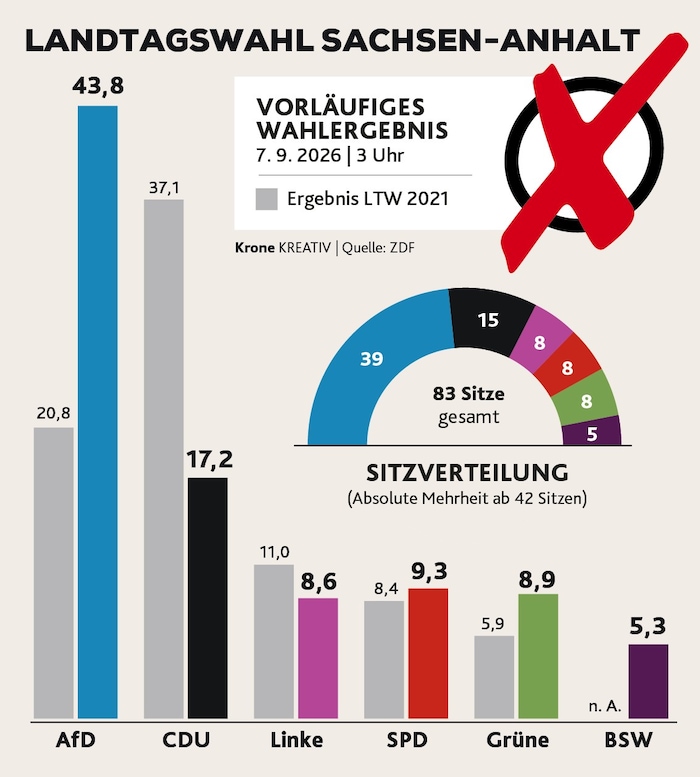
Voters in Saxony-Anhalt have spoken—the AfD has clearly won the election. However, it’s still unclear who will govern the state, which has over two million residents. According to preliminary results, the AfD’s nearly 44 percent of the vote isn’t enough for a single-party government.
 Kronen Zeitung als bevorzugte Google-Quelle hinzufügen
Even though the AfD narrowly missed securing a majority in the state parliament, one thing is certain for lead candidate Ulrich Siegmund: he wants to govern. This would make him the first head of government from the far-right party in a federal state.
The Mystery of Forming a Government
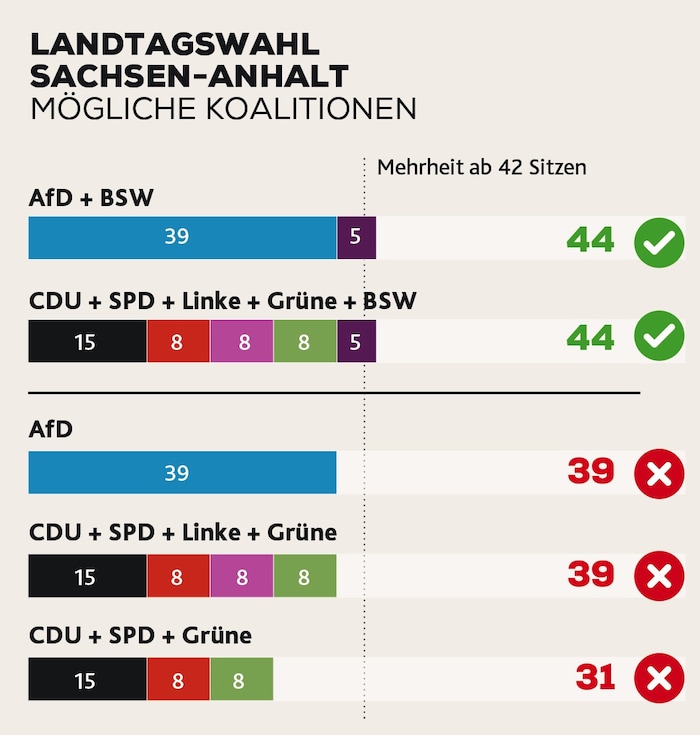
With the preliminary election result of just under 44 percent, however, a single-party government is out of the question for the party, which is classified as far-right—it is three seats short of a majority in the state legislature. It would therefore need supporters. Before the election, the other parties in the state legislature had clearly ruled out a coalition with the AfD.
Five Parties Against One
Forming a government against the AfD would only be possible if all the others worked together—that is, from the CDU to the SPD, the Greens, the Left Party, and the BSW. However, cooperation among five partners would be extremely unusual, very complicated, and hardly conceivable.
CDU Rules Out Cooperation with The Left
The CDU has already ruled out a coalition or coalition-like cooperation with the Left Party via a party convention resolution, just as it has with the AfD—the Left Party would be willing to engage in informal cooperation, but only if there are policy concessions.
Could the BSW be the solution?
The race was particularly close for Sahra Wagenknecht’s Alliance (BSW), which received 5.3 percent of the second votes. Now, however, that could make all the difference. One option would be for the BSW to cooperate with the SPD, CDU, Greens, and Left Party. On Sunday evening, the possibility of a minority government was also on the table—one that would be tolerated by the BSW and rely on shifting majorities.
Ulrich Siegmund made it clear, however, that this option was merely a last resort for him. Almost defiantly, he said, “In a worst-case scenario, there would just be new elections, and then we’d get 50 or 55 percent.”

In a worst-case scenario, there would simply be new elections, and then we’d just have 50 or 55 percent.

Ulrich Siegmund
Bild: AFP/RONNY HARTMANN
Speculation about defections from the CDU to the AfD
The CDU plummeted to 17.2 percent (37.1)—its worst result in a state election in Saxony-Anhalt. For some time now, there has been speculation about whether there might be defectors from the CDU to the AfD. A few AfD politicians said there had been talks with CDU state legislators about whether they could imagine switching to the right-wing party. But they didn’t name any names—and there’s no evidence either.
One thing is certain: the ruling coalition of the CDU, SPD, and FDP has come to an end. However, Minister-President Schulze and his cabinet will remain in office on an interim basis until a new minister-president is elected.
This article has been automatically translated,
read the original article here.










Liebe Leserin, lieber Leser,
die Kommentarfunktion steht Ihnen ab 6 Uhr wieder wie gewohnt zur Verfügung.
Mit freundlichen Grüßen
das krone.at-Team
Hinweis in eigener Sache: Das krone.at-Forum präsentiert sich ab sofort in neuem Design! Wir freuen uns über konstruktives Feedback. Damit die Diskussionen in den Kommentarbereichen beim jeweiligen Thema bleiben, können Sie uns Rückmeldungen hier hinterlassen.
User-Beiträge geben nicht notwendigerweise die Meinung des Betreibers/der Redaktion bzw. von Krone Multimedia (KMM) wieder. In diesem Sinne distanziert sich die Redaktion/der Betreiber von den Inhalten in diesem Diskussionsforum. KMM behält sich insbesondere vor, gegen geltendes Recht verstoßende, den guten Sitten oder der Netiquette widersprechende bzw. dem Ansehen von KMM zuwiderlaufende Beiträge zu löschen, diesbezüglichen Schadenersatz gegenüber dem betreffenden User geltend zu machen, die Nutzer-Daten zu Zwecken der Rechtsverfolgung zu verwenden und strafrechtlich relevante Beiträge zur Anzeige zu bringen (siehe auch AGB). Hier können Sie das Community-Team via unserer Melde- und Abhilfestelle kontaktieren.