Ban on CO₂ Storage
Hattmannsdorfer Wants to Repeal Old ÖVP Law
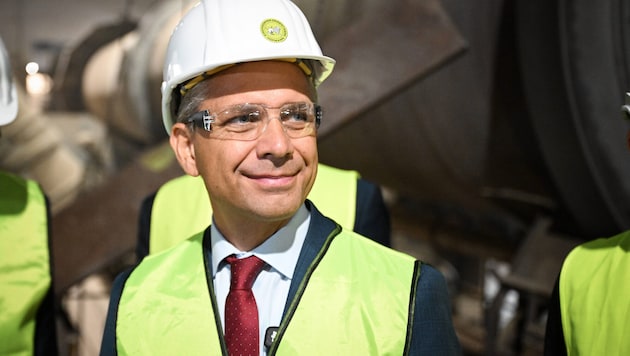

ÖVP Minister of Economic Affairs Wolfgang Hattmannsdorfer now wants to repeal a law that one of his predecessors and his own party initiated: Since 2011, the geological storage of CO₂ has been banned in Austria. Now, this very technology is seen as one of the key climate protection measures for domestic industry in the coming years.
 Kronen Zeitung als bevorzugte Google-Quelle hinzufügen
 Accompanied by Provincial Governor Thomas Stelzer, the Minister of Economic Affairs visited the cement plant of the internationally active Kirchdorfer Group in Upper Austria on Tuesday. There, tests are already underway for what Hattmannsdorfer wants to make possible on a large scale in the future: capturing CO₂ directly during production and then storing it permanently underground.
The problem: Since 2011, it has been generally prohibited in Austria to geologically store CO₂. The only exceptions are smaller projects for research and testing purposes. It is precisely this ban that Hattmannsdorfer and the ÖVP now want to overturn. The relevant law was passed in 2011 with the votes of the SPÖ, ÖVP, and the Greens. The FPÖ and the BZÖ (as it was known at the time) voted against the ban, which had been initiated by the government under SPÖ Chancellor Werner Faymann and ÖVP Minister of Economic Affairs Reinhold Mitterlehner.

CO2 storage is one of the key climate protection measures for our industry in the coming years.
Minister Wolfgang Hattmannsdorfer, ÖVP
Speaking to the “Krone” during a site visit in Kirchdorf, Hattmannsdorfer said: “If we want industry to remain in Austria, then we need to pay special attention to energy-intensive industries. When it comes to process emissions, our only chance is to allow carbon storage.”
How this might work is already being tested on a small scale in Kirchdorf. Scheuch, a company based in Aurolzmünster, has installed a pilot plant in a container at the cement plant to capture CO₂ from the exhaust gas produced during cement manufacturing. Simply put, the carbon dioxide is separated from the other components of the exhaust gas and then processed for further transport.
On a large scale, the captured CO₂ will be transported to suitable underground storage sites in the future and stored there permanently. This is where RAG Austria AG comes into play, as the company has decades of experience with underground gas storage. “We have a great deal of experience in utilizing these storage sites and can be very confident in our approach,” says RAG CEO Markus Mitteregger. For him, storage could even be just the beginning: Together with hydrogen, the CO₂ is to be used later in a circular economy to manufacture products that are still based on fossil raw materials today.
Politically, Hattmannsdorfer directly links the issue to the climate law currently being negotiated within the federal government. His message to the coalition partners is unambiguous: The climate law should not stand alone. At the same time, the ban on CO₂ storage must be lifted, and the announced amendment to the Environmental Impact Assessment Act—aimed at speeding up approval procedures—must be put into motion. “These three laws belong together,” says the Minister of Economic Affairs.
We want to reduce emissions, but not jobs.
Thomas Stelzer (ÖVP) unterstützt die Hattmannsdorfer-Initiative
ÖVP Minister: “It’s not enough to just set climate targets”
According to Hattmannsdorfer, the federal government has already agreed in principle to lift the storage ban—even in the coalition agreement with the SPÖ and NEOS. Now he is pushing for a joint review of the three proposals: “A climate law alone doesn’t build a plant or speed up a process.” Setting climate targets isn’t enough, argues the ÖVP minister—industry must simultaneously be given the legal means to implement them.
The scale is enormous: Even by 2040, depending on the scenario, Austria’s industry is still expected to emit between 4.4 and 12.1 million metric tons of CO₂ per year—emissions that cannot be completely avoided through technology alone—such as in the cement and lime industries. At a certificate price of 82 euros per metric ton, this could result in costs of up to 900 million euros annually. Hattmannsdorfer warns: “The answer to this cannot be to drive production and jobs out of Austria.”
This article has been automatically translated,
read the original article here.











Willkommen in unserer Community! Eingehende Beiträge werden geprüft und anschließend veröffentlicht. Bitte achten Sie auf Einhaltung unserer Netiquette und AGB. Für ausführliche Diskussionen steht Ihnen ebenso das krone.at-Forum zur Verfügung. Hier können Sie das Community-Team via unserer Melde- und Abhilfestelle kontaktieren.
Hinweis in eigener Sache: Das krone.at-Forum präsentiert sich ab sofort in neuem Design! Wir freuen uns über konstruktives Feedback. Damit die Diskussionen in den Kommentarbereichen beim jeweiligen Thema bleiben, können Sie uns Rückmeldungen hier hinterlassen.
User-Beiträge geben nicht notwendigerweise die Meinung des Betreibers/der Redaktion bzw. von Krone Multimedia (KMM) wieder. In diesem Sinne distanziert sich die Redaktion/der Betreiber von den Inhalten in diesem Diskussionsforum. KMM behält sich insbesondere vor, gegen geltendes Recht verstoßende, den guten Sitten oder der Netiquette widersprechende bzw. dem Ansehen von KMM zuwiderlaufende Beiträge zu löschen, diesbezüglichen Schadenersatz gegenüber dem betreffenden User geltend zu machen, die Nutzer-Daten zu Zwecken der Rechtsverfolgung zu verwenden und strafrechtlich relevante Beiträge zur Anzeige zu bringen (siehe auch AGB). Hier können Sie das Community-Team via unserer Melde- und Abhilfestelle kontaktieren.