Hardly any hope left
Researchers see a last chance for whale “Timmy”
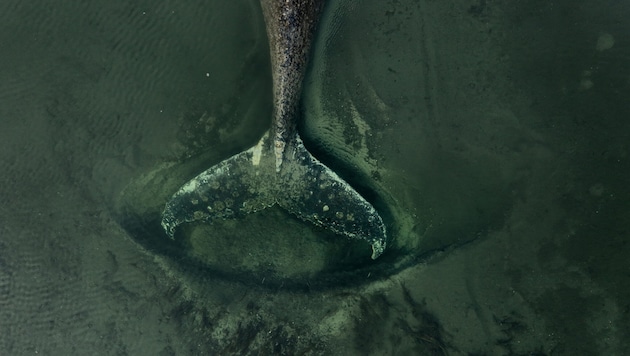

Even nearly two weeks after the humpback whale—which had stranded multiple times on the Baltic Sea coast—was released, there is still no information on where the animal is or whether it is even still alive. The rescue teams are deeply divided and threatening to sue one another. A photo ID is being brought into play as a last chance for clarity.
 Kronen Zeitung als bevorzugte Google-Quelle hinzufügen
 The GPS transmitter continues to send no signals for tracking, according to a statement Thursday from the private initiative organizing the whale’s transport. There is no data available at all. The Ministry of the Environment of the eastern German state of Mecklenburg-Western Pomerania also has no information, it was reported.
“We still have no data available or information on whether any is expected,” a spokeswoman said. “Our lawyers are reviewing legal steps.” She expects the ministry to decide on its next course of action next week, the spokeswoman explained. The ministry had already raised the possibility of legal action last week. According to the ministry, the transmission of tracking data had been agreed upon in advance with the initiative.
According to the initiative, a GPS transmitter was supposed to have been attached to the humpback whale’s dorsal fin before its release on May 2, designed to continuously provide location data. Whether this actually took place could not be verified by independent sources.
A whale lying on the seabed does not transmit data
If a whale is too weak to stay at the surface, sinks to the bottom, and drowns, a GPS transmitter does not provide data: The data is typically only recorded by satellites flying over the region when the animal remains at the water’s surface for some time.
Despite the gases produced during decomposition, the carcass would not float to the surface and become visible because water pressure prevents this in deeper waters. Only if the animal was still swimming near the coast before its death could it be washed ashore there.
The bull was first spotted in the Baltic Sea in early March. In the roughly 60 days leading up to its transport, it spent about two-thirds of the time in shallow water zones. It was transported from the island of Poel to the North Sea by barge.
Last Chance: a Photo ID
According to the initiative, there are no photos or videos of the release. It also remained unclear what condition the weakened animal, injured from being tossed about in the barge, was in at that time. According to assessments by Whale and Dolphin Conservation (WDC) and the International Whaling Commission (IWC), among others, the whale had little chance of long-term survival.
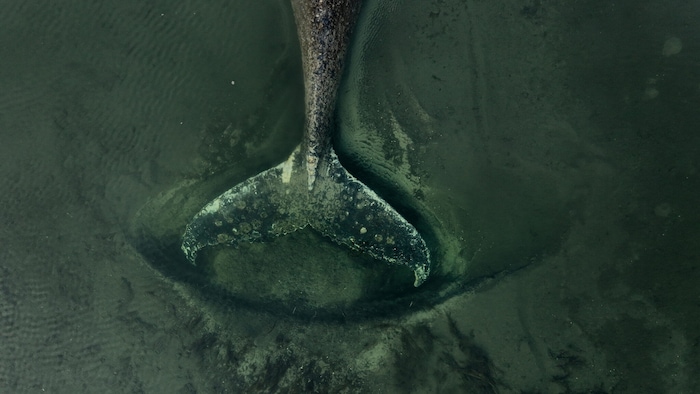
There may still be one last chance to locate it again: According to the initiative, a photo of the fluke—the animal’s large tail fin—was taken, which is to be entered into relevant databases as a photo ID. However, there was no confirmation of this information from independent sources either.
In addition to a photo of the underside of the fluke, the animal welfare organization WDC states that distinctive features such as a scar pattern on the skin can also serve to identify a whale. The Poel whale belongs to the North Atlantic humpback whale population. “Every research team working with this population photographs the individuals,” they said. Over the years, thousands of ID photos have been compiled.
In the future, the whale could be rediscovered in its northern feeding grounds, southern mating areas, or during its migrations between them via such a photo ID—provided it is still alive and this ID was actually created by the initiative.
This article has been automatically translated,
read the original article here.











Willkommen in unserer Community! Eingehende Beiträge werden geprüft und anschließend veröffentlicht. Bitte achten Sie auf Einhaltung unserer Netiquette und AGB. Für ausführliche Diskussionen steht Ihnen ebenso das krone.at-Forum zur Verfügung. Hier können Sie das Community-Team via unserer Melde- und Abhilfestelle kontaktieren.
User-Beiträge geben nicht notwendigerweise die Meinung des Betreibers/der Redaktion bzw. von Krone Multimedia (KMM) wieder. In diesem Sinne distanziert sich die Redaktion/der Betreiber von den Inhalten in diesem Diskussionsforum. KMM behält sich insbesondere vor, gegen geltendes Recht verstoßende, den guten Sitten oder der Netiquette widersprechende bzw. dem Ansehen von KMM zuwiderlaufende Beiträge zu löschen, diesbezüglichen Schadenersatz gegenüber dem betreffenden User geltend zu machen, die Nutzer-Daten zu Zwecken der Rechtsverfolgung zu verwenden und strafrechtlich relevante Beiträge zur Anzeige zu bringen (siehe auch AGB). Hier können Sie das Community-Team via unserer Melde- und Abhilfestelle kontaktieren.