Seriously injured children
Patchwork quilt of helmet laws poses a major risk
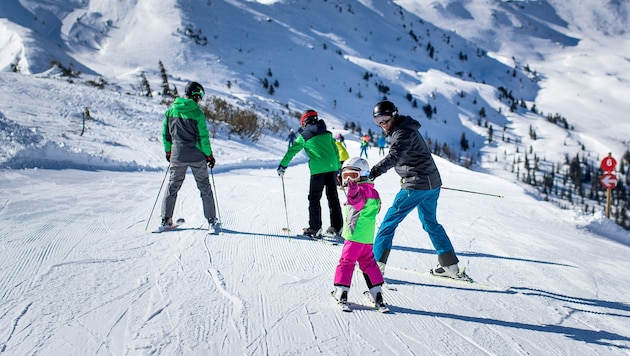


Serious injuries on the slopes or while sledding are practically an everyday occurrence. In Tyrol, the introduction of mandatory helmet use for children up to the age of 15 is now being considered. Head protection is the order of the day! The "Krone" newspaper took a closer look at the situation.
 Kronen Zeitung als bevorzugte Google-Quelle hinzufügen
 Winter is currently treating lift operators and sports enthusiasts in the state well, the slopes are full – and yet there is always a risk. It sits on top of your head. Or not. Because while ski helmets have long been a matter of course for many, a quiet debate is still raging in Austria about whether children, at least, should really be required to wear them.
For doctors who rescue injured people from the slopes every winter, this discussion is difficult to understand (see interview below). Every day, children and young people end up in hospital with serious head injuries.
Traumatic brain injuries after falls on hard, icy slopes, collisions with other skiers, collisions with barriers or lifts. Very treacherous: sledding. This leisurely winter fun often ends in a rescue helicopter.
Legal patchwork in Austria
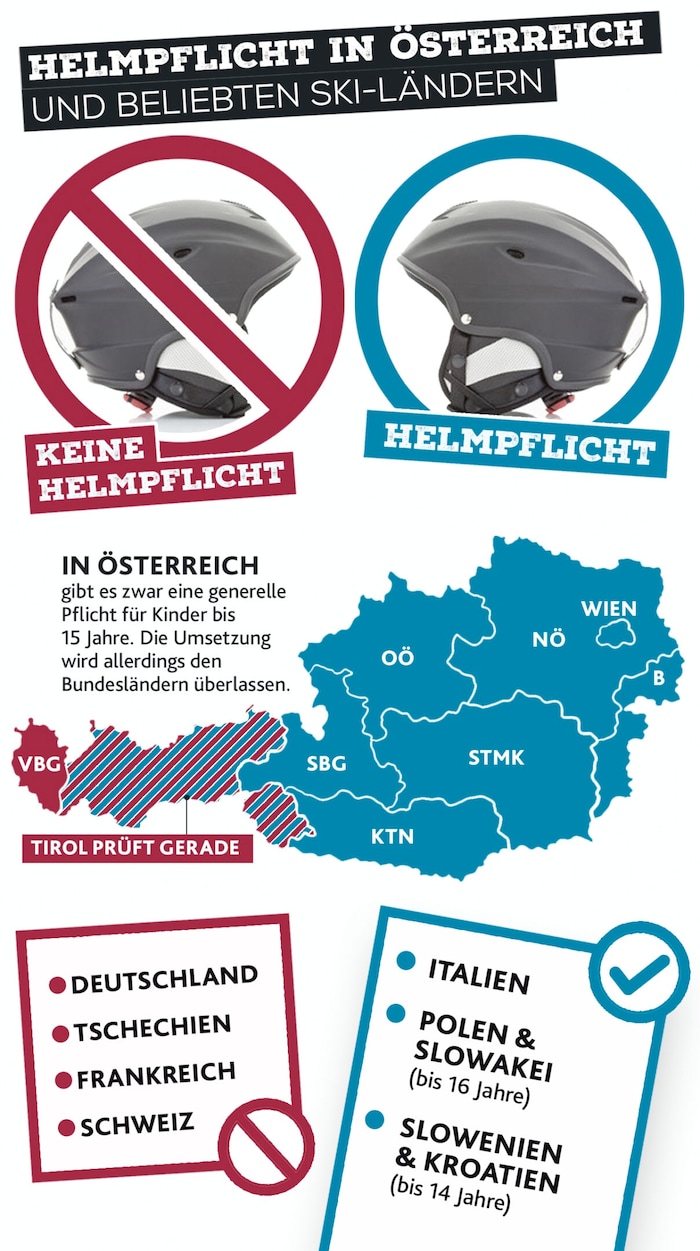
There have long been rules in Austria—just not uniform ones. In Salzburg, Upper Austria, and Styria, children up to the age of 15 are required to wear helmets when skiing, and in the eastern region and Carinthia, this also applies to sledding. Tyrol and Vorarlberg, of all places, are still the exception. While Vorarlberg at least recommends it, Tyrol is currently considering a legal extension.
Italy & Co. respond with hefty fines
The Austrian Road Safety Board has been warning for years that a well-fitting helmet can prevent or at least mitigate serious head injuries. The risk is particularly high when sledding, but the rate of helmet use is alarmingly low. Nevertheless, there are neither comprehensive checks nor penalties in Austria. Anyone caught without a helmet will receive a warning at most – and then continue on their way.
A look abroad shows how quickly negligence can turn into a serious matter. In Italy, helmets are mandatory on the ski slopes, enforced by the Carabinieri. Anyone caught without a helmet pays up to 200 euros, and in the worst case, their ski pass is revoked.
In Slovenia, Croatia, Poland, and Slovakia, there are also hefty fines and the immediate termination of the skiing day. There, it is clear that safety is not a recommendation, but an obligation. And yet, laws are not always necessary. In Germany, France, and Switzerland, helmets are not mandatory, but most winter sports enthusiasts wear them anyway.
Nevertheless, in many places the question is becoming increasingly urgent: how many more accidents will it take before helmets become mandatory?
"If you wear a helmet, you survive"
Trauma surgeon Dr. Patrick Weninger explains the benefits of head protection in an interview with the "Krone" newspaper:
"Krone": How do you feel about mandatory helmet use in sports?
Weninger: Very important. Children's brains are particularly vulnerable. The head is especially susceptible. In accidents, it is exposed to strong gravitational forces that can lead to serious, even permanent damage.

Which injuries can be prevented by a helmet, and which cannot?
Direct skull fractures can be prevented. The helmet causes direct, localized forces to be diverted into less localized, more widespread forces. Unfortunately, these diverted forces can also cause damage to the brain. In any case, the following applies to many accidents: if you wear a helmet, you survive; if you don't, you die.
Are serious head injuries common in winter?
Severe traumatic brain injury is one of the most common injuries in winter sports and the most common cause of death among skiers and sledders.
What is important when it comes to helmets?
It should be comfortable to wear and as light as possible, so that people are more likely to wear it. It must not restrict vision.
What effect does it have on risk awareness?
In principle, a helmet provides very good protection and can mean the difference between life and death. Two conclusions are incorrect: 1. I wear a helmet, so nothing can happen to me, and 2. I don't wear a helmet because it doesn't help anyway.
It's like in a car: I buckle up so that I am better protected in a collision than without a seat belt. In a collision at 250 km/h, I won't survive despite the seat belt. Nevertheless, more people survive with a seat belt than without one. The same applies to helmets.
This article has been automatically translated,
read the original article here.











Liebe Leserin, lieber Leser,
die Kommentarfunktion steht Ihnen ab 6 Uhr wieder wie gewohnt zur Verfügung.
Mit freundlichen Grüßen
das krone.at-Team
Hinweis in eigener Sache: Schon bald erwartet Sie auf krone.at ein rundum erneuerter Forenbereich mit vielen neuen Features! Mehr Informationen finden Sie hier.
User-Beiträge geben nicht notwendigerweise die Meinung des Betreibers/der Redaktion bzw. von Krone Multimedia (KMM) wieder. In diesem Sinne distanziert sich die Redaktion/der Betreiber von den Inhalten in diesem Diskussionsforum. KMM behält sich insbesondere vor, gegen geltendes Recht verstoßende, den guten Sitten oder der Netiquette widersprechende bzw. dem Ansehen von KMM zuwiderlaufende Beiträge zu löschen, diesbezüglichen Schadenersatz gegenüber dem betreffenden User geltend zu machen, die Nutzer-Daten zu Zwecken der Rechtsverfolgung zu verwenden und strafrechtlich relevante Beiträge zur Anzeige zu bringen (siehe auch AGB). Hier können Sie das Community-Team via unserer Melde- und Abhilfestelle kontaktieren.