"Science" ranking
Anti-HIV drug is “Breakthrough of the Year”
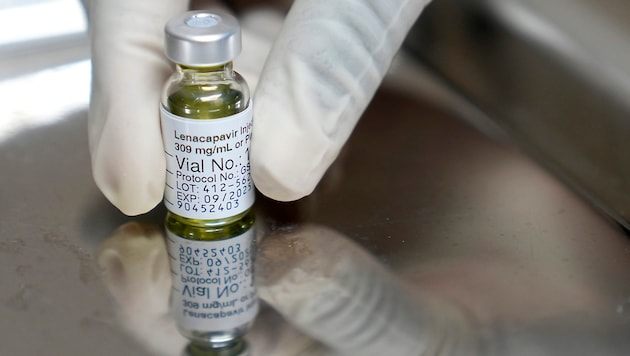

The US journal "Science" has named the development of the drug Lenacapavir as this year's "Breakthrough of the Year". The drug prevents infection with HIV. This is in recognition of the next, but by no means final, step in the fight against AIDS.
 Kronen Zeitung als bevorzugte Google-Quelle hinzufügen
 A six-monthly injection with the drug lenacapavir effectively protects against infection with the virus, as study data has shown. Previously used drugs for HIV pre-exposure prophylaxis (PrEP) such as Truvada must be taken daily as a tablet.
Six-month duration of effect
The development of the drug represents a similar advance in HIV prevention as earlier breakthroughs with antiretroviral drugs, explained "Science" editor-in-chief Holden Thorp. "Lenacapavir's six-month duration of action makes a big difference and offers a new and better way to make prophylaxis available to more people around the world," Thorp continued.
The manufacturer Gilead intends to apply for approval as HIV protection in numerous countries. Targeted efforts are also being made to supply poorer countries. The drug is to be offered prophylactically to people with a high risk of HIV infection.
In addition to the "Breakthrough of the Year", "Science" also recognized numerous other highlights from the world of science. This year, these included new approaches, so-called "Chimeric Antigen Receptor" cells (CAR-T cells for short) not only against cancer, but now also against autoimmune diseases such as multiple sclerosis or lupus. Also mentioned were discoveries of new galaxies with the James Webb Space Telescope (JWST) - the "breakthrough" of 2022 - novel RNA-based pesticides, the discovery that a marine algae can extract nitrogen from its environment with a kind of mini-organ in its cells, new insights into when and how multicellular organisms formed, an expansion of the body of thought surrounding plate tectonics and the progress made by the US space company SpaceX with its large rocket "Starship".
Proof of a new form of magnetism
Proof of a new form of magnetism and progress in decoding ancient DNA also bear the hallmarks of Austrian researchers. For example, samples of the "ancient magnetism" candidate manganese telluride were produced under special conditions at the University of Linz and examined in Switzerland. There, photoemission spectroscopy was used to show that it is an "alter magnet", as the researchers reported in the journal "Nature" in February. They were able to "experimentally prove the existence of a completely new class of magnetic materials for the first time", explained Gunther Springholz, a physicist from Linz who was involved in the work.
Relationships from ancient DNA
The Austrian scientists Harald Ringbauer and David Reich, who work at the Max Planck Institute for Evolutionary Anthropology in Leipzig, were also involved in a project in which ancient DNA was used to determine the exact relationships that existed thousands of years ago.
This article has been automatically translated,
read the original article here.











Da dieser Artikel älter als 18 Monate ist, ist zum jetzigen Zeitpunkt kein Kommentieren mehr möglich.
Wir laden Sie ein, bei einer aktuelleren themenrelevanten Story mitzudiskutieren: Themenübersicht.
Bei Fragen können Sie sich gern an das Community-Team per Mail an forum@krone.at wenden.