Home office hype over
cccc
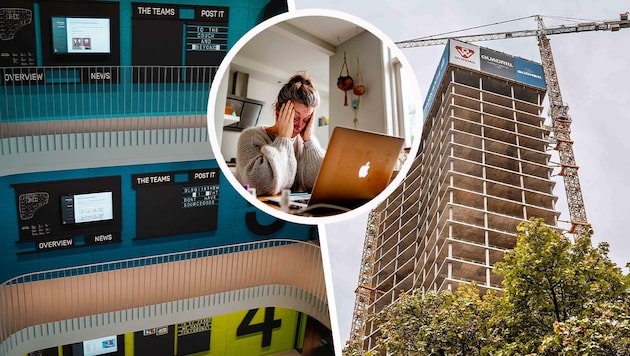

Due to the high costs of purchasing and financing and the stricter lending guidelines, new construction plummeted. For a long time, people wondered why so many office properties were still being built in view of the home office boom. And now? More and more companies are increasingly bringing their employees back to the office. How is the real estate market reacting to this?
 Kronen Zeitung als bevorzugte Google-Quelle hinzufügen
 Retail giant Amazon is scrapping the home office regulation from the end of the year and wants to bring employees back to their offices. The SAP Group also wants to see its employees more often again. "There is a clear trend towards bringing employees back into the company," says Christoph Oßberger, who is responsible for western Austria at real estate service provider CBRE.
What are companies doing to be attractive again? "Companies from the information and communication technology sector in particular are investing horrendous amounts in office equipment," says Oßberger, "they are doing everything they can to bring employees into the company because they have realized that people need direct contact and that teamwork simply works better over short distances."

Investment funds are currently disposing of real estate properties because investors have reoriented themselves. For regional investors, there are opportunities to acquire buildings that they would otherwise never have been able to buy.

Christoph Oßberger, Teamleiter West bei CBRE Österreich
Bild: CBRE
An attractive office location, state-of-the-art facilities, flexible models that provide for working at home and in the office - all this is becoming the order of the day. Projects in Linz, such as the Techbase campus, the expansion of the tobacco factory including the Quadrill complex and the harbor portal, are well on track here.
"No parking spaces, no good facilities"
However, Oßberger knows that times are difficult for offices in city center locations. "The better is the enemy of the good, the new is the enemy of the old," he muses. It is therefore not easy to find tenants for properties in the center of the Upper Austrian capital. On Linzer Landstrasse, there are not only vacant commercial spaces, but also many vacant spaces on the upper floors. "There are no parking spaces, no good facilities, the infrastructure is tired - the question of subsequent use really arises," says Oßberger.
"The wheat has already been separated from the chaff"
Will there still not be too much construction in Linz? The real estate expert waves it off: "Certainly, many projects were built before corona. But what is standing today, what is actively being let, what can be occupied now and in 2025, that is 'survival of the fittest'. The wheat has already been separated from the chaff." Project operators who jumped on the bandwagon in the boom years between 2019 and 2022 and believed they could make money with office properties have already disappeared again in some cases.
Some of the planned expansions are not needed after all
The stuttering economic engine, uncertain future prospects - all of this is leaving its mark on potential tenants. "We are also seeing in Linz that there are companies in the information and communication technology sector that planned office expansions three or four years ago and are now thinking about repurposing."
This article has been automatically translated,
read the original article here.











Da dieser Artikel älter als 18 Monate ist, ist zum jetzigen Zeitpunkt kein Kommentieren mehr möglich.
Wir laden Sie ein, bei einer aktuelleren themenrelevanten Story mitzudiskutieren: Themenübersicht.
Bei Fragen können Sie sich gern an das Community-Team per Mail an forum@krone.at wenden.