What happens next?
Trump never hid the fact that he has no plan
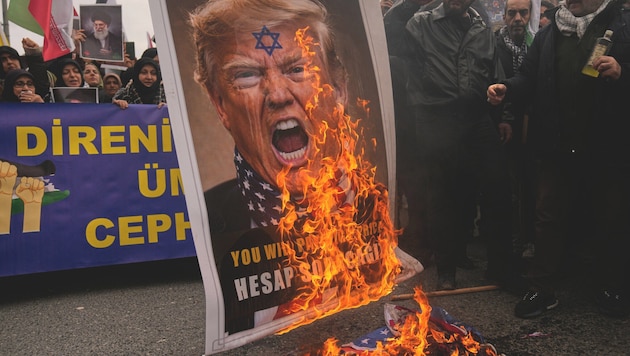

US President Donald Trump has once again set the Middle East ablaze with his unprecedented "Epic Rage" operation. After this weekend, it is completely unclear how things will proceed in the region. The only thing that seems clear is that the Iranians themselves will pay the true price in blood. An analysis.
 Kronen Zeitung als bevorzugte Google-Quelle hinzufügen
 According to Middle East experts, a bitter reality is emerging after this historic weekend: the US and Israel have no exit strategy for Iran. This became apparent just minutes after the start of the joint large-scale attack on the mullah regime in Iran – in an eight-minute statement by the US president, which was intended to justify the turning point.
In it, Trump first attributed the military escalation to Iran's nuclear program. Then to its ballistic missiles. And then to the heart of the regime itself, the mullahs, who must now be brought down.
The US supplies the bombs, the people supply the rest
Trump's appeal to the Iranian people was unambiguous: "When we are done, take over your government." At the same time, he cautiously disclaimed responsibility if that did not work out: "Now you have a president (assumption: Trump means himself) who will give you what you always wanted. We'll see how you respond." He added: "This is – probably – your only chance for generations."
Listen to the entire speech:
For a highly unstable region, Trump's advisors are betting on the following: We will demoralize the mullahs from the air, and you will have to provide clarity on the ground yourselves. And indeed, there have been short-term successes. Supreme Leader Ayatollah Ali Khamenei was killed in a spectacular undertaking. In addition to the leadership elite, missile launch and production facilities, command centers, and other strategic infrastructure were severely damaged.
Trump opens Pandora's box
However, according to political scientists, the fact remains that this massive attack has set in motion a geopolitical lottery with no clear end goal or path to de-escalation in sight. Taking out an entire regime from the air alone is an enormously complicated undertaking. The mullahs are scattered throughout the country, as are their weapons systems. In Iran, this principle is called "mosaic defense."
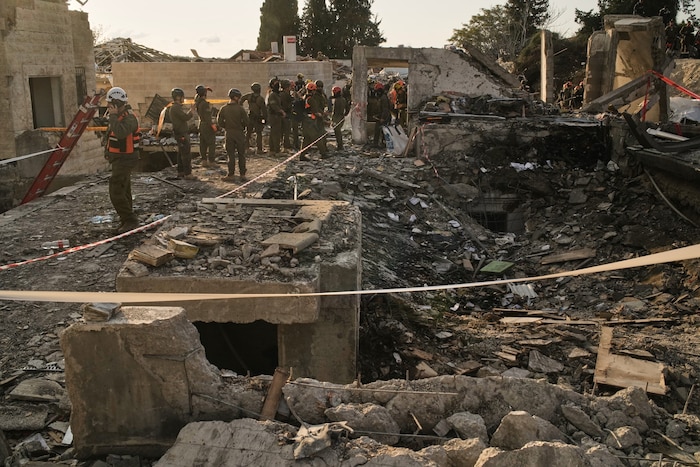
In the event of war, commanders have a great deal of autonomy and are capable of acting even if they lose a superior, according to experts on the region. Even in its weakened state, the regime still has formidable firepower, as the past few hours have shown. And that's despite the fact that the "head of the snake" has been cut off.
Who are "the people"?
The situation on the ground is chaotic. The opposition is completely divided. With a population of nearly 90 million, the country is far from united. Instead, "the people" are divided into monarchists, republicans, reformists from the establishment, the People's Mujahideen, socialists, and many others.
"Bombs can destroy infrastructure. They can weaken capabilities and eliminate leaders. But they do not create organized political alternatives. The Iranian population is unarmed, fragmented, and faces one of the most developed security apparatuses in the region," explained Ali Vaez, a renowned Middle East analyst, in a blog post for Foreign Affairs.
The Islamist dictatorship has powerful coercive institutions at its disposal, such as the Revolutionary Guards, the secret services, and the internal security forces, which were created precisely for such moments of struggle for survival. At the beginning of the year, the bodies of young people who dared to rebel against this institutionalized brutality were piling up across the country.
It is also questionable how long Trump can continue to justify these attacks at home. According to recent polls, only 27 percent of Americans currently support Operation Epic Rage. Trump told the British newspaper Daily Mail that the war could last another four weeks. "Sadly," there will "probably" be more casualties among the ranks of the US Army before the end of the mission. Over the weekend, three US soldiers were killed.
The principle of hope prevails
The US government's current approach has few historical precedents and ignores the resilience of deeply entrenched authoritarian systems. According to Vaez, scenarios other than the liberation of an entire nation from the air seem more likely: a more open takeover by the Revolutionary Guards or a protracted, bloody civil war.
The US response to this is succinct: they themselves do not know what will happen after the air offensive in Iran. There will be no ground troops to secure a transition. "No, that's not the president's job," influential US Senator and Trump confidant Lindsey Graham told NBC. He doesn't believe in taking responsibility for what one has "broken" (see tweet below).
That sounds ignorant and like wishful thinking – but certainly not like a master plan for the biggest powder keg in the Middle East...
This article has been automatically translated,
read the original article here.











Liebe Leserin, lieber Leser,
die Kommentarfunktion steht Ihnen ab 6 Uhr wieder wie gewohnt zur Verfügung.
Mit freundlichen Grüßen
das krone.at-Team
User-Beiträge geben nicht notwendigerweise die Meinung des Betreibers/der Redaktion bzw. von Krone Multimedia (KMM) wieder. In diesem Sinne distanziert sich die Redaktion/der Betreiber von den Inhalten in diesem Diskussionsforum. KMM behält sich insbesondere vor, gegen geltendes Recht verstoßende, den guten Sitten oder der Netiquette widersprechende bzw. dem Ansehen von KMM zuwiderlaufende Beiträge zu löschen, diesbezüglichen Schadenersatz gegenüber dem betreffenden User geltend zu machen, die Nutzer-Daten zu Zwecken der Rechtsverfolgung zu verwenden und strafrechtlich relevante Beiträge zur Anzeige zu bringen (siehe auch AGB). Hier können Sie das Community-Team via unserer Melde- und Abhilfestelle kontaktieren.