Two-tier healthcare
Wait 13 times longer to see a doctor—unless you pay


Every year, more money is poured into the healthcare system, but at the same time, care is deteriorating, complains the SPÖ. Two-tier healthcare remains in place. This is also confirmed by a recent study by the comparison portal krankenversichern.at: "Those who don't want to pay have to wait a long time, up to 13 times longer for an appointment with a specialist," says SPÖ health spokesperson Rudolf Silvan, appalled.
 Kronen Zeitung als bevorzugte Google-Quelle hinzufügen
 "The Austrian healthcare system has deteriorated significantly in recent years. This is not the fault of the people who work in the system, but of those who design it. It is the failure of recent governments in recent years – blue, black, and green," Silvan criticizes the coalition partner ÖVP, among others, and also issues an ultimatum: "If waiting times remain high, we will take further steps – up to and including obliging private doctors to accept a certain proportion of patients with public health insurance."
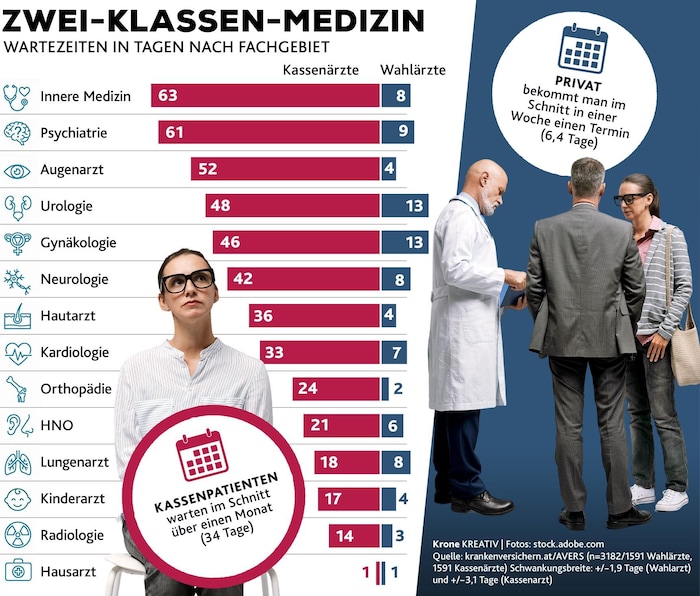
Internal medicine, psychiatry, and ophthalmology lead the way
According to an analysis by krankenversichern.at (based on 1,591 mystery appointment requests between November 25, 2025, and January 16, 2026), there is a huge gap between private and public health insurance doctors in terms of waiting times. The difference is particularly drastic in the most sought-after disciplines: while public health insurance patients often wait for weeks, private availability is around two days in orthopedics, three days in radiology, and only four days in ophthalmology (see chart below).

Even in highly frequented specialist areas such as gynecology or urology, which have waiting times of just under seven weeks (46 and 48 days, respectively) in the public health insurance sector, the median in the elective doctor sector remains stable below the two-week mark (13 days).
In view of these figures, SPÖ politician Silvan demands: "It must be the e-card that counts again, not the credit card." According to the SPÖ's plans, elective doctors should initially be brought into the health insurance system on a voluntary basis. If this does not bring the desired success, the Reds are also considering an obligation to accept a certain number of health insurance patients.
This article has been automatically translated,
read the original article here.











Willkommen in unserer Community! Eingehende Beiträge werden geprüft und anschließend veröffentlicht. Bitte achten Sie auf Einhaltung unserer Netiquette und AGB. Für ausführliche Diskussionen steht Ihnen ebenso das krone.at-Forum zur Verfügung. Hier können Sie das Community-Team via unserer Melde- und Abhilfestelle kontaktieren.
User-Beiträge geben nicht notwendigerweise die Meinung des Betreibers/der Redaktion bzw. von Krone Multimedia (KMM) wieder. In diesem Sinne distanziert sich die Redaktion/der Betreiber von den Inhalten in diesem Diskussionsforum. KMM behält sich insbesondere vor, gegen geltendes Recht verstoßende, den guten Sitten oder der Netiquette widersprechende bzw. dem Ansehen von KMM zuwiderlaufende Beiträge zu löschen, diesbezüglichen Schadenersatz gegenüber dem betreffenden User geltend zu machen, die Nutzer-Daten zu Zwecken der Rechtsverfolgung zu verwenden und strafrechtlich relevante Beiträge zur Anzeige zu bringen (siehe auch AGB). Hier können Sie das Community-Team via unserer Melde- und Abhilfestelle kontaktieren.