Vienna Integration Council
“A colorful society is not a sure-fire success”
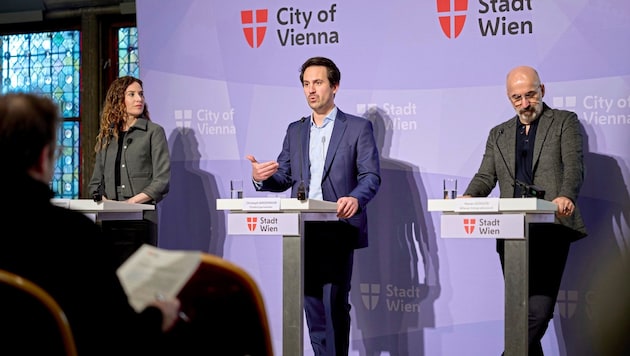

What characterizes peaceful coexistence in Vienna? Is it the right to a Sunday schnitzel? Vienna's values put to the test.
 Kronen Zeitung als bevorzugte Google-Quelle hinzufügen
 The Vienna Integration Council (W.I.R.) has now addressed the public with clear words. At the presentation of the latest results, it was made unmistakably clear how precarious cohesion is in Vienna's increasingly diverse society. Almost half of the city's population has a migrant background, and cultural diversity brings not only opportunities but also points of friction.
Devaluation on many levels
"We are experiencing polarization and group-based devaluations on many levels," says Kenan Güngör, sociologist and member of W.I.R. "The challenges of a diverse society can only be overcome through clear values, dialogue and prevention." His words make it clear that urban policy urgently needs to take action. The focus is on appealing to common values. City Councillor for Integration Christoph Wiederkehr (Neos) emphasizes: "Human rights, pluralism and democracy are non-negotiable. These values form the basis for respectful coexistence."

The goal is a consensus of values that promotes diversity without slipping into clumsy debates about dominant cultures.
Vizebürgermeister Christoph Wiederkehr

Overly romanticized view of diversity
Güngör warns against a romanticized view of diversity: "Plurality is not a sure-fire success. If communities close themselves off and create their own structures, we lose what unites them." Migration expert Judith Kohlenberger adds: "When it comes to discrimination, regardless of whether it comes from the majority society or from minorities, we must not have blind spots." But a look at practice shows: These principles are not equally supported by everyone.
45 percent
of first-graders at Viennese elementary school can no longer speak German. In some schools, a different colloquial language now prevails.
Problems at the schools
The problems are becoming particularly acute at Viennese schools. Kohlenberger speaks of "institutional segregation", in which social and ethnic dividing lines are becoming increasingly apparent in the structures. Many parents are moving to other districts or private schools, which makes social mixing even more difficult. One of the most important points is the willingness to address tensions openly. Güngör: "If the proportion of groups with different values becomes too large, orientation dwindles." This dynamic requires the city to take a clear stance in order to not only defend democratic values, but to actively promote them. For this reason, the Neos now want to anchor the teaching of democracy as a school subject throughout Austria. However, the introduction of a school subject is not possible, as Wiederkehr emphasized. This is a federal competence - although he is currently discussing the topic in the coalition negotiations. Good progress is being made there. The education plan for kindergartens is also being revised. This will be accompanied by a second compulsory year of kindergarten and investment in education.
This article has been automatically translated,
read the original article here.











Da dieser Artikel älter als 18 Monate ist, ist zum jetzigen Zeitpunkt kein Kommentieren mehr möglich.
Wir laden Sie ein, bei einer aktuelleren themenrelevanten Story mitzudiskutieren: Themenübersicht.
Bei Fragen können Sie sich gern an das Community-Team per Mail an forum@krone.at wenden.