Soil sealing
Parking lots: VCÖ calls for unsealing offensive
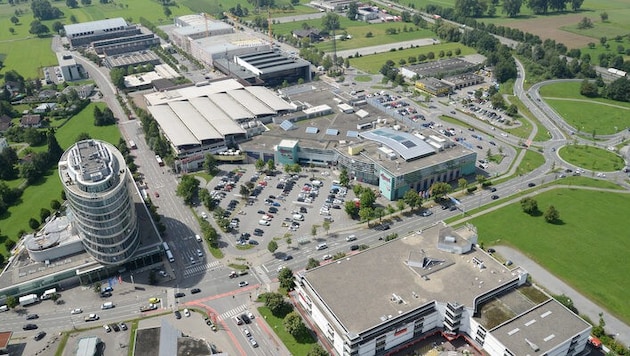

The parking lots and access roads to shopping centers and specialist stores in the province require as much space as 53 soccer pitches.
Vorarlberg is currently experiencing a heat wave, with the thermometer constantly climbing above the 30 degree mark in the valleys. Of course, it is even hotter where the surfaces are sealed - asphalt, for example, can heat up to over 60 degrees Celsius. Temperatures like this pose a health risk, especially for sick and elderly people. Due to global warming, the number of hot days has also increased significantly in Vorarlberg in recent years. In Bregenz, for example, 20 days with a temperature above 30 degrees Celsius were measured last year - that's twice as many as the annual average for the period from 1991 to 2020 and almost seven times as many as the average for the years 1961 to 1990, according to data from Geosphere Austria.
So there is a need for action - but how can the heat be made more bearable? One very effective option would be the consistent unsealing of concreted and asphalted areas. The potential is definitely there: According to a study by the trade association, the nine shopping centers in the country alone have parking spaces for around 4700 vehicles, for which an area of no less than ten hectares has been asphalted - including the access roads. If you add to this the parking lot deserts of the countless specialist stores, this results in a sealed area of 22 hectares, which is equivalent to the size of 53 soccer pitches.
Soil sealing
22 hectares of land in Vorarlberg are sealed by the parking lot deserts alone that belong to shopping centers or specialist stores.
It should be noted that unsealing does not mean removing the parking lots. For example, a lot would already be achieved if trees were planted along the rows of parking spaces. Another efficient measure is surfaces that allow water to seep away, such as grass pavers. This could kill two birds with one stone, as VCÖ expert Katharina Jaschinsky explains: "During heavy rainfall, water can seep into the ground, which relieves the sewer system and prevents flooding. In hot weather, on the other hand, the permeable surfaces have a cooling effect compared to asphalt."
An often underestimated factor that increases local heat pollution is the waste heat from vehicle traffic. Incidentally, this is significantly higher for combustion engines than for electric vehicles.
This article has been automatically translated,
read the original article here.









Da dieser Artikel älter als 18 Monate ist, ist zum jetzigen Zeitpunkt kein Kommentieren mehr möglich.
Wir laden Sie ein, bei einer aktuelleren themenrelevanten Story mitzudiskutieren: Themenübersicht.
Bei Fragen können Sie sich gern an das Community-Team per Mail an forum@krone.at wenden.