"Cosmic stray"
Will it hit? Experts have their eyes on the asteroid
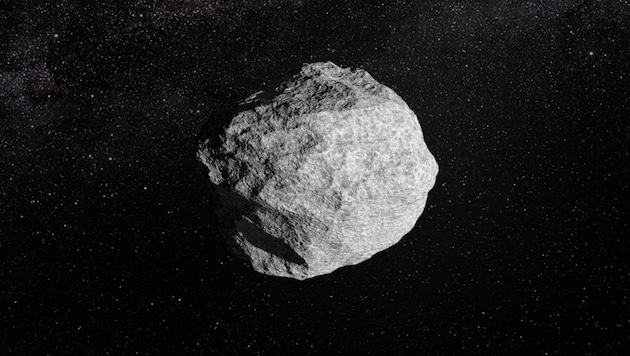

There was great excitement when it was announced that the asteroid "2024 YR4", discovered in December, could be on a possible collision course with Earth. The European Space Agency (ESA) has now ranked it as the number one asteroid threat and announced how likely an impact actually is.
 Kronen Zeitung als bevorzugte Google-Quelle hinzufügen
 The "Asteroid 2024 YR4" appeared in a telescope of the asteroid warning system (ATLAS) in Río Hurtado (Chile) on December 27 last year. The object probably has a diameter of between 40 and 100 meters - and according to calculations, there is a possibility that it will hit the Earth on 22 December 2032.
Impact could have serious consequences
According to ESA, an impact by an object of this size only occurs every few thousand years. Under unfavorable circumstances, such an impact could cause significant regional destruction. The ESA's calculations, which concluded the 17th European Space Conference in Brussels yesterday (Wednesday), would match those of the US space agency NASA.
The now calculated probability of currently around 1.2 percent is "one of the highest probabilities for an impact of a rock of significant size that has ever existed," wrote David Rankin from the Catalina Sky Survey telescope system on Bluesky, referring to data collected so far, which, however, only covers a tiny period of Earth's history.
Calculated probability may still change
The ESA stated that the calculated impact probability of a distant asteroid often drops to zero after further observations. The asteroid is currently around 27 million kilometers away from Earth. It is classified as a 3 on the so-called Turin Scale.
This means that it is a closer approach of a celestial body to Earth, which requires the attention of astronomers. If the probability of an impact is at least one percent, the International Asteroid Warning Network (IAWN) is activated and collects data.
ESA: "No cause for alarm"
Should "2024 YR4" actually hit the Earth, it could explode in the atmosphere and cause damage with a pressure wave and heat, according to reports. It could also cause a crater with a diameter of more than one kilometer. "2024 YR4" is not a so-called "planet killer" that could wipe out life on Earth, the head of asteroid defense at ESA, Richard Moissl, was quoted as saying in the "Münchner Merkur", among others. "There is no cause for alarm," said the scientist. "We assume that it will be a close or even very close flyby of Earth."
According to ESA, the asteroid will initially move away from the Earth on its elongated orbit around the sun over the next few months and disappear from view. It will not be observable again until 2028.
This article has been automatically translated,
read the original article here.










Da dieser Artikel älter als 18 Monate ist, ist zum jetzigen Zeitpunkt kein Kommentieren mehr möglich.
Wir laden Sie ein, bei einer aktuelleren themenrelevanten Story mitzudiskutieren: Themenübersicht.
Bei Fragen können Sie sich gern an das Community-Team per Mail an forum@krone.at wenden.