New savings potential
How electricity tariffs vary in Carinthia
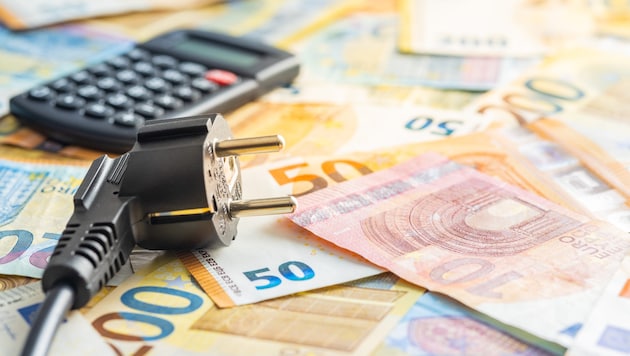

As of this year, there is no longer an electricity price brake, but energy companies are still trying to keep their tariffs within reasonable limits - and there are sometimes enormous differences and potential savings. The "Krone" compared prices.
 Kronen Zeitung als bevorzugte Google-Quelle hinzufügen
 Believe it or not, Energie AG from Upper Austria will soon be the cheapest electricity provider in Carinthia. The company, which focuses on green electricity, is lowering its energy price to 12.93 cents or even 11.23 cents per kilowatt hour (kWh) gross from April 1, 2025. This tariff runs directly through the sales department (and is therefore not available online), but will soon apply to customers and new customers in almost all of Austria. Compared to other energy companies, this results in potential savings of up to 50 percent.
The reduction is made possible, among other things, by the Group result of 398.2 million euros. "We procure energy for our customers in tranches and on a long-term basis in order to keep prices stable. This means that price increases and decreases on the energy markets only have a delayed effect," says the company, which promises a price guarantee until March 31, 2026.
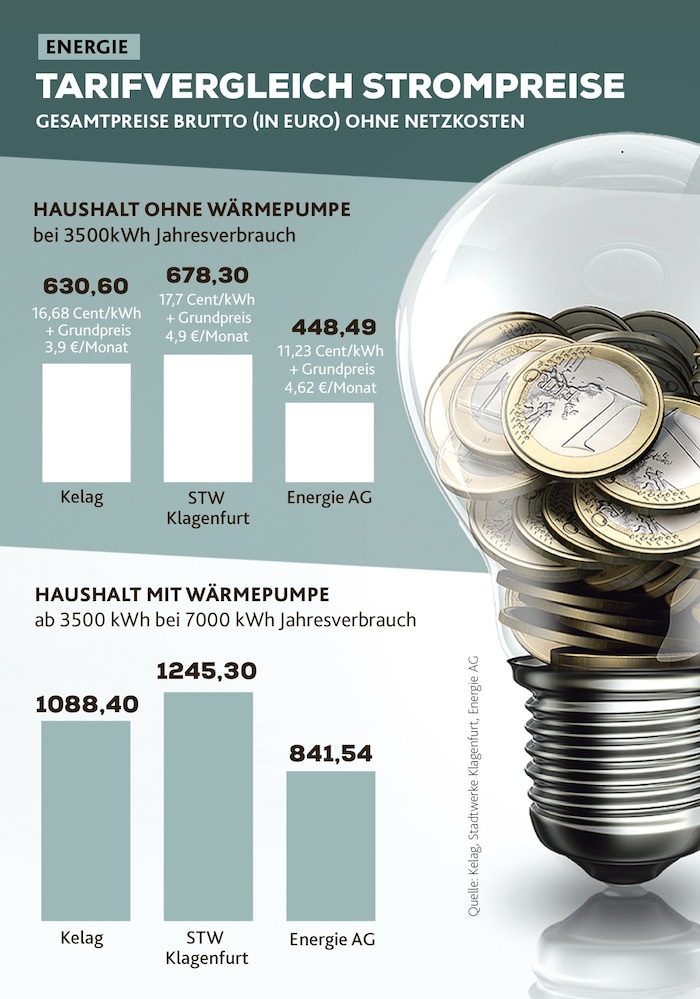
A comparison of this tariff (excluding grid costs) with those of Kelag or Klagenfurter Stadtwerke (STW), for example - see chart - shows savings of more than 200 euros in some cases.
Comparison with Carinthian energy suppliers
With a working price of 16.68 cents / kWh and a basic flat rate of 3.9 euros per month, an annual consumption of 3,500 kilowatt hours at Kelag amounts to 630.60 euros. At 17.7 cents and a basic flat rate of 4.9 euros, Stadtwerke even charges 678.30 euros, while Energie AG (with a basic flat rate of 4.62 euros) charges 448.49 euros per year at these values. The price difference is even more pronounced for heat pump tariffs (chart).
Further savings potential through energy communities
More and more renewable energy communities (EEG) are being set up throughout Austria, offering further opportunities to save money. And every citizen can benefit from this - whether as a small energy producer who already produces renewable energy themselves through their PV system on the roof of the family home, for example, or as a simple consumer who would like to purchase green energy at a low price but has not had the opportunity to do so to date.
"Energy communities are also localized and therefore do not need the entire grid infrastructure of the large energy suppliers. This also reduces the grid costs for all EEG members," explains Benjamin Kuschnig from Solar Union Austria.
This article has been automatically translated,
read the original article here.









Da dieser Artikel älter als 18 Monate ist, ist zum jetzigen Zeitpunkt kein Kommentieren mehr möglich.
Wir laden Sie ein, bei einer aktuelleren themenrelevanten Story mitzudiskutieren: Themenübersicht.
Bei Fragen können Sie sich gern an das Community-Team per Mail an forum@krone.at wenden.