Natural phenomenon
Cold forms “pancake ice” on Lake Erie
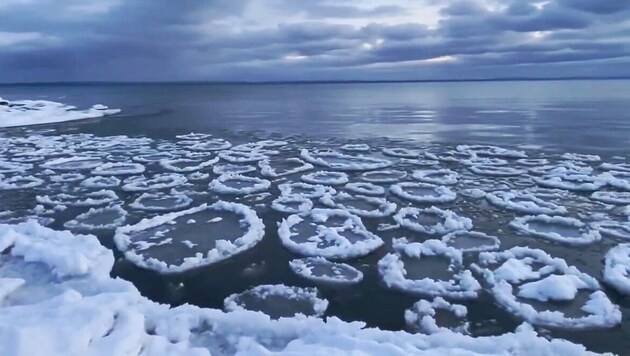

Low temperatures combined with swells are currently leading to the appearance of so-called pancake ice on the shores of Lake Erie in Canada, the southernmost and fourth largest of North America's five Great Lakes (see video above).
 Kronen Zeitung als bevorzugte Google-Quelle hinzufügen
 Pancake ice (also known as plate ice, note) can cover large areas of water within a few days. A prerequisite for its formation is the presence of swell as well as freezing cold - otherwise a closed ice surface would form without waves.
The weather phenomenon can currently be observed on the shores of Lake Erie - through which the border between Canada and the United States runs - in the Canadian province of Ontario.
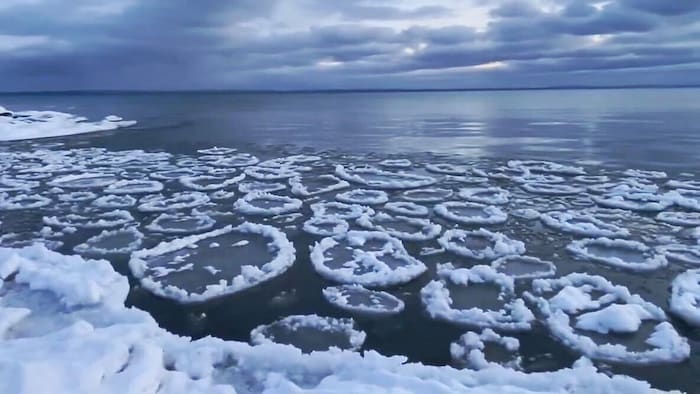
The pieces of ice, which usually have a diameter of between 30 centimetres and three meters, get their typical shape from the constant collision with other pieces of pancake ice. The collisions are also responsible for the bulging edge of the floe.
As the National Oceanic and Atmospheric Administration (NOAA) reported on Wednesday, the 388-kilometer-long and up to 92-kilometer-wide floe currently has an ice concentration of 12.35 percent.
This article has been automatically translated,
read the original article here.











Da dieser Artikel älter als 18 Monate ist, ist zum jetzigen Zeitpunkt kein Kommentieren mehr möglich.
Wir laden Sie ein, bei einer aktuelleren themenrelevanten Story mitzudiskutieren: Themenübersicht.
Bei Fragen können Sie sich gern an das Community-Team per Mail an forum@krone.at wenden.