Without austerity measures
Deficit could rise to 4.2 percent by 2025
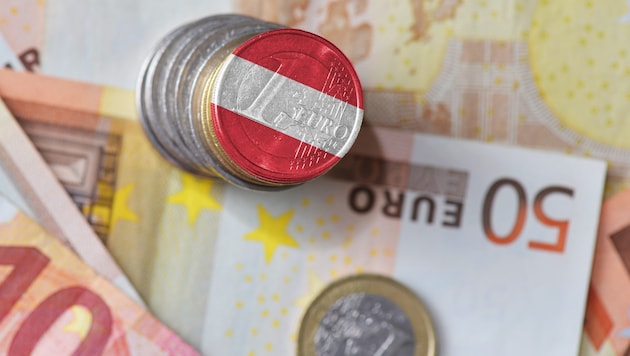

Without drastic austerity measures from a new government, the domestic deficit would continue to explode: The experts at Wifo and IHS are then predicting minus 4.2 percent and minus 3.8 percent respectively for 2025, after 3.7 percent this year.
 Kronen Zeitung als bevorzugte Google-Quelle hinzufügen
 There is no reason to be in a good mood under the Christmas tree when you look at the economic researchers' figures: Without massive austerity measures, Austria's deficit next year would move significantly further away from the three percent target that applies according to EU debt rules. Next year, the deficit would still be 4.1 percent (Wifo) or 3.6 percent (IHS), and the government's debt level would climb to 84.5 percent of economic output without budget consolidation.
Politicians can no longer ignore budget shortfalls
Nevertheless, IHS head Holger Bonin sees some good things in the current situation: "The economic debate has been more intense since the National Council elections than it has been for a long time. The players simply cannot ignore the major problems and budget holes."
What needs to be done? Bonin: "Firstly, a new government could jump over its shadow and get involved in an EU deficit procedure. The motivation should not be that we then have to save less over the next five years, but that we then have to save a little less in the coming year, at least in the short term. Why? So as not to stifle the economy, which is still in its infancy." Over the next five years, however, a savings target in the order of "20 to 25 billion euros" would be needed.
Where should savings be made? Bonin: "Primarily on the expenditure side, but also through unpopular measures such as cuts to pensions, so that the effective retirement age, which is very low here, can be increased.
In any case, the next government should resist the temptation to "bail out struggling companies, because that could be money wasted. Experience shows that a dead horse does not come back to life."
There are also opportunities for the economy
Wifo head Gabriel Felbermayr sees risks for the economy, such as possible new tariffs imposed by Trump, but also opportunities: "If Germany reforms the debt brake, this will lead to more growth. If the Germans do their job, we will have to save less, which would be good." And it is also possible that the EU could reach a deal with Trump and not be hit so hard by tariffs.
The climate bonus is a thorn in Felbermayr's side. He is in favor of a complete abolition: "A complete abolition would save 2.3 billion euros, I would be in favor of that." At the same time, educational leave should be changed: "Many academics use this as an extension of parental leave, which even has negative effects on growth because highly qualified workers are withdrawn from the labor market."
Important: not just making savings, but also tackling reforms
In any case, it is important "not only to make savings, but also to push through reforms." In order to avoid an EU deficit procedure, austerity measures amounting to 6.3 billion euros are necessary as a first step. Felbermayr: "The 6.3 billion will be found. But that could lead to important reforms not happening. And that would be the worst-case scenario if we find out in a year's time: We haven't made it and are slipping into a deficit procedure all the more. Then the financial markets would react very negatively and that would lead to higher premiums on government bonds."
This article has been automatically translated,
read the original article here.











Da dieser Artikel älter als 18 Monate ist, ist zum jetzigen Zeitpunkt kein Kommentieren mehr möglich.
Wir laden Sie ein, bei einer aktuelleren themenrelevanten Story mitzudiskutieren: Themenübersicht.
Bei Fragen können Sie sich gern an das Community-Team per Mail an forum@krone.at wenden.